
Diabetes reaches the feet before it reaches almost anywhere else you can see. Nerves, arteries, skin, bone and the immune response are each affected differently, and nearly every foot problem that follows is a combination of the five.
The short version
“Diabetic foot” is the umbrella term for what diabetes does to the feet. The International Working Group on the Diabetic Foot defines diabetes-related foot disease as one or more of these in the foot of someone who has, or has had, diabetes: nerve damage (peripheral neuropathy), peripheral artery disease, infection, an ulcer, Charcot neuro-osteoarthropathy, gangrene or an amputation.
Diabetes damages the small nerves that carry sensation, the arteries that carry blood, the sweat glands that keep skin supple, the bone underneath, and the white cells that fight infection. Alone, none of those is dramatic. Together they turn a blister into a wound, a wound into an infection, and an infection into a hospital admission — usually without much pain to announce any of it.
Which is why the advice that sounds trivial — look at your feet every day — is the single most effective thing anyone with diabetes does for their legs.
Five systems, five different failures
Nerves
Sensory loss removes the warning. Motor nerve damage claws the toes and drops the metatarsal heads, moving pressure onto small areas. Autonomic damage stops the foot sweating, so the skin dries and cracks.
Arteries
Narrowing in the calf and foot vessels reduces the blood a wound needs to heal. In diabetes those arteries also calcify, which makes standard pressure tests read falsely reassuring.
Skin
Dry, inelastic skin fissures at the heel. Callus builds where pressure concentrates and becomes a lid over damaged tissue underneath. Fungal infection between the toes opens a door for bacteria.
Bone and joints
Deformity shifts load. In the worst version — Charcot neuroarthropathy — the bone itself softens and the arch collapses in weeks, in a foot too numb to complain.
Immune response
High glucose impairs how white cells work, so infection spreads further and faster before it looks impressive from the outside, and the usual signs are muted.
And the interaction
The reason diabetic feet fail is not any one of these. It is that the alarm system, the repair system and the defence system are all degraded at the same time.
What to look for, and what each sign means
| What you see or feel | What it usually means | How urgent |
|---|---|---|
| Numbness, tingling, burning, or feet that feel like they are wrapped in cloth | Peripheral neuropathy. The single biggest risk factor for everything else on this list. | Get tested at your next visit; do not wait for it to hurt |
| Thick yellow callus, especially under the ball of the foot | Pressure concentration. Callus over a bony prominence is a pre-ulcer, not a cosmetic problem. | Have it professionally debrided; never cut it yourself |
| Dry, cracked heels; skin that flakes or peels | Autonomic damage has switched off local sweating. Fissures are open doors. | Routine, but treat it properly — a deep heel fissure becomes an ulcer |
| One foot warmer, redder and more swollen than the other, with no wound | Charcot neuroarthropathy until proven otherwise. Frequently misread as gout or cellulitis. | Days, not weeks — see Charcot foot |
| Redness that fades when the leg is raised | Usually inflammation or dependent rubor rather than infection — but dependent rubor with cold, hairless, shiny skin points at poor arterial supply. | Have circulation formally assessed |
| An open sore, however small or painless | A diabetic foot ulcer. Painless is normal and is not reassuring. | This week — see diabetic foot ulcers |
| Nails thickened, crumbling or lifting | Fungal nail disease. It matters here because a thick nail presses on the nail bed and cracks the skin around it. | Routine, but do not do bathroom surgery on it |
| Swelling in one foot that does not settle overnight | Infection, Charcot, a fracture you did not feel, or a circulation or heart problem. One-sided is the important word. | Have it examined |
| Cold, pale or dusky foot, or a new rest pain in the forefoot at night | Critical limb ischaemia. | Emergency |
“Early stage” diabetic feet, honestly
People searching for early diabetic foot changes are usually looking for a photograph that will settle whether what they are looking at counts. The honest answer is that the earliest changes are mostly things you feel rather than see, and the visible ones are non-specific.
The genuinely early signs are: sensation that has quietly changed, skin that has become dry in a way it never used to be, callus appearing somewhere it did not before, and nail or skin infections that take longer to clear than they used to. Redness, brown spots, shiny skin and hair loss on the toes come later and belong as much to circulation as to diabetes itself.
For comparison anyway, our diabetic feet pictures page illustrates sixteen common changes, from dry heels and thick nails to ulcers and gangrene, grouped by how soon each needs to be seen.
The test that matters more than any photograph
A 10-gram monofilament pressed against defined points on the sole. If you cannot feel it at one or more sites, you have lost protective sensation — which changes your risk category, your footwear needs and how often you should be seen, regardless of how your feet look. It takes about two minutes and it is the core of a diabetic foot exam.
What actually reduces risk
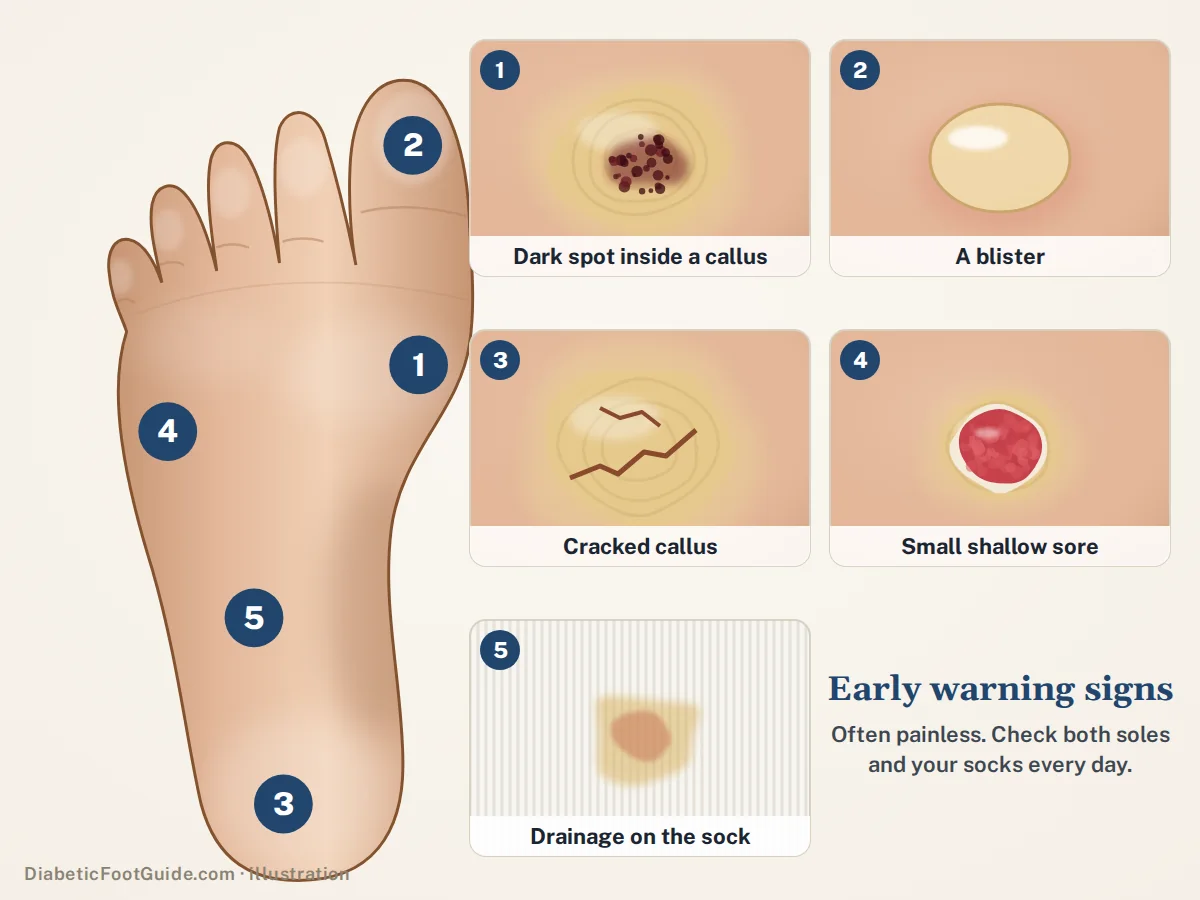
- Look at both feet every day, including the soles and between the toes. A mirror on the floor or a phone camera works. You are looking for anything new: redness, a blister, a crack, drainage on a sock.
- Never go barefoot, indoors included. Most injuries in an insensate foot happen at home.
- Check inside the shoe with your hand before putting it on. A stone or a folded insole causes damage that no amount of good footwear prevents.
- Moisturise the soles and heels, not between the toes. Between the toes stays dry; macerated skin there is where fungal and then bacterial infection begins.
- Do not use corn plasters, callus removers or blades. Salicylic-acid products burn a hole in skin that cannot report it.
- Test bath water with your hand or elbow, never your foot, and keep feet away from heaters, hot water bottles and heated blankets. Burns in this population are common and are almost always accidental.
- Have your feet professionally checked at least yearly, and much more often if you have neuropathy, deformity, poor circulation, kidney disease or a previous ulcer.
- Glucose control still matters, and so do blood pressure, lipids and stopping smoking — because the artery is what decides whether anything heals.
Where to go from here
Charcot foot
The hot, swollen, painless foot that collapses in weeks and gets sent home as gout. The stages, the temperature test, and why the cast takes months.
Diabetic foot ulcers
Why offloading is the treatment, how ulcers are graded, and what the six-week mark should trigger.
Early-stage diabetic foot ulcers
What an ulcer looks like before it is obvious, the stages 0 to 5 in pictures, and what to do today at each one.
The diabetic foot exam
What a proper examination includes, what the monofilament is testing, and why a normal ABI can lie in a diabetic foot.
Diabetic shoes and inserts
What therapeutic footwear is actually for, Medicare’s benefit, and the certification rule that catches nearly everyone out.
Diabetic feet pictures
Sixteen illustrated pictures, from the earliest changes to the emergencies, grouped by how soon each needs to be seen.
Common questions
What are the first signs of diabetes in your feet?
Changed sensation is usually first — tingling, numbness, burning, or a feeling of walking on padding. Skin that has become unusually dry, new callus, and nail or skin infections that clear more slowly than they used to are the next. Visible colour change and hair loss on the toes generally come later and reflect circulation as much as nerve damage.
Can prediabetes affect your feet?
It can. Nerve damage sometimes starts before diabetes is diagnosed: in one series of 107 people with nerve damage in the feet and no other explanation, a third had impaired glucose tolerance, nearly three times the rate in people of the same age. The small fibers that carry pain and temperature tend to go first, so the early complaints are burning, tingling or numb toes rather than wounds. Women and men notice the same kinds of changes. Either way, symptoms like these deserve a foot exam and a blood sugar check.
What are the stages of a diabetic foot?
The staging many diabetic foot clinics use comes from Foster and Edmonds, and it has six steps: 1, a normal foot at low risk; 2, a high-risk foot, with one or more of neuropathy, poor circulation, deformity, callus or swelling; 3, an ulcerated foot; 4, an infected (cellulitic) foot; 5, a necrotic foot, with dead tissue or gangrene; and 6, a foot that can no longer be saved. Lists of “five stages” usually stop at necrosis. Each step has its own job: prevention at stages 1 and 2, healing and saving the foot from stage 3 on. An ulcer itself is graded separately, on the Wagner and University of Texas scales.
What does a diabetic foot look like?
Often like any other foot until something goes wrong, which is why the exam matters more than the mirror. The changes you can see are dry, cracked heels, thick callus under the ball of the foot or the heel, thick or discolored nails, clawed toes, and shiny, hairless skin; later, a red, hot, swollen foot or a dark spot inside a callus. Our diabetic feet pictures guide illustrates sixteen of them, from the earliest changes to the emergencies.
How does diabetes affect the toes?
The toes are usually where it shows first. Numbness and tingling start at the tips, because the longest nerves are affected earliest. Weak muscles in the foot let the toes curl into hammer or claw shapes, which puts pressure on the knuckles and tips, the usual sites of toe ulcers. Pale, blue or dusky toes point at circulation, and thick, discolored nails are common. A toe that turns black or dark purple needs to be seen the same day. Toe color changes and diabetic toenails have their own guides.
Why are the soles of my feet red?
Common causes are simple inflammation, prolonged standing, fungal infection, and dependent rubor — a deep red flush that appears when the foot hangs down and drains when it is raised, which suggests poor arterial inflow. Redness confined to one foot, especially with warmth and swelling, is the pattern that needs urgent assessment rather than reassurance. Swelling in a diabetic foot is worked through separately.
Can diabetic foot problems be reversed?
Some can. Skin, callus, fungal infection and pressure problems respond well. Established nerve damage largely does not reverse, although progression can be slowed and symptoms managed. Deformity, once bone has remodelled, is permanent unless it is surgically corrected. Which is why the whole discipline is built around prevention rather than repair.
How often should someone with diabetes see a podiatrist?
At minimum once a year for a comprehensive foot examination. If you have lost protective sensation, have deformity or poor circulation, or have had an ulcer or amputation before, that moves to every one to three months — the interval is set by risk category, not by whether anything currently hurts.
Is it safe to cut my own toenails?
If your sensation and vision are intact, your circulation is good and the nails are normal, generally yes — straight across, not into the corners. If you have neuropathy, poor circulation, thickened or fungal nails, or you cannot comfortably see and reach your feet, it should be done professionally. Most self-inflicted diabetic foot wounds start with nail and callus care at home.
Why do my feet hurt if the nerves are damaged?
Damaged nerves misfire as well as fall silent. Burning, shooting and electric pain, and pain from things that should not hurt, come from the same neuropathy that removes protective sensation. Pain and numbness coexisting in the same foot is normal — and the numbness is still the dangerous half. Our guide to safe home remedies for diabetic foot pain covers what eases it and what to avoid on a numb foot.
Sources
Clinical literature retrieved from PubMed.
- Armstrong DG, Swerdlow MA, Armstrong AA, et al. Five year mortality and direct costs of care for people with diabetic foot complications are comparable to cancer. Journal of Foot and Ankle Research. 2020;13(1). doi:10.1186/s13047-020-00383-2 — five-year mortality of 30.5% after a diabetic foot ulcer, against 31.0% pooled five-year mortality for all cancers.
- Armstrong DG, Boulton AJ, Bus SA. Diabetic Foot Ulcers and Their Recurrence. N Engl J Med. 2017;376(24):2367-2375. doi:10.1056/NEJMra1615439 — lifetime ulcer incidence of 19–34%, and recurrence of roughly 40% at one year and 65% at five.
- Pecoraro RE, Reiber GE, Burgess EM. Pathways to Diabetic Limb Amputation: Basis for Prevention. Diabetes Care. 1990;13(5):513-521. doi:10.2337/diacare.13.5.513 — the landmark series in which ulceration preceded 84% of lower-limb amputations.
- American Diabetes Association Professional Practice Committee. 12. Retinopathy, Neuropathy, and Foot Care: Standards of Care in Diabetes—2026. Diabetes Care. 2026;49(Suppl 1):S261-S276. doi:10.2337/dc26-S012 — annual comprehensive foot evaluation, and the recommendation that the neurological exam pair the 10-gram monofilament with at least one other assessment: vibration with a 128 Hz tuning fork, pinprick, or ankle reflexes.
- Schaper NC, van Netten JJ, Apelqvist J, et al. Practical guidelines on the prevention and management of diabetes-related foot disease (IWGDF 2023 update). Diabetes Metab Res Rev. 2024;40(3):e3657. doi:10.1002/dmrr.3657 — the definition of diabetes-related foot disease, the IWGDF risk categories and the screening interval attached to each.
- Singleton JR, Smith AG, Bromberg MB. Increased prevalence of impaired glucose tolerance in patients with painful sensory neuropathy. Diabetes Care. 2001;24(8):1448-1453. doi:10.2337/diacare.24.8.1448 — impaired glucose tolerance in 34% of 107 people with otherwise unexplained neuropathy, nearly three times the age-matched rate, with milder, mainly sensory nerve involvement.
- Foster A, Edmonds M. Simple staging system: a tool for diagnosis and management. The Diabetic Foot. 2000;3(2):56-62. PDF at diabetesonthenet.com — the six stages, from the normal foot to the unsalvageable foot, and the five risk factors (neuropathy, ischaemia, deformity, callus and oedema) that make a foot high risk.
Related guides
Diabetic foot pain: safe home remedies
Burning, cramping, aching or cold feet — what helps at home and what causes burns.
Toe color changes with diabetes
Red, purple, black, yellow or pale feet, and how urgently each color needs looking at.
Blisters on a diabetic foot
Bullosis diabeticorum, and why the roof stays on.
Rashes on diabetic feet
Fungal, dry skin, dermopathy or circulation – which is which.
The diabetic foot exam
What the monofilament tests and how often you should be seen.
Diabetic foot infection
What a wound looks like when it has crossed the line.
Brown spots on feet
Diabetic dermopathy is harmless in itself. What it travels with is the reason to mention it — and one pigmented pattern on the foot is not dermopathy at all.
Diabetic dermopathy and spots on the legs
The harmless shin spots, and the look-alikes worth telling apart.
Diabetic foot care in Michigan
Balance Foot & Ankle provides at-risk foot exams, routine diabetic foot care, wound treatment and therapeutic footwear in Howell and Bloomfield Hills.

Dr. Tom Biernacki is a double board-certified podiatric foot and ankle surgeon practising in Michigan. He treats diabetic wounds, Charcot neuroarthropathy and at-risk feet daily, and writes here to put the clinical reasoning behind that care in front of the people living with it.