
A diabetic foot ulcer is not a wound that happens to be on a foot. It is a pressure injury on a limb that cannot report pain, and it is treated by taking the pressure off — not by finding a better dressing.
The short version
Neuropathy removes the pain that would make you limp. A shoe, a seam, a callus or a pebble then loads the same square centimetre of skin thousands of times a day, and the skin gives way. The ulcer that appears is the visible end of a process that has been running for weeks.
Healing depends on three things, in this order: is there enough blood supply, is the pressure off it, and is it infected. Dressings matter far less than any of the three, which is why a wound that has been dressed faithfully for four months without offloading is still open.
The numbers that explain the urgency
That last figure is the one clinicians find hardest to say out loud and patients are least often told. A diabetic foot ulcer is not a skin problem with a bad reputation — it is a marker of advanced vascular and metabolic disease, and the survival statistics reflect the whole person, not the wound. It is also why the right response to a small, painless, unimpressive-looking hole in the bottom of a foot is a same-week appointment.
Amputation rates were falling for years and, in some regions, have since risen by as much as half — with the increase concentrated in younger patients and in racial and ethnic minority populations. This is not a solved problem getting quietly better.
Why it happened: three things line up
Loss of protective sensation
You cannot feel the rub. Nothing makes you shift your weight, change your shoe, or stop walking. The single most important consequence of neuropathy is not the burning — it is the missing alarm.
Deformity and pressure
Clawed toes, a bunion, a dropped metatarsal head, a Charcot rocker-bottom. Load concentrates on a point instead of spreading across the sole, and callus builds over it — the callus is the warning sign, and the ulcer is usually underneath it.
Minor trauma
A new shoe, a hot bath, a stone, a bathroom-cabinet attempt at a corn. The trigger is nearly always trivial. It is trivial because the foot could not object.
The classic pathway is those three together. What has changed over the last two decades is the mix: the population has shifted from purely neuropathic ulcers towards neuro-ischaemic ones, where circulation is also part of the problem. That single shift changes the treatment plan more than any dressing choice does.
Circulation decides whether it can heal at all
The sentence worth reading twice
Where offloading is genuinely achieved, a neuropathic ulcer will heal. An ulcer with even a minor degree of arterial insufficiency has little chance of healing without restoring blood flow first.
That is why the first appointment should involve pulses, and usually more than pulses. In diabetes the arteries calcify, which falsely raises an ankle-brachial index — so a “normal” ABI in a diabetic foot is not proof of perfusion. Toe pressures and a toe-brachial index are more reliable, and duplex imaging or angiography follows when the numbers are poor.
The failure pattern documented in large European cohort work is depressingly consistent: arterial disease is not assessed, imaging is underused, and referral for revascularisation comes late. If your wound has not healed in six weeks and nobody has yet checked your circulation properly, that is the question to ask.
How ulcers are graded, and why two systems exist
Grading is not bureaucracy. It sets the treatment and it predicts the outcome, and the two systems in common use measure different things.
| System | What it measures | Why it is used |
|---|---|---|
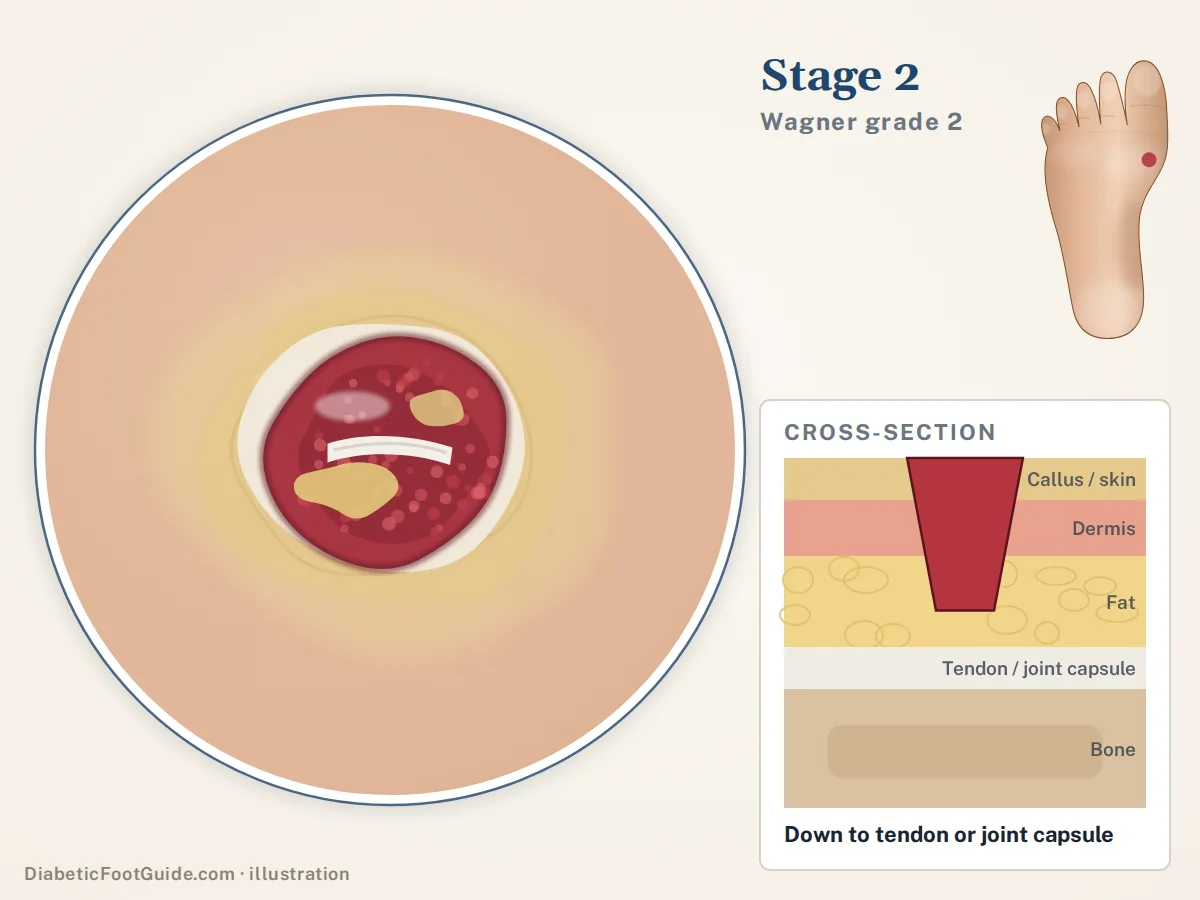
| Wagner | Depth alone, 0 to 5 — from an at-risk foot with no open lesion, through superficial and deep ulcers, to abscess and osteomyelitis, then partial and whole-foot gangrene. | Fast, universally understood, and the one most often quoted in a chart. Its weakness is that it says nothing about infection or blood supply until the very high grades. |
| University of Texas | Two axes: grade 0–3 for depth, and stage A–D for whether infection, ischaemia, or both are present. | Better at predicting what will actually happen. A grade 1 ulcer that is stage D — infected and ischaemic — is a different problem from a grade 1 stage A, and only this system says so. |
If you want one takeaway from a grading conversation, it is this: depth and infection and circulation are three separate questions, and a plan that only answers the first one is incomplete.
What each Wagner grade looks like on a foot, from the callus about to break down to gangrene, and what to do today at each one, is illustrated on the early-stage diabetic foot ulcer page.
Treatment: offloading is the treatment
Everything else supports it. Debridement removes dead tissue and the callus rim so the wound edge can advance. Dressings manage moisture and bacterial burden. Antibiotics treat infection when infection is present, and are not a substitute for anything. Revascularisation restores the blood supply. But the reason a plantar ulcer stays open is almost always that it is still being walked on.
The reference standard for a plantar neuropathic ulcer is a non-removable offloading device — a total contact cast, or an equivalent that the patient cannot take off. Non-removable is the operative word. Removable boots work well in the clinic and poorly in a house at two in the morning.
If it has not improved in four to six weeks, something in the plan is wrong
Not the dressing. Usually it is one of: the pressure is not actually off it, the blood supply has not been assessed, there is infection in the bone, or there is a deformity that will keep re-opening the same wound until it is corrected.
Infection, and the bone question
Infection in a diabetic foot is diagnosed clinically — warmth, swelling, redness, purulence, a foul smell, a wound that suddenly enlarges — not by swabbing every wound. Every open wound grows bacteria; that is not the same as being infected.
The question that changes everything is whether the infection has reached bone. A probe that passes through the ulcer and hits hard, gritty bone raises the probability of osteomyelitis substantially, and a plain X-ray taken early can look entirely normal because bone loss has to be well advanced before it shows on film. MRI is the imaging that settles it, and a bone biopsy settles it definitively.
Emergency, not an appointment
- Redness spreading up the foot or leg, fever, chills, or feeling systemically unwell
- A wound that has become foul-smelling, or is draining pus
- Black tissue appearing at the edge, or a toe turning dusky, cold or blue
- Crepitus — a crackling under the skin — or rapidly spreading swelling
- Blood sugars that have suddenly become uncontrollable for no obvious reason
After it heals: the part almost nobody plans for
Two thirds of people whose ulcer heals will have another within three to five years. A healed ulcer is not a cured foot — it is a foot in remission, with the same nerve damage, the same deformity and the same pressure map that produced the first one. The scar is also weaker than the skin around it, so the same spot is the likeliest place for the next one.
- Therapeutic footwear and custom inserts that redistribute load away from the site. A previous ulcer is one of the qualifying conditions under Medicare’s therapeutic shoe benefit — the rules, including the certification requirement that trips most people up, are on our diabetic shoes page.
- Regular professional callus debridement. Callus over a previous ulcer site is a pre-ulcer, not a cosmetic issue, and it should not be cut at home.
- Daily inspection, with a mirror or a phone camera for the sole and between the toes.
- Correcting the deformity where one keeps driving the same wound — a tendon lengthening or a bony procedure sometimes ends a cycle that footwear alone cannot.
Common questions
What does an early diabetic foot ulcer look like?
Often unimpressive. A callus with a dark spot or a blood blister inside it, a small crack that will not close, a shallow crater with a pale or yellow base, or simply an area that stays red after the shoe comes off. It is frequently painless. Drainage staining a sock is a common way people find out, and by then it has usually been there a while. Pictures of each early stage, and what to do the day you find one, are on a page of their own. Blood inside a callus is a same-day problem: there is usually a wound under the lid.
How long does a diabetic foot ulcer take to heal?
A straightforward neuropathic plantar ulcer with good blood supply and proper offloading is often measured in weeks — means of roughly five to eight weeks are reported for cast treatment. Ulcers that are deep, infected, or short of blood supply take much longer and some do not close until the underlying cause is fixed. Slow healing is a signal to re-examine the cause, not to be patient.
Can a diabetic foot ulcer heal on its own?
A very superficial one occasionally does, if the pressure happens to come off it. Relying on that is the mistake, because the foot cannot tell you when things are getting worse and the same absence of pain that caused the wound also hides its progression. Treated ulcers heal in weeks; neglected ones become bone infections.
Can I walk on a diabetic foot ulcer?
Not on the ulcer itself. Walking on an unprotected ulcer on the sole is one of the main reasons it stays open, because every step presses on the wound again. What makes walking possible is an offloading device that takes the weight off the wound: the reference standard is a total contact cast or another device you cannot take off, and people do walk in these, though less than usual. A removable boot only works if it is on for every step, including the trip to the bathroom at night. Bare feet, slippers and ordinary shoes all load the wound again. Until it closes, limit standing and walking to what you need, and ask your podiatrist how much the device allows.
Should I use hydrogen peroxide, iodine or antibiotic ointment on it?
Peroxide and full-strength antiseptics damage the new tissue you are trying to grow. Over-the-counter antibiotic ointment does not reach an infection under the surface and can create a false sense that something is being done. Wound care in this setting is a clinical decision about debridement, moisture balance and offloading — not a product choice from a shelf.
Why does my doctor keep cutting away tissue that looks healthy?
The rim of thick callus around a plantar ulcer keeps loading the edge and physically prevents it from closing, and the surface film on a chronic wound holds bacteria in a form that dressings cannot reach. Sharp debridement removes both. It usually does not hurt in a neuropathic foot, which is exactly why it is possible in a clinic room.
Does a foot ulcer mean I will lose my foot?
No — most ulcers heal. But the risk is real enough to take seriously: roughly one in five people who ulcerate will eventually undergo a lower-extremity amputation, and the odds turn on how quickly circulation is assessed, pressure is removed, and infection is controlled. Speed is the variable you can influence. If a toe amputation is being discussed, our toe amputation guide covers the operation, recovery and what changes afterward.
Sources
Clinical literature retrieved from PubMed.
- McDermott K, Fang M, Boulton AJM, Selvin E, Hicks CW. Etiology, epidemiology, and disparities in the burden of diabetic foot ulcers. Diabetes Care. 2023;46(1):209–221. doi:10.2337/dci22-0043 — lifetime risk 19–34%, 65% recurrence at three to five years, 20% lifetime amputation incidence, 50–70% five-year mortality, and the recent rise in amputation rates.
- Peter-Riesch B. The diabetic foot: the never-ending challenge. Endocr Dev. 2016;31:108–134. doi:10.1159/000439409 — offloading versus perfusion as the determinant of healing, the shift towards neuro-ischaemic ulcers, and the Eurodiale findings on unassessed arterial disease and late referral.
- Vierhout BP, Visser R, Hutting KH, et al. Comparing a non-removable total contact cast with a non-removable softcast in diabetic foot ulcers. Diabetes Res Clin Pract. 2022;191:110036. doi:10.1016/j.diabres.2022.110036 — 71% overall healing and the 8.4-week versus 5.5-week mean healing times.
Related guides
Healing a diabetic wound faster
The five levers that actually move a stalled wound, and the myths that hold one open.
Diabetic foot infection
When a wound stops being a wound and becomes an infection.
Non-diabetic foot ulcers
Venous, arterial and pressure ulcers, and why compression can harm the wrong one.
Charcot foot
The deformity that creates the pressure point the ulcer sits on.
Diabetic shoes and inserts
A previous ulcer qualifies you for therapeutic footwear.
Wound care in Michigan
Balance Foot & Ankle treats diabetic wounds, infections and at-risk feet in Howell and Bloomfield Hills, including offloading, debridement and therapeutic footwear. An open wound on a diabetic foot is a this-week problem.

Dr. Tom Biernacki is a double board-certified podiatric foot and ankle surgeon practising in Michigan. He treats diabetic wounds, Charcot neuroarthropathy and at-risk feet daily, and writes here to put the clinical reasoning behind that care in front of the people living with it.