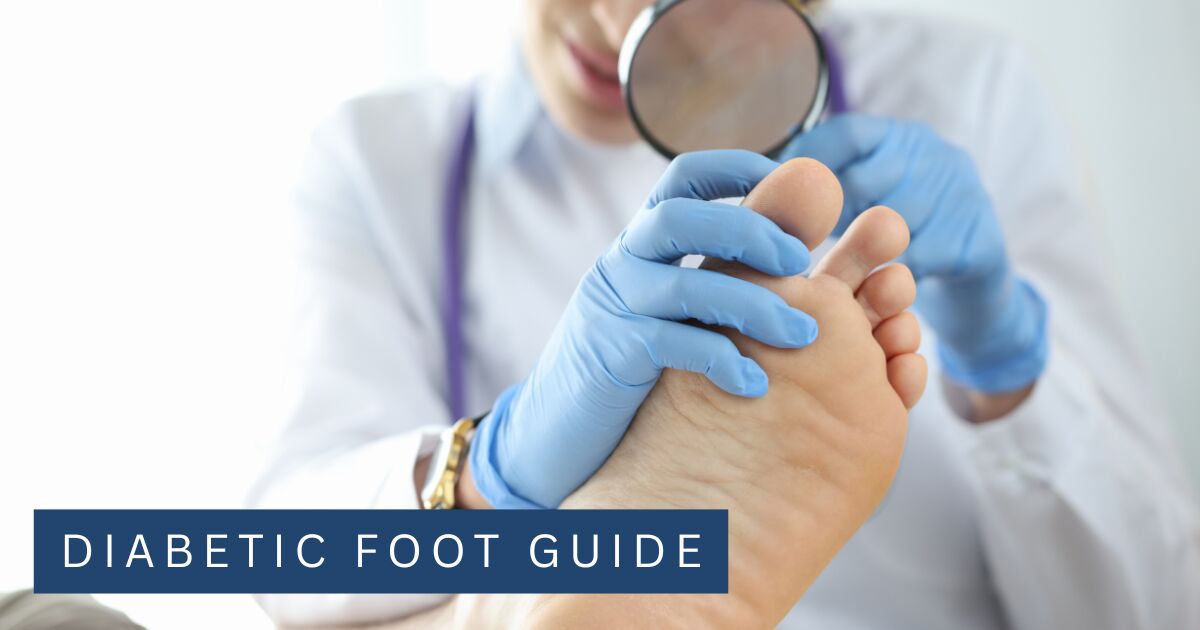
Most rashes on a diabetic foot are one of five things, and only one of them is an emergency. The useful question is not “what does this look like” but “is it fungal, is it circulation, or is it the skin of a foot that has stopped sweating”.
The short version
Fungal infection is the commonest — between the toes and across the sole, often mistaken for dry skin. Autonomic neuropathy stops the foot sweating, so the skin dries, flakes and fissures. Diabetic dermopathy leaves brown, shallow, painless patches on the shins. Poor circulation makes the foot deep red when it hangs down and pale when it is raised.
The one that needs same-day attention is a rash that is hot, spreading and one-sided — that is cellulitis until proven otherwise, and a diabetic foot deserves no benefit of the doubt on it.
What each pattern usually is
| Pattern | Usually | What to do |
|---|---|---|
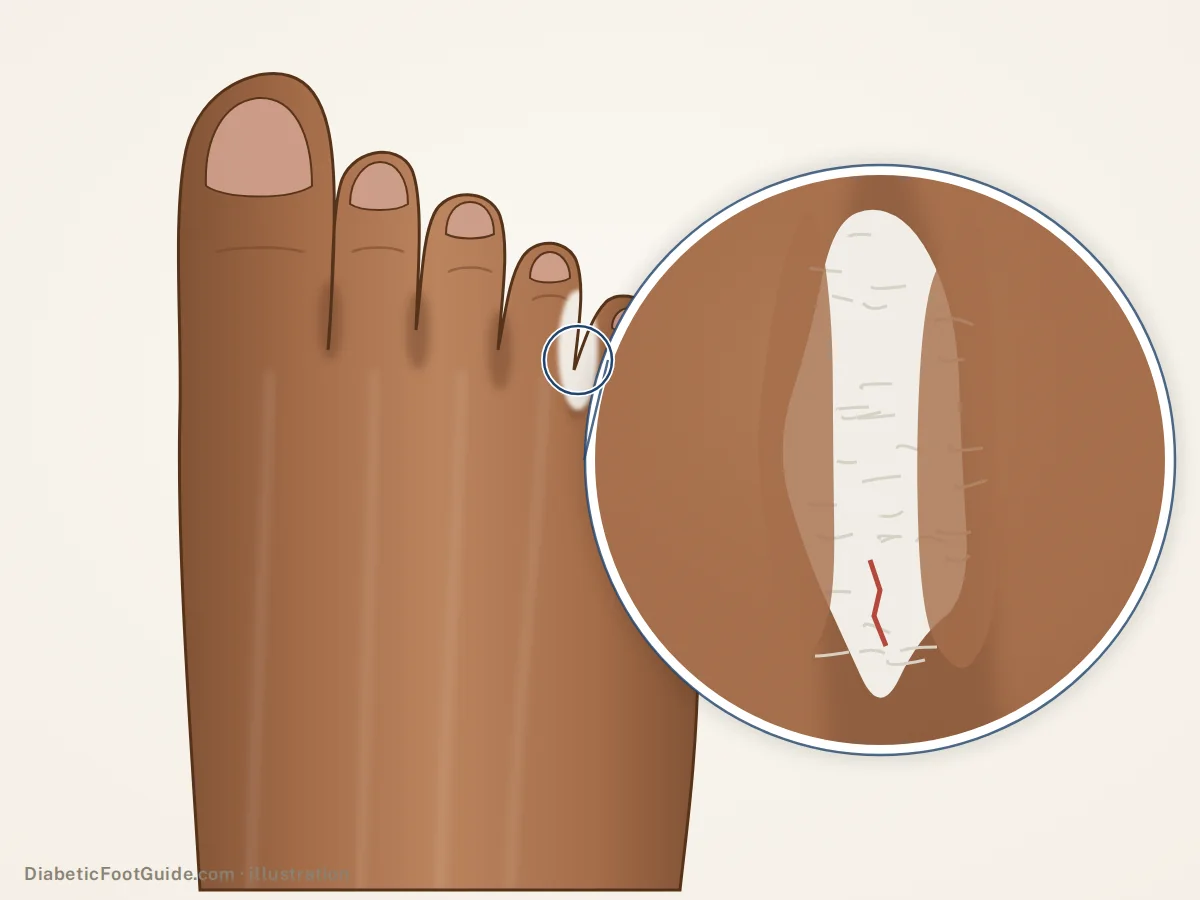
| Damp, white, split or peeling skin between the toes, sometimes itchy | Fungal infection — athlete’s foot | Treat it. This is the commonest entry point for the bacteria that cause foot infections. |
| Fine, dry, silvery scale across the sole and up the sides in a moccasin pattern | Fungal, frequently misread as dry skin for years | Needs antifungal treatment, not just moisturiser. Check the nails too. |
| Dry, flaky skin with cracks at the heel | Autonomic neuropathy — the foot has stopped sweating | Urea-based moisturiser to the soles and heels, never between the toes. Deep fissures are an open door. |
| Round, shallow, brown, painless patches on the shins | Diabetic dermopathy | Harmless in itself. A marker of longer-standing diabetes and worth mentioning to whoever manages it. |
| Deep red or purple discolouration when the foot hangs down, draining to pale when it is raised | Dependent rubor — poor arterial supply | Get circulation formally assessed. This is not a skin problem. |
| Itchy raised welts, or a rash that appeared after a new medication | Allergic or drug reaction | Tell the prescriber. Some diabetes medications cause skin reactions. |
| Shiny, yellow-brown, depressed plaques with visible small vessels, usually on the shins | Necrobiosis lipoidica | Uncommon, associated with diabetes, and it can ulcerate. Have it looked at properly. |
| Hot, spreading redness, one foot only, tender, sometimes with fever | Cellulitis — or, with no wound and a neuropathic foot, Charcot | Same day. Both need seeing within days, not weeks. |
Red spots or dots on the feet
Small red spots are usually minor: pressure from a shoe or a sock seam, insect bites, or the small itchy blisters of athlete’s foot on the arch. Two things decide how much they matter — whether they fade when you press on them, and whether the skin around them is hot.
| What you see | Usually | What to do |
|---|---|---|
| A red mark over a toe knuckle, the side of the foot or the heel, where a shoe or seam presses | Pressure from footwear | If it is still red once the foot has rested, the shoe is pressing too hard. Stop wearing that pair; a numb foot will not warn you. |
| Small itchy red bumps or tiny blisters on the arch or sole, often with peeling between the toes | Athlete’s foot | Treat it for the full course. Be seen if it is no better after two weeks. |
| Itchy raised red bumps in a cluster or a line, often around the ankle | Insect bites | Try not to scratch. Broken skin on a diabetic foot can become infected. |
| Pinpoint red or purple dots that do not fade when pressed | Petechiae — tiny bleeds in the skin | New and unexplained: have them checked within a day or two. With fever, feeling unwell, or spreading fast: emergency. |
| A red patch that is warm, tender and growing | Cellulitis until proven otherwise | Same day. |
The press test
Press a clear glass or a fingertip firmly on the spots for a few seconds. Redness from irritation or inflammation fades under pressure and comes back. Spots that stay visible through the glass are blood in the skin, and a doctor needs to find out why. On darker skin the spots may look purple, brown or black rather than red.
Why fungal infection is not a cosmetic problem here
On a foot with normal sensation and circulation, athlete’s foot is an itch. On a diabetic foot it is a breach in the barrier that keeps bacteria out, sited in exactly the place that stays warm and damp all day. A large share of diabetic foot infections start as an unremarkable split between the fourth and fifth toes.
The rule about moisturiser
Soles and heels yes, between the toes never. Macerated skin between the toes is the problem you are trying to avoid, and putting cream there manufactures it.
Nails matter too: thickened, discoloured nails are a fungal reservoir that reinfects the skin, and a thick nail also presses on the nail bed and splits the skin around it.
What to do at home, and where the line is
- Wash and dry properly, especially between the toes — dab, do not rub, and let them air before socks go on.
- Moisturise soles and heels daily. A urea-containing cream works better than a general body lotion on the thick skin of a heel.
- Change socks daily, and more often if your feet sweat. Rotate shoes so each pair dries out.
- Treat athlete’s foot properly and for the full course — most people stop when the itch goes, which is why it comes back.
- No corn plasters, no callus removers, no scraping. Salicylic acid burns a hole in skin that cannot report it.
- Photograph it. A rash is much easier to assess when someone can see what it looked like a week ago.
Stop treating it yourself and be seen if
- It is spreading, hot, or confined to one foot
- The skin has broken, is weeping, or smells
- There is fever, or your blood sugars have become hard to control
- It has not responded to two weeks of appropriate treatment
- There is any dark, blistered or black area
Common questions
What does a diabetic rash on the feet look like?
There is no single diabetic rash. The common ones are fungal infection between the toes and across the sole, dry flaking skin from loss of sweating, brown patches on the shins from diabetic dermopathy, and colour change from poor circulation. What separates them is distribution and behaviour rather than colour alone.
Can diabetes cause a rash on top of the feet?
It can, though the top of the foot is less typical than between the toes or the sole. Contact reactions to shoe materials, drug reactions, fungal infection spreading from elsewhere, and early cellulitis all appear there. A rash confined to the top of one foot, particularly with warmth, deserves an examination.
Can prediabetes cause a rash?
Not usually on the feet. The skin change most closely tied to insulin resistance and prediabetes is acanthosis nigricans: dark, velvety, thickened skin in body folds such as the back of the neck, the armpits and the groin, often with skin tags nearby. It is worth showing a doctor, because it can be the first visible sign of rising blood sugar. A red, itchy or scaling rash on the feet of someone with prediabetes is most often athlete’s foot, and it is worth treating properly, because broken skin between the toes lets bacteria in.
Why do my legs itch or break out with diabetes?
Usually because the skin is dry: less sweating and poorer circulation leave the skin of the lower legs thin and dry, and dry skin itches, especially in winter. Three other causes are worth knowing. Diabetic dermopathy, the brown shin spots, rarely itches. Necrobiosis lipoidica causes shiny, yellow-brown patches on the shins that can ulcerate and need a dermatologist. Long-standing swelling brings itchy, darkened skin above the ankles. A leg rash that is hot, spreading or painful is treated as a possible infection and seen the same day.
Are the brown spots on my shins from diabetes?
Round, shallow, brown, painless patches on the shins are the classic appearance of diabetic dermopathy, which is associated with longer-standing diabetes. It is harmless in itself and does not need treating, but it is worth mentioning because it tends to travel with other complications. Diabetic dermopathy and its look-alikes have their own page, with pictures; brown spots on the feet are covered separately.
Why are the soles of my feet red?
Common causes are inflammation, prolonged standing, fungal infection and dependent rubor — a deep red flush that appears when the foot hangs down and drains when it is raised, which points at poor arterial inflow. Redness in one foot only, with warmth and swelling, is the pattern that needs urgent assessment.
Is it safe to use hydrocortisone cream on my feet?
Ask first. Steroid cream on a fungal infection makes it worse and blurs the picture, and steroids thin skin that is already fragile. On a diabetic foot the sequence should be diagnosis then treatment, not the other way round.
Sources
Clinical literature retrieved from PubMed.
- Gupta AK, Shemer A, Economopoulos V, et al. Diabetic Foot and Fungal Infections: Etiology and Management from a Dermatologic Perspective. Journal of Fungi. 2024;10(8):577. doi:10.3390/jof10080577 — tinea pedis and onychomycosis raising the risk of diabetic foot ulcer and infection.
- Bristow IR, Spruce MC. Fungal foot infection, cellulitis and diabetes: a review. Diabetic Medicine. 2009;26(5):548-551. doi:10.1111/j.1464-5491.2009.02722.x — fungal foot infection as a route to cellulitis in diabetes.
- Morgan AJ, Schwartz RA. Diabetic dermopathy: A subtle sign with grave implications. Journal of the American Academy of Dermatology. 2008;58(3):447-451. doi:10.1016/j.jaad.2007.11.013 — diabetic dermopathy as atrophic hyperpigmented macules on the shins.
- Rogers LC, Frykberg RG, Armstrong DG, et al. The Charcot Foot in Diabetes. Diabetes Care. 2011;34(9):2123-2129. doi:10.2337/dc11-0844 — the hot, one-sided foot that mimics cellulitis and needs seeing the same day.
- Karadağ AS, You Y, Danarti R, et al. Acanthosis nigricans and the metabolic syndrome. Clinics in Dermatology. 2018;36(1):48-53. doi:10.1016/j.clindermatol.2017.09.008 — acanthosis nigricans as the skin marker of insulin resistance and the metabolic syndrome.
- Sibbald C, Reid S, Alavi A. Necrobiosis lipoidica. Dermatologic Clinics. 2015;33(3):343-360. doi:10.1016/j.det.2015.03.003 — necrobiosis lipoidica as slow, atrophic plaques on the lower legs that can ulcerate.
- StatPearls. Petechiae. Updated September 4, 2023. StatPearls — Petechiae — pinpoint spots under 2 mm that do not blanch, and the fever and bleeding signs that make them urgent.
Related guides
Diabetic dermopathy and spots on the legs
The brown shin spots, and the look-alikes worth telling apart.
Dry and cracked feet
The commonest thing mistaken for a rash.
Blisters on a diabetic foot
When the rash raises fluid.
Diabetic toenails
Fungal nails reinfect the skin you just treated.
Diabetic foot cream
What to put on it, and what never to.
Skin and nail care in Michigan
Balance Foot & Ankle treats fungal infection, fissures, nail disease and diabetic skin problems in Howell and Bloomfield Hills.

Dr. Tom Biernacki is a double board-certified podiatric foot and ankle surgeon practising in Michigan. He treats diabetic wounds, Charcot neuroarthropathy and at-risk feet daily, and writes here to put the clinical reasoning behind that care in front of the people living with it.