Your toenails are the part of a diabetic foot you can watch change, and each change — yellowing, a dark patch, a stripe, a corner starting to curve in — usually means something specific. The one people underrate is the plainest: a thick nail on a numb toe is a pressure problem, pressing on the nail bed from above on a toe that cannot report any of it.
The short version
Nails thicken with age, trauma and fungal infection. On a diabetic foot the consequence is mechanical: the thick nail acts like a stone inside the shoe, pressing on the tissue underneath until it breaks down. In clinic, many of the toe ulcers and toe infections we treat start under or beside a nail.
Which is why the standard advice is blunt. If you have neuropathy, poor circulation, thickened nails, or you cannot comfortably see and reach your feet, nail care should be done professionally — not because you are incapable, but because the cost of one slip is disproportionate.
Diabetic toenail pictures: what each color and change usually means
The toenail changes we see most on diabetic feet fall into six pictures. Find the closest match, then read the urgency line, which is set for a foot with reduced feeling rather than a normal one. If a nail matches two pictures, act on the more urgent line.
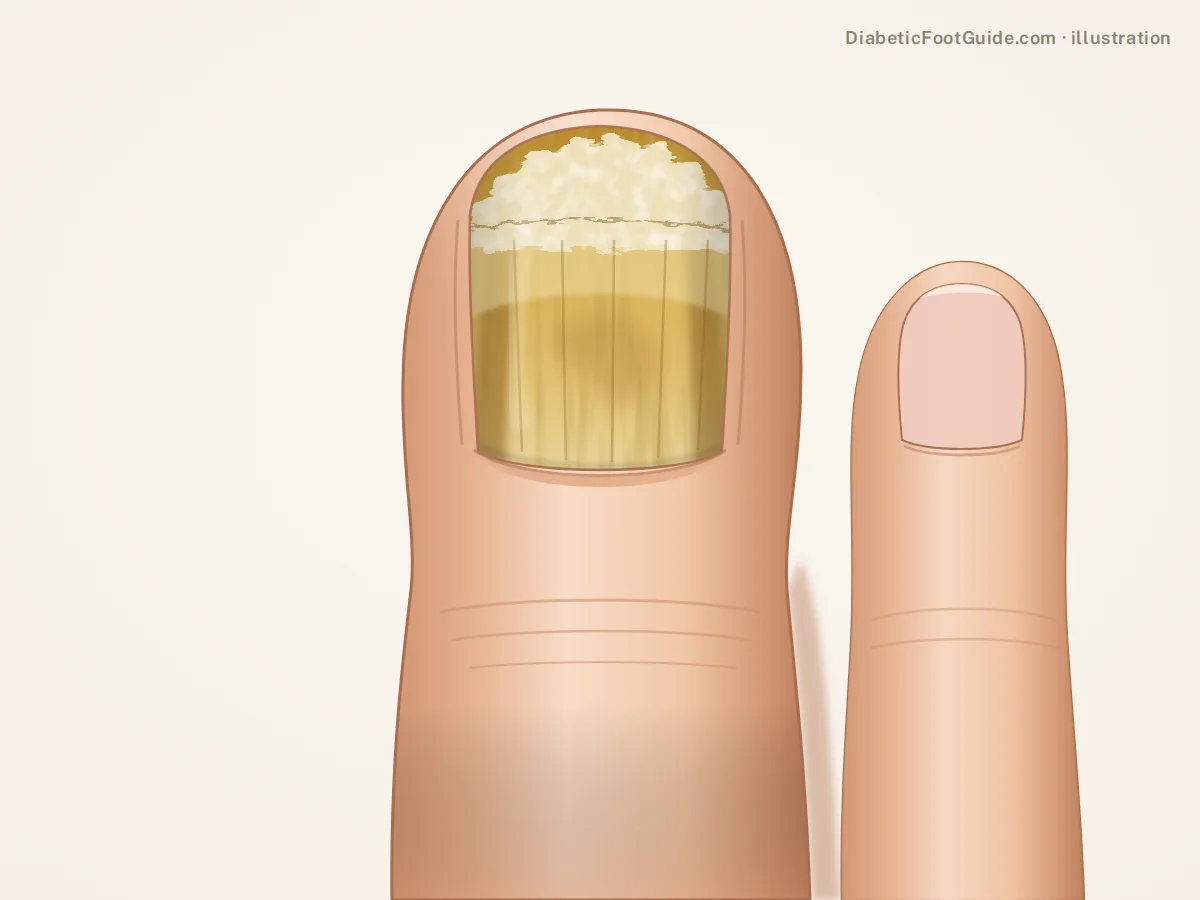
Yellow, thick and crumbly
Usually: fungal nail infection (onychomycosis), often lifting at the tip with debris packed underneath.
Urgency: routine, but have it thinned professionally. The thickness is what presses on the toe.
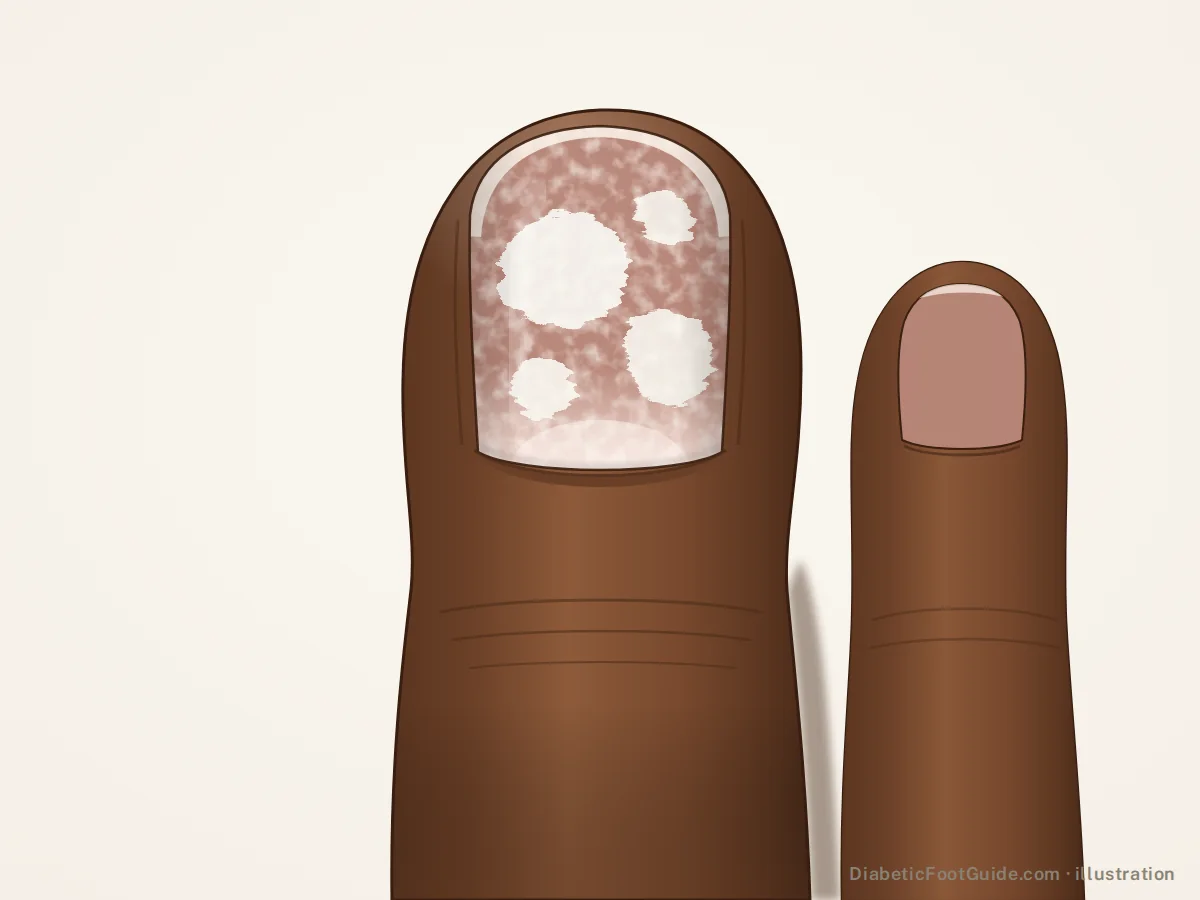
White, chalky, powdery surface
Usually: fungus living on the top layer of the nail (superficial white onychomycosis).
Urgency: routine. Confirm it is fungus before starting prescription treatment; other nail problems look alike.
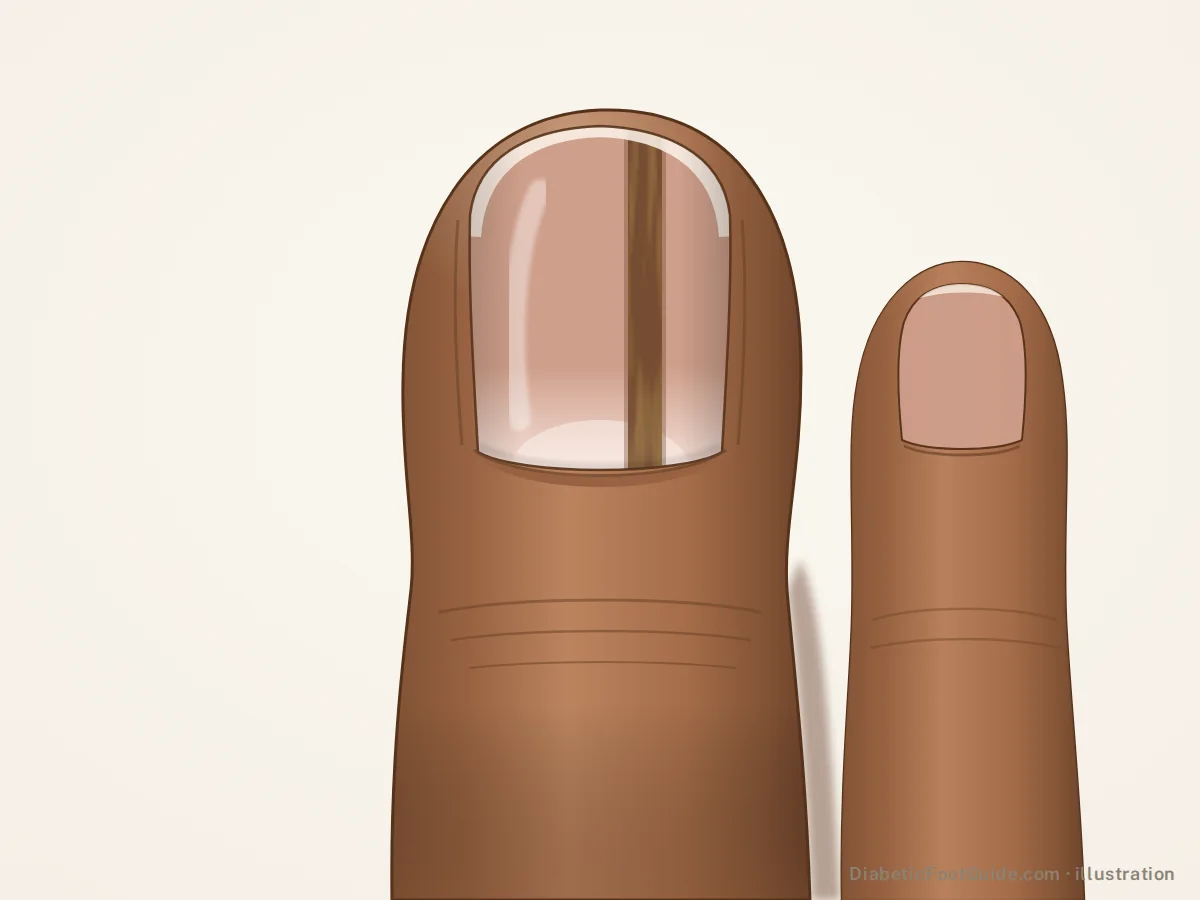
A brown or black stripe along the nail
Usually: pigment from the nail’s growth center (longitudinal melanonychia). Most are harmless.
Urgency: have it examined at your next foot check; within weeks if it is a single new stripe, is darkening or widening, or the pigment reaches the skin.
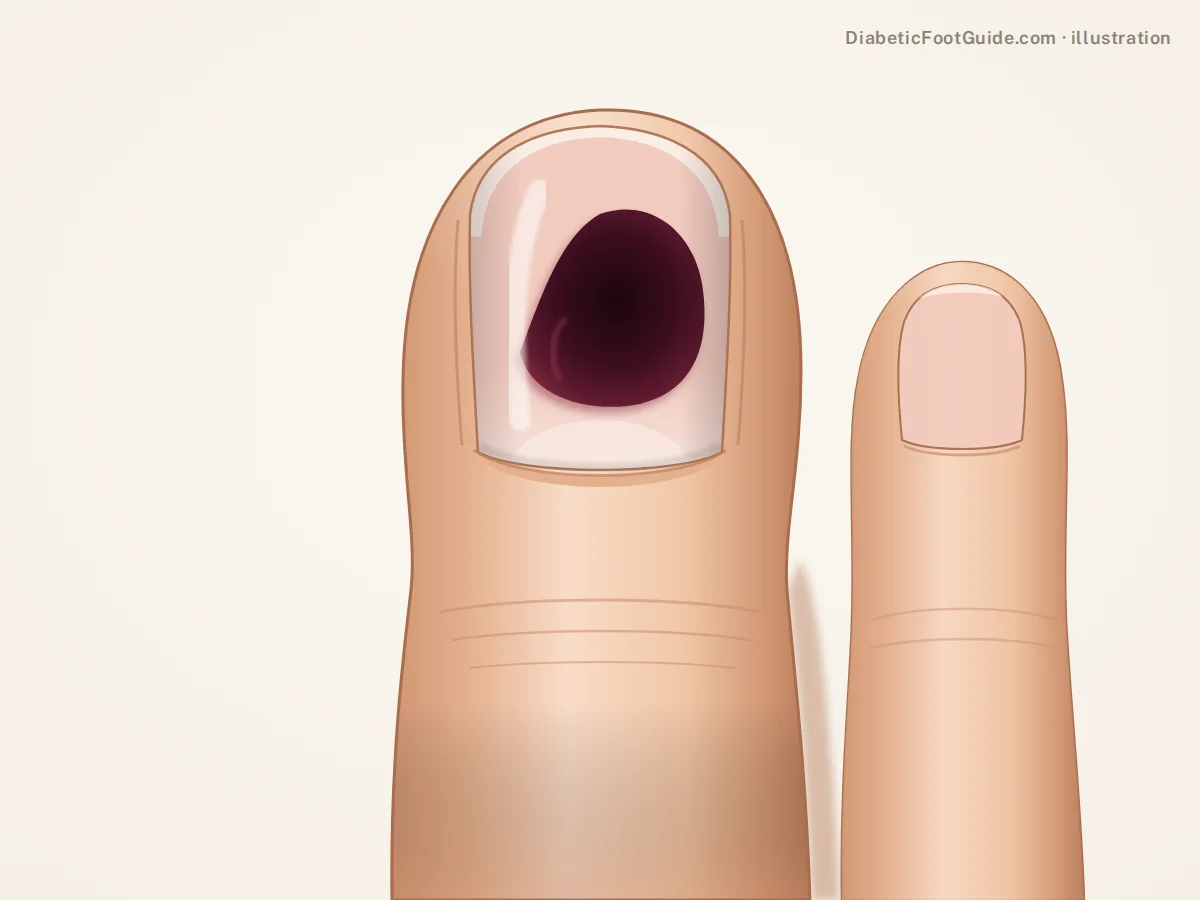
Dark red, purple or black patch under the nail
Usually: blood under the nail from pressure or a knock, often one nobody remembers.
Urgency: within days on a numb foot. Something pressed hard enough to bleed, and you did not feel it.
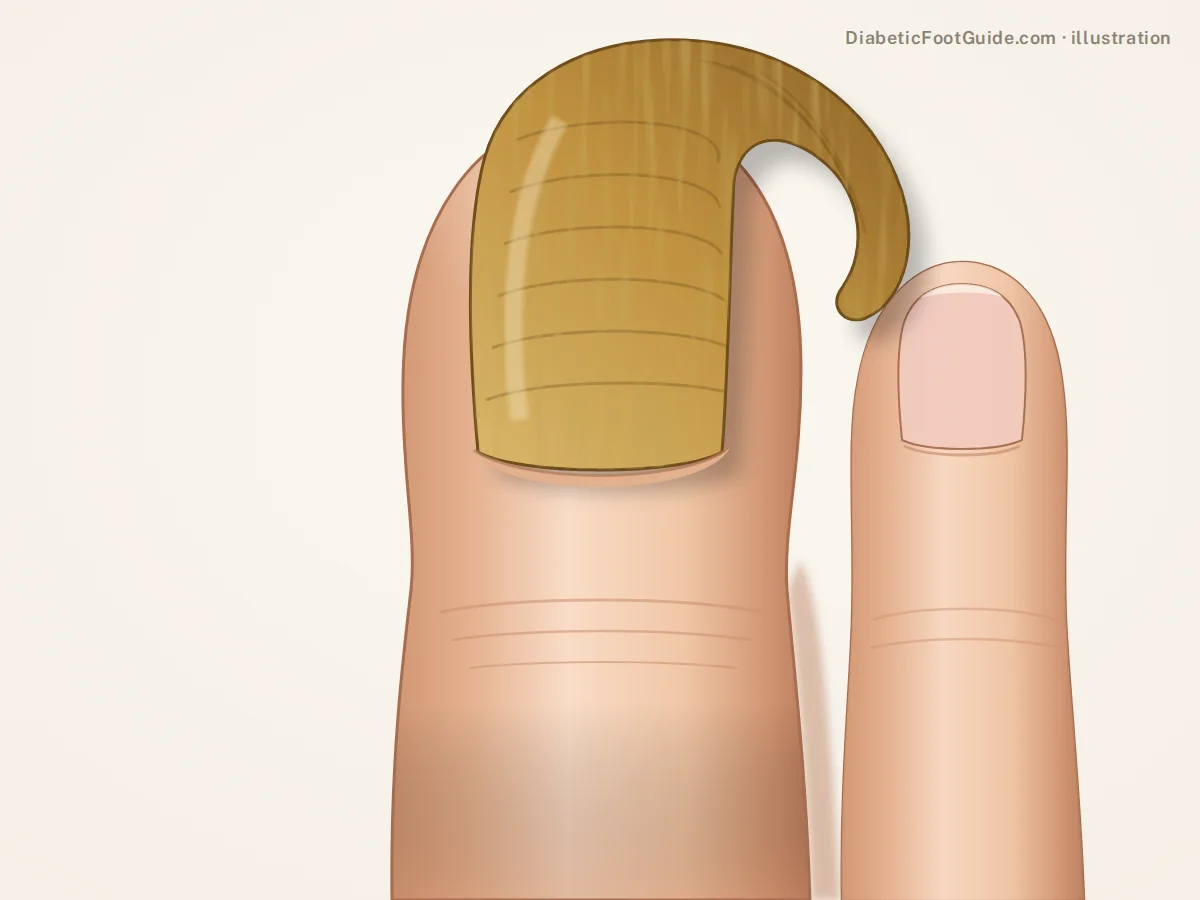
Very thick, curved and overgrown
Usually: a ram’s horn nail (onychogryphosis), after years of shoe pressure, an old injury, or a nail too hard to reach.
Urgency: podiatry visit within weeks. It needs reducing, and it can cut into the toe beside it.
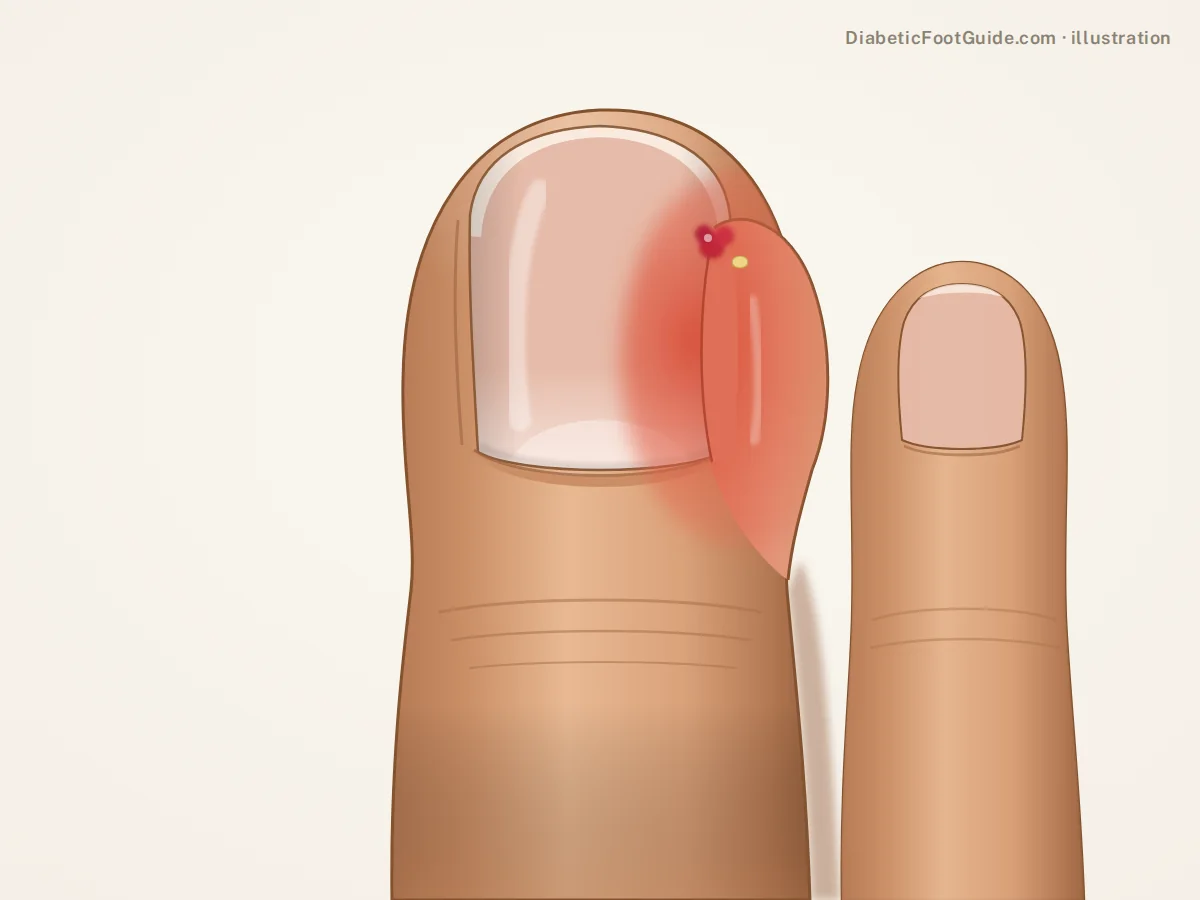
Red, swollen or draining skin at the nail edge
Usually: an ingrown toenail, often with infection of the skin fold (paronychia).
Urgency: same day on a diabetic foot. Do not dig the corner out yourself.
These pictures are medical illustrations drawn for this guide, not photographs of patients. On darker skin, redness around a nail can look purple or dark brown rather than red.
First-stage toenail changes with diabetes
Most people asking about first-stage toenail changes want to know one of two things: whether their nails mean they have diabetes, or whether diabetes is starting to show in their feet. The first has a short answer. No toenail change diagnoses diabetes. Fungal nails are more common with diabetes. In clinic, thick, slow-growing nails tend to travel with poor circulation. But all of these are common in people without diabetes too, especially with age.
The second question is the useful one. On a foot that already has diabetes, these are the earliest nail changes worth acting on, and each is easiest to deal with at this stage:
- A nail starting to thicken or yellow, usually the big toe first. Caught while the nail is still thin, it is easier to treat and far easier to keep trimmed.
- A nail that has started to lift from the bed at the tip or side. The gap collects moisture and debris, and gives fungus and bacteria a way underneath.
- Debris under the edge: chalky or crumbly material packed under the tip, often an early sign of fungal infection.
- A corner beginning to curve in, before it is red or sore. This is the stage for a proper trim, not for digging.
- A spot of blood under a nail you do not remember hurting. On a numb toe the spot is not the finding; the pressure that caused it is. Check the shoe, and the nail above it.
The early signs elsewhere on the foot are mostly things you feel rather than see, and they are covered in what diabetes does to feet. Skin, callus and wound changes are pictured in diabetic feet pictures.
Brown toenails and diabetes
Brown on a toenail usually has one of three explanations. Fungal infection stains the nail and the debris under it yellow-brown, and some fungi turn it darker brown or black. Old blood darkens from red-purple to brown-black and moves forward as the nail grows, over months. Staining sits on the surface, from dyes, chemicals, cosmetics or dirt. Diabetes makes the first two more likely, through fungal infection and pressure you cannot feel, but a brown nail is not a sign of diabetes on its own.
Brown needs a proper look when it is a stripe running lengthways, particularly a single new one; when it does not move forward as the nail grows; when pigment appears on the skin around the nail; or when the nail is lifting with redness, swelling or drainage at the edge, which is infection and a same-day visit. Brown patches on the skin of the shins and feet are a different thing, covered in brown spots on feet with diabetes.
Worried your toenails mean you have diabetes?
Your toenails cannot tell you; a blood test can. The simplest is an A1c, which needs no fasting and reflects your average blood sugar over roughly the past two to three months; your primary care doctor can order it. An A1c of 6.5% or higher is in the diabetes range and 5.7% to 6.4% is prediabetes, and unless blood sugar is unmistakably high, a second abnormal result is needed to confirm the diagnosis. Get the test, and have the nails looked at as nails.
Why fungal nails matter more in diabetes
Onychomycosis is more common in diabetes and harder to clear. The nail becomes a persistent source that reinfects the surrounding skin, and athlete’s foot between the toes is the commonest doorway for the bacteria that cause serious foot infections. So treating the nail is partly about the nail and mostly about what the nail keeps re-seeding.
Set expectations before starting treatment
Topical lacquers have modest cure rates and need months of daily use. Oral antifungals work better but require attention to liver function and drug interactions, which matter in a population usually taking several medications. Regular professional reduction of the nail thickness helps mechanically whether or not the infection is ever eradicated — and on a diabetic foot, the mechanical problem is the one that causes wounds.
How to trim diabetic toenails safely at home
Home trimming is reasonable if your sensation is intact, your circulation is good, your vision and reach are fine, and the nails are normal. If any of those is not true, this is a professional job.
- Decide whether this is a home job. If anything in the box below applies to you, it is not.
- Use the right tools, kept for your feet only: straight-edged toenail clippers and a fine emery board or nonsharp nail file. Nothing pointed near the corners. The rest of a sensible kit is in diabetic foot care products.
- Trim after washing, when nails are softer. A shower or an ordinary wash, not a long soak. Test the water with your elbow rather than your foot, and dry well, including between the toes.
- Work in good light, with your reading glasses on or a magnifier, sitting so the foot comes to you without twisting.
- Cut straight across, following the shape of the end of the toe, in small bites rather than one big cut. Leave a millimeter or two of white; cutting to the skin invites an ingrown edge.
- File the corners rather than cutting into them, so no spike is left to grow into the skin. File rather than clip any nail that is thick or brittle; clippers can split it down into the bed.
- Never dig at a corner, and never use a blade on skin or callus at the nail edge.
- If you cannot see it clearly, stop. Nail care performed by feel on a numb foot is how people find out they have cut themselves a week later.
- Look at every toe afterwards. On a diabetic foot any nick is a wound: clean it, cover it, and follow the timings below.
When nail care becomes a podiatry visit
Hand routine trimming to a podiatrist if any of these is true:
- Neuropathy, or loss of protective sensation on a foot exam
- Poor circulation
- Thick, yellowed or fungal nails, or nails that curve into the skin
- Trouble seeing or reaching your feet
- A past foot ulcer
- You take a blood thinner
Same day if the skin beside a nail is red, swollen, warm or draining (treat it as a foot infection until proven otherwise), or you have a fever or blood sugars that have become hard to control. Within days for any break in the skin, including a nick from trimming; a dark patch under a nail; or a nail that has lifted. Within weeks for a new dark streak along a nail.
What professional nail care involves
Reduction, not just cutting
A thick nail is thinned with a burr as well as shortened, which removes the downward pressure on the bed.
Clearing the sides
Debris and any incurving edge is removed from the sulcus, where infection otherwise starts.
Checking underneath
What is under a thick nail — an ulcer, bleeding, a wound — is only visible once the nail has been reduced.
An interval, not a one-off
Usually every two to three months for at-risk feet, set by your risk category rather than by how the nails look.
Whether this is covered by insurance depends on your risk findings and documentation rather than on convenience — the presence of neuropathy, vascular disease or a qualifying systemic condition is generally what makes routine foot care a covered service rather than an excluded one. Ask the practice before assuming either way.
Free: the 30-Second Daily Foot Check. Nails, and the skin between the toes, are part of the daily check, which is how nail problems get caught while they are small. This one printable page from Dr. Tom Biernacki lists five steps to do before your socks go on, says when to call your foot doctor and when to go to the ER, and gives you a week of tick boxes for the fridge.
ER or 911 now, not a download: a foot or leg that is suddenly cold, pale, blue or very painful; any skin turning black; redness spreading fast, or fever or chills with a foot wound.
Download the Daily Foot Check (PDF, 1 page)
Coming fall 2026: The Diabetic Foot Care Guide, Dr. Tom’s book.
Common questions
What do diabetic toenails look like?
There is no single diabetic toenail. The common pictures on a diabetic foot are thick, yellow, crumbling nails from fungal infection; chalky white patches on the nail surface; a dark red, purple or black patch of blood under the nail; a brown or black stripe along the nail; very thick, curved “ram’s horn” nails; and red, swollen skin at an ingrown edge. What makes them matter more in diabetes is not the look but the setting: a thick or ingrown nail on a toe that cannot feel it is where pressure wounds and infections start.
Are yellow toenails a sign of diabetes?
Not on their own. Yellow, thickened toenails are usually a fungal infection, and diabetes is one of its established risk factors, but so are age, athlete’s foot and old nail injuries, and plenty of people with yellow nails do not have diabetes. If you have no diagnosis and are worried, an A1c blood test answers the question; your nails cannot. If you do have diabetes, a nail that is yellowing and thickening is worth having reduced and treated before it gets thicker.
Why are my toenails turning brown?
Usually one of three things: fungal infection, which stains the nail and the debris under it yellow-brown or darker; old blood from pressure or a knock, which darkens to brown-black and grows out with the nail over months; or surface staining from dyes, chemicals or dirt. A brown stripe running the length of the nail is different. Most are harmless, but it should be examined, and within weeks if it is a single new stripe, is darkening or widening, or the pigment spreads onto the skin around the nail. On a diabetic foot, brown with redness, swelling or drainage at the nail edge is infection until proven otherwise and needs seeing the same day.
Should diabetics cut their own toenails?
If sensation, circulation, vision and reach are all intact and the nails are normal, cutting them straight across is generally fine. Once there is neuropathy, poor circulation, thickened or fungal nails, or difficulty seeing and reaching the feet, it should be done professionally. Most self-inflicted diabetic foot wounds begin with nail or callus care at home.
Why are my toenails so thick?
The three common reasons are fungal infection, repeated trauma from footwear or an old injury, and age-related change. In diabetes all three are more likely, and the practical effect is the same: a nail thick enough to press on the tissue underneath on a toe that cannot feel it.
Can diabetics get pedicures?
Commercial pedicures carry real risk on an at-risk foot — shared instruments, aggressive callus removal, cutting into nail corners, and foot baths, all on skin that cannot report injury. If you have neuropathy or poor circulation, nail and skin care belongs in a clinical setting. If your feet are low risk and you still want one, bring your own instruments and tell them not to cut anything.
What treats fungal toenails in diabetes?
Topical lacquers, oral antifungals, and mechanical reduction of the nail, often in combination. Topicals are safe but slow with modest cure rates; orals are more effective but need attention to liver function and interactions. Regular thinning of the nail addresses the pressure problem regardless of whether the fungus is ever fully cleared, and on a diabetic foot that is the part that prevents wounds.
Is a black toenail dangerous?
Usually it is blood under the nail from pressure or injury — but on a diabetic foot, “something pressed hard enough to bruise and I did not notice” is itself the finding. It also needs distinguishing from other causes of nail pigmentation, so have it looked at rather than waiting for it to grow out.
Sources
Clinical literature retrieved from PubMed, plus the governing federal sources.
- Watjer RM, Heckmans KM, Eekhof JA, et al. Association between onychomycosis and ulcerative complications in patients with diabetes: a longitudinal cohort study in Dutch general practice. BMJ Open. 2024;14(4):e076441. doi:10.1136/bmjopen-2023-076441 — onychomycosis independently raising ulcer risk in 48,212 patients, adjusted HR 1.23, and skin infection HR 1.27.
- Mayser P, Freund V, Budihardja D. Toenail Onychomycosis in Diabetic Patients. American Journal of Clinical Dermatology. 2009;10(4):211-220. doi:10.2165/00128071-200910040-00001 — untreated thick toenails causing pressure and irritation, and onychomycosis among the most significant ulcer predictors.
- Gupta AK, Konnikov N, MacDonald P, et al. Prevalence and epidemiology of toenail onychomycosis in diabetic subjects: a multicentre survey. British Journal of Dermatology. 1998;139(4):665-671. doi:10.1046/j.1365-2133.1998.02464.x — the prevalence of toenail onychomycosis in diabetes.
- Schaper NC, van Netten JJ, Apelqvist J, et al. Practical guidelines on the prevention and management of diabetes-related foot disease (IWGDF 2023 update). Diabetes Metab Res Rev. 2024;40(3):e3657. doi:10.1002/dmrr.3657 — professional nail and callus care, and the instruction not to use chemical agents or plasters.
- National Institute of Diabetes and Digestive and Kidney Diseases. Diabetes and Foot Problems. NIH. niddk.nih.gov — Diabetes and Foot Problems — how to trim toenails (after washing and drying, straight across, corners smoothed with an emery board), not soaking the feet, and when toenail cutting should be handed to a foot doctor.
- Lee DK, Lipner SR. Optimal diagnosis and management of common nail disorders. Annals of Medicine. 2022;54(1):694-712. doi:10.1080/07853890.2022.2044511 — diabetes as an established risk factor for onychomycosis and the thick, yellow-brown, lifting nail with debris beneath it; superficial white onychomycosis; ingrown nails as a common cause of toenail paronychia; blood as the commonest dark nail pigment, often without remembered injury, and growing out with the nail; and longitudinal melanonychia as mostly benign but always worth investigating, with pigment on the nail fold among the warning features.
- American Diabetes Association Professional Practice Committee for Diabetes. 2. Diagnosis and Classification of Diabetes: Standards of Care in Diabetes—2026. Diabetes Care. 2026;49(Suppl 1):S27-S49. doi:10.2337/dc26-S002 — diabetes diagnosed on A1C or plasma glucose criteria: A1C of 6.5% or higher for diabetes and 5.7–6.4% for prediabetes, confirmation needed without unequivocal hyperglycemia, and A1C as a nonfasting measure of roughly the past two to three months.
Related guides
Diabetic foot cream
Skin care alongside the nails.
Rashes on diabetic feet
Fungal nails and fungal skin travel together.
Diabetic foot infection
What a break beside a nail can turn into.
The diabetic foot exam
The risk category that sets your nail-care interval.
Diabetic foot care products
The six items that do almost all the work, and the three sold for diabetic feet that should never touch one.
Diabetic nail care in Michigan
Balance Foot & Ankle provides at-risk nail and callus care in Howell and Bloomfield Hills, on the interval your risk category calls for.

Dr. Tom Biernacki is a double board-certified podiatric foot and ankle surgeon practising in Michigan. He treats diabetic wounds, Charcot neuroarthropathy and at-risk feet daily, and writes here to put the clinical reasoning behind that care in front of the people living with it.