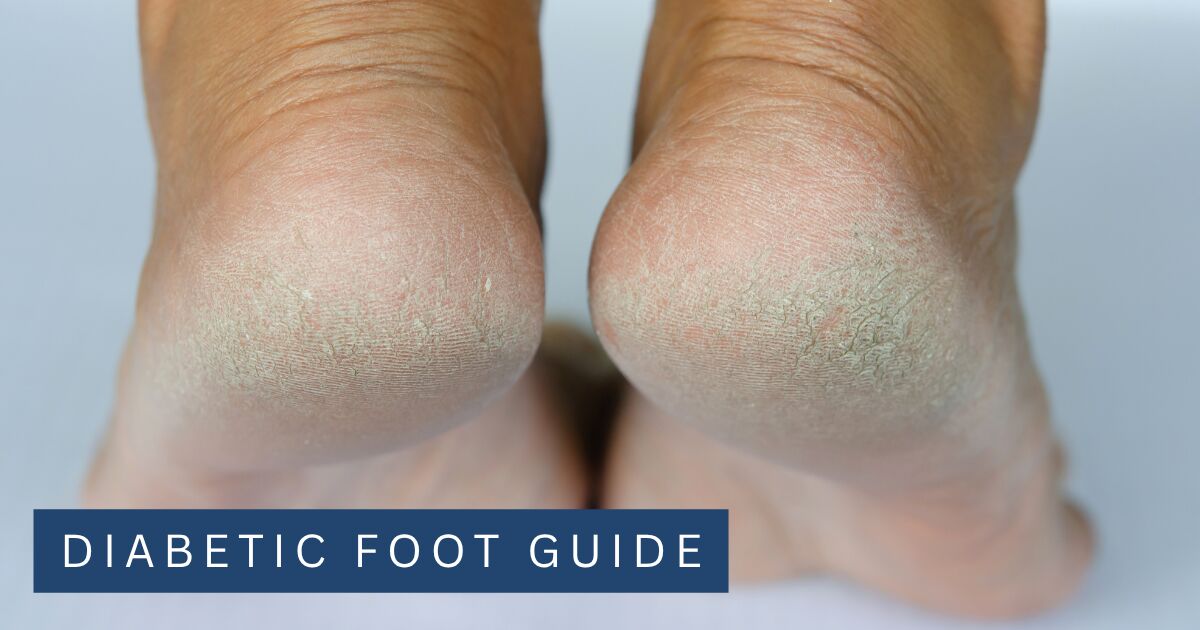
Dry, flaking, cracking skin on a diabetic foot is not neglect and it is not a cosmetic issue. It is usually the first visible sign that the nerves controlling the sweat glands have stopped working — and a deep heel fissure is an open wound waiting to happen.
The short version
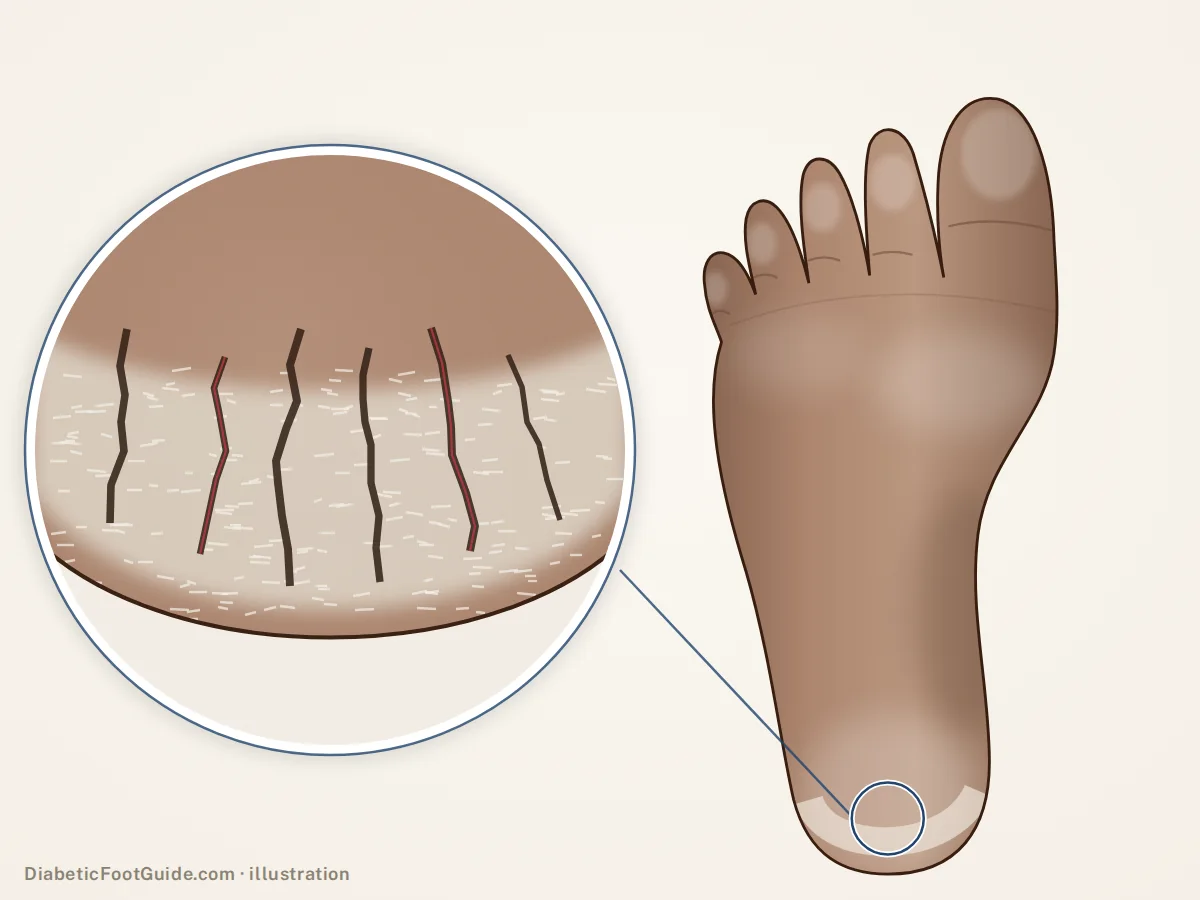
Autonomic neuropathy switches off local sweating, so the skin loses the moisture that keeps it flexible. It thickens where it takes load, then splits — classically around the heel rim, where the fat pad spreads on weight-bearing and the dry skin cannot stretch with it.
The treatment is a urea-based cream used daily and professional reduction of the thick edge. The thing not to do is attack it with a pumice, a file or a callus remover, because on a numb foot you have no way of knowing when you have gone too deep.
Why it happens, and why it is not just “dry skin”
Sweat glands in the foot are controlled by small autonomic nerve fibres, which are among the first to be damaged in diabetic neuropathy. When they fail, the skin gets no moisture and no surface lipid. It becomes stiff, scaly and prone to fissuring, and it does so on a foot that is simultaneously losing its ability to report injury.
The important consequence: dry skin in diabetes is a neuropathy sign. If your feet have become dry in a way they never used to be, that is a reason to have your sensation formally tested rather than to buy a bigger tub of cream. See the diabetic foot exam.
Dry skin, callus and fissure are three stages of one problem
| Stage | What it looks like | What it needs |
|---|---|---|
| Dry, flaky skin | Fine scale over the sole and heel, sometimes silvery and often mistaken for fungal infection — or the other way round | Daily urea 10%. If it is a moccasin-pattern scale up the sides of the foot, consider fungal and treat that instead. |
| Callus | Thick yellow build-up where load concentrates — the ball of the foot, the heel rim, under a bony prominence | Professional reduction plus urea 20–40%. Callus over a bony point is a pre-ulcer, not hard skin. |
| Fissure | Cracks through the thick edge, often around the back and sides of the heel, sometimes bleeding | Clinical assessment. A fissure through the full thickness is a wound with a direct route to the tissue underneath. |
| Callus with a dark centre | A yellow lid with a red, brown or black spot inside it, sometimes soft or boggy to press | Urgent. That is bleeding or breakdown under the callus, and there is usually an ulcer beneath it. |
What to do
Urea, daily, everywhere but the web spaces
10% for maintenance, 20–40% for thick heels. Soles, heels and the tops of the feet. Never between the toes. Details on our foot cream page.
Apply after washing, at night
Onto slightly damp skin, then a clean cotton sock. Humectants need water present to work with.
Get the thick edge reduced
Cream softens skin; it does not remove a rim of callus that a fissure keeps re-opening through. That is a blade in trained hands.
Fix the footwear
Open-backed shoes and going barefoot let the heel pad spread unsupported, which is what splits it. A closed, cushioned heel counter helps more than any cream.
Look at the whole foot daily
Fissures do not announce themselves on a numb foot. You find them by looking, including with a mirror.
Do not soak for long periods
Prolonged soaking strips what little lipid is left and softens skin that then splits further. Wash and dry, do not marinate.
Off the list entirely
Pumice stones, metal files, callus graters, medicated corn plasters and any salicylic-acid callus remover. All of them remove tissue you cannot feel, on a foot with impaired healing. Salicylic acid in particular keeps working after you stop paying attention, and a chemical ulcer at a pressure point is a genuinely bad outcome from a five-dollar purchase.
When it is not simply dryness
- Fine silvery scale in a moccasin distribution — across the sole and up the sides — is frequently fungal and has often been treated as dry skin for years. Check the nails too.
- Peeling in sheets between and under the toes points at fungal infection rather than dehydration.
- Dryness on one foot only is unusual and deserves a circulation assessment.
- Skin that is shiny, thin and hairless with cool toes is an arterial picture, not a moisturiser problem.
- Itchy, inflamed, weeping skin is dermatitis or infection — see rashes on diabetic feet.
Common questions
Why are my feet so dry since being diagnosed with diabetes?
Because the small autonomic nerve fibres that drive sweating in the foot are among the earliest affected by diabetic neuropathy. When they stop working the skin gets no moisture and no surface oil. It is one of the earliest visible signs of nerve involvement, and it is worth mentioning to whoever manages your diabetes rather than treating silently.
Are dry feet an early sign of diabetes?
They can be. The nerves that drive sweating in the feet are among the first that diabetes affects, so persistently dry, thickening skin can appear before any numbness is noticed. Dry feet on their own do not mean diabetes, and most dry heels are just dry heels. New, persistent dryness with cracking in someone who has diabetes or its risk factors is worth raising at the next check-up, where sensation can be tested at the same visit.
How do I get rid of cracked heels with diabetes?
A urea cream daily — 20–40% if the skin is thick — applied to damp skin at night under a cotton sock, plus professional reduction of the callused rim the crack keeps splitting through, plus closed shoes with a supportive heel. Expect weeks rather than days. What you should not do is file or grate it down yourself.
Is peeling skin on the bottom of my feet a sign of diabetes?
It can be part of the picture, but peeling has plenty of other causes — most commonly fungal infection, which is also more frequent in diabetes. The pattern helps: fine dry scale over the whole sole suggests one thing, damp peeling between the toes another. If you have diabetes and the skin is breaking anywhere, have it looked at.
Can I use a pumice stone on a callus?
Not on a diabetic foot with neuropathy. You cannot feel how much you are removing, the skin’s healing is impaired, and callus over a bony prominence often has damaged tissue directly beneath it. Reduction should be done by someone who can see what is under the callus while removing it.
How often should I moisturise?
Daily, and consistently. Cracked heels respond to weeks of regular use and go straight back if it stops. It is also a useful habit for a second reason — applying cream is the moment most people actually look at both feet.
Sources
Clinical literature retrieved from PubMed, plus the governing federal sources.
- Pop-Busui R, Boulton AJ, Feldman EL, et al. Diabetic Neuropathy: A Position Statement by the American Diabetes Association. Diabetes Care. 2017;40(1):136-154. doi:10.2337/dc16-2042 — sudomotor dysfunction presenting as dry skin and anhidrosis, the reason diabetic xerosis is a neuropathy sign.
- Gin H, Rorive M, Gautier S, et al. Treatment by a moisturizer of xerosis and cracks of the feet in men and women with diabetes: a randomized, double-blind, placebo-controlled study. Diabetic Medicine. 2017;34(9):1309-1317. doi:10.1111/dme.13402 — untreated fissures as an entry point for bacteria leading to infection and ulceration, and the trial showing a urea-containing moisturiser closing them.
- Bus SA, Sacco ICN, Monteiro-Soares M, et al. Guidelines on the prevention of foot ulcers in persons with diabetes (IWGDF 2023 update). Diabetes Metab Res Rev. 2024;40(3):e3651. doi:10.1002/dmrr.3651 — fissures as pre-ulcerative lesions predicting future ulceration, and the requirement to treat them.
- Piquero-Casals J, Morgado-Carrasco D, Granger C, et al. Urea in Dermatology: A Review of its Emollient, Moisturizing, Keratolytic, Skin Barrier Enhancing and Antimicrobial Properties. Dermatol Ther (Heidelb). 2021;11(6):1905-1915. doi:10.1007/s13555-021-00611-y — urea concentration deciding the effect: low for moisturising, medium and high for keratolysis.
- Federici A, Federici G, Milani M. An urea, arginine and carnosine based cream shows greater efficacy in the treatment of severe xerosis of the feet in Type 2 diabetic patients in comparison with glycerol-based emollient cream. A randomized, assessor-blinded, controlled trial. BMC Dermatol. 2012;12:16. doi:10.1186/1471-5945-12-16 — a randomised comparison of a urea-based cream against a glycerol-based emollient in diabetic foot xerosis.
- Borgström K, Björklund S, Gudmundsson P, et al. Moisturizer formulations for diabetic foot xerosis: a systematic review and meta-analysis of randomized controlled trials. Front Clin Diabetes Healthc. 2026;7. doi:10.3389/fcdhc.2026.1922860 — meta-analysis of 12 randomised trials finding urea-containing creams outperform plain base creams.
- National Institute of Diabetes and Digestive and Kidney Diseases. Diabetes and Foot Problems. NIH. niddk.nih.gov — Diabetes and Foot Problems — the instruction not to put lotion or cream between the toes.
Related guides
Diabetic foot pain: safe home remedies
Why soaking and heating pads are the wrong answer for sore, dry, numb feet — and what to do instead.
Diabetic foot cream
Which humectant, at what strength.
Diabetic foot ulcers
What a callus with a dark centre is hiding.
What diabetes does to feet
Why the sweating stopped.
Diabetic shoes and inserts
A supportive heel counter beats any cream.
Diabetic foot care products
The six items that do almost all the work, and the three sold for diabetic feet that should never touch one.
Callus and fissure care in Michigan
Balance Foot & Ankle reduces callus and treats heel fissures in Howell and Bloomfield Hills — safely, on feet that cannot report pain.

Dr. Tom Biernacki is a double board-certified podiatric foot and ankle surgeon practising in Michigan. He treats diabetic wounds, Charcot neuroarthropathy and at-risk feet daily, and writes here to put the clinical reasoning behind that care in front of the people living with it.