Gangrene means tissue has died. On a diabetic foot the question that follows is not “which dressing” but “is there enough blood supply to heal anything, and is this infected” — and one form of it is measured in hours, not days.
The short version
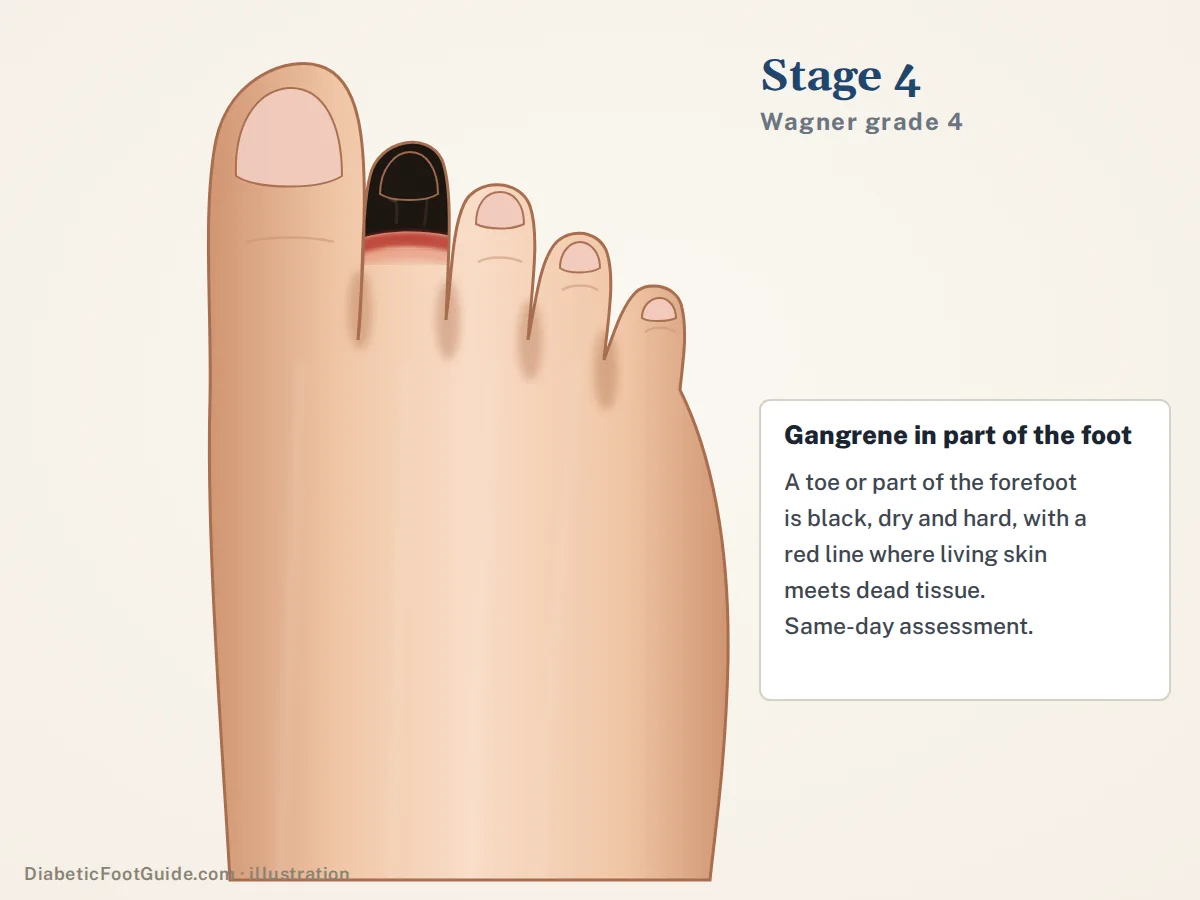
Dry gangrene is tissue that has died from lack of blood: black, shrivelled, usually a toe, with a clear line between dead and living tissue. Wet gangrene is dead tissue that is also infected: swollen, boggy, foul-smelling, spreading. Gas gangrene is a rapidly advancing infection that produces gas in the tissue, and it is limb- and life-threatening.
Dry gangrene needs urgent vascular assessment. Wet and gas gangrene need a hospital today.
Telling the three apart
| Dry | Wet | Gas | |
|---|---|---|---|
| Appearance | Black or dark brown, dry, shrunken, mummified — usually a toe or its tip | Swollen, discoloured, moist, blistered, boggy to touch | Discoloured and rapidly spreading, skin often tense, sometimes crackling under the fingers |
| Smell | Little or none | Foul, distinctive | Foul, often described as sweet or putrid |
| Border | Sharp line between dead and living tissue | Poorly defined, advancing | Advancing fast, sometimes by the hour |
| Cause | Loss of arterial supply | Infection in tissue with poor supply | Gas-forming bacteria in deep tissue |
| Systemic illness | Often none | Common — fever, high sugars, unwellness | Marked, and progresses rapidly |
| Response | Urgent vascular assessment | Hospital today | Emergency, immediately |
Do not wait to see how it develops
The distinction between dry and wet is not always obvious early, and dry gangrene can become wet. A black area on a diabetic foot is never an appropriate thing to watch for a week — and in a neuropathic foot it may not hurt at all, which is exactly why people do wait.
How it is assessed
Blood supply first
Pulses, ankle pressures and toe pressures, then imaging. Toe pressure matters because calcified arteries in diabetes push an ankle-brachial index into a falsely reassuring range.
Is it infected
Swelling, discharge, smell, systemic signs, inflammatory markers. See diabetic foot infection.
How deep
Probe to bone, X-ray, and usually MRI. Bone involvement changes both the treatment and the level of any surgery.
The whole person
Glucose control, kidney function, cardiac risk. These decide what surgery is survivable as much as what the foot needs.
What treatment involves
- Restoring blood flow where possible. Angioplasty or bypass. Nothing distal heals without inflow, and this frequently comes before any surgery on the foot rather than after it.
- Controlling infection. Antibiotics guided by deep tissue cultures, and drainage or debridement where there is pus or dead tissue — antibiotics do not sterilise necrotic tissue.
- Removing dead tissue. Sometimes surgically; sometimes, in stable dry gangrene of a toe with poor surgical options, by allowing it to demarcate and separate under close supervision.
- Amputation at the lowest level that will heal. A toe, a ray, part of the forefoot — the goal is always the most distal level that has the blood supply to heal and leaves a foot that still takes weight.
- Preventing the next one. Offloading, footwear and surveillance, because the foot that produced this is still the foot you have.
Amputation is not the default, and it is not the failure it feels like
A well-planned toe or partial-foot amputation that heals and leaves a functional, weight-bearing foot is a better outcome than months of a non-healing wound followed by a higher-level amputation. The conversation worth having with your surgeon is about level and function, not simply about whether. Our toe amputation guide walks through the operation, recovery week by week and how to prevent the next ulcer.
Emergency department now if
- Any black, blue or dusky area on the foot or a toe
- Swelling that is spreading, especially with a bad smell or discharge
- Crackling under the skin
- Fever, chills, confusion or vomiting
- A foot that has become cold, pale or mottled, or new severe pain in the forefoot at night
- Blood sugars that have become uncontrollable alongside any of the above
Common questions
What does gangrene look like on a diabetic foot?
Dry gangrene is a black or dark brown, shrivelled area, usually starting at a toe tip, with a fairly clear border against living tissue and little smell. Wet gangrene is swollen, moist, discoloured and foul-smelling with an advancing edge. Both need urgent assessment; wet gangrene needs a hospital the same day.
Can gangrene be reversed?
Tissue that has died does not come back. What can change is everything around it: restoring blood flow can stop the process advancing and allow a lower amputation level, and controlling infection can turn an emergency into a planned procedure. So the aim is not reversal but limiting how much is lost.
Does gangrene always mean amputation?
No. Small areas of stable dry gangrene at a toe tip are sometimes managed by allowing the tissue to demarcate and separate, particularly where surgery carries high risk. But it frequently does involve removing dead tissue, and the useful question is the level rather than whether — the lowest level that will heal and leave a working foot.
Why does it not hurt?
Because the same neuropathy that allowed the original injury also removes the pain that dying tissue would otherwise cause. Painless gangrene is common in diabetes and it is the reason presentations are so often late. The absence of pain says nothing reassuring about severity here.
What is the ICD-10 code for diabetic gangrene?
For type 2 diabetes with peripheral arterial disease and gangrene it is E11.52, which already includes the gangrene — adding a separate gangrene code duplicates it. The structure of these pairings is set out on our diabetic foot ICD-10 reference.
Sources
Clinical literature retrieved from PubMed.
- AlWahbi A. Autoamputation of diabetic toe with dry gangrene: a myth or a fact? Diabetes Metab Syndr Obes. 2018;11:255-264. doi:10.2147/DMSO.S164199 — the separation of dry, wet and gas gangrene by mechanism and speed.
- Hussain H, Fadel A, Garcia E, et al. Clostridial Myonecrosis: A Comprehensive Review of Toxin Pathophysiology and Management Strategies. Microorganisms. 2024;12(7):1464. doi:10.3390/microorganisms12071464 — gas gangrene as a rapidly progressive infection requiring emergent surgery.
- Stevens DL, Bisno AL, Chambers HF, et al. Practice Guidelines for the Diagnosis and Management of Skin and Soft Tissue Infections: 2014 Update by the Infectious Diseases Society of America. Clinical Infectious Diseases. 2014;59(2):e10-e52. doi:10.1093/cid/ciu296 — guideline management of necrotising soft-tissue infection.
- Meloni M, Morosetti D, Giurato L, et al. Foot Revascularization Avoids Major Amputation in Persons with Diabetes and Ischaemic Foot Ulcers. J Clin Med. 2021;10(17):3977. doi:10.3390/jcm10173977 — successful revascularisation cutting major amputation from 36.3% to 2.1%.
- Conte MS, Bradbury AW, Kolh P, et al. Global vascular guidelines on the management of chronic limb-threatening ischemia. Journal of Vascular Surgery. 2019;69(6):3S-125S.e40. doi:10.1016/j.jvs.2019.02.016 — gangrene as part of chronic limb-threatening ischaemia, and why limb-threat severity is staged.
- Abbade LPF, Frade MAC, Pegas JRP, et al. Consensus on the diagnosis and management of chronic leg ulcers – Brazilian Society of Dermatology. Anais Brasileiros de Dermatologia. 2020;95:1-18. doi:10.1016/j.abd.2020.06.002 — calcified arteries falsely elevating the ABI, and toe pressure as the alternative.
Related guides
Toe amputation with diabetes
Why it is done, how healing and walking go afterward, and what lowers the risk of another.
Toe color changes with diabetes
What red, purple, black or pale toes mean before tissue dies, and how urgent each one is.
Diabetic foot infection
The wet-gangrene half of the problem.
Diabetic foot ulcers
Where most of these start.
Non-diabetic foot ulcers
Arterial disease without diabetes does the same thing.
The diabetic foot exam
Toe pressures, and why an ABI can mislead.
Limb salvage in Michigan
Balance Foot & Ankle works on at-risk and threatened limbs in Howell and Bloomfield Hills, alongside vascular colleagues. If tissue has gone black, go to an emergency department rather than booking.

Dr. Tom Biernacki is a double board-certified podiatric foot and ankle surgeon practising in Michigan. He treats diabetic wounds, Charcot neuroarthropathy and at-risk feet daily, and writes here to put the clinical reasoning behind that care in front of the people living with it.