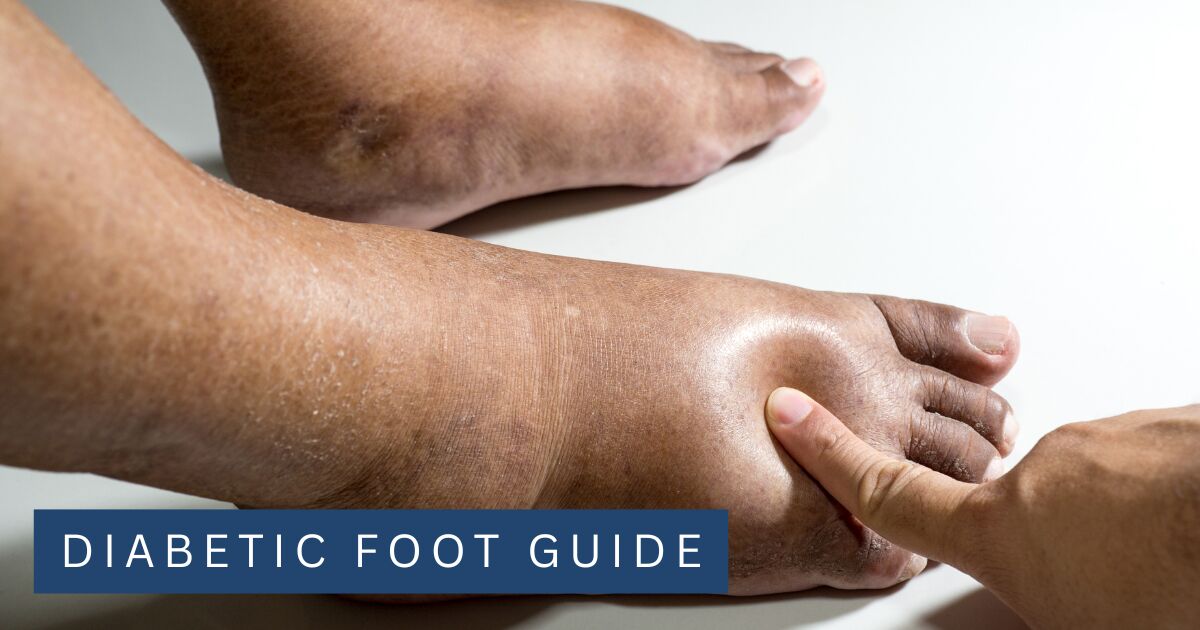
Brown marks on a diabetic foot are usually harmless: old bleeding under a toenail, rust-brown staining around the ankle, or shin spots that have spread onto the top of the foot. Three of them are not harmless, and telling those apart is what this page is for.
The short version
Most brown marks on the feet and ankles are one of three harmless things: old bleeding under a toenail from pressure, rust or brown staining around the ankles from vein disease, or the small round patches of diabetic dermopathy spreading down from the shins.
Three need a proper look: a dark spot inside a callus, which is bleeding under a lid with a wound usually underneath and is a same-day problem; a new or changing pigmented patch anywhere on the foot or under a nail; and brown discoloration with a hot, spreading, one-sided rash, which is infection rather than pigment.
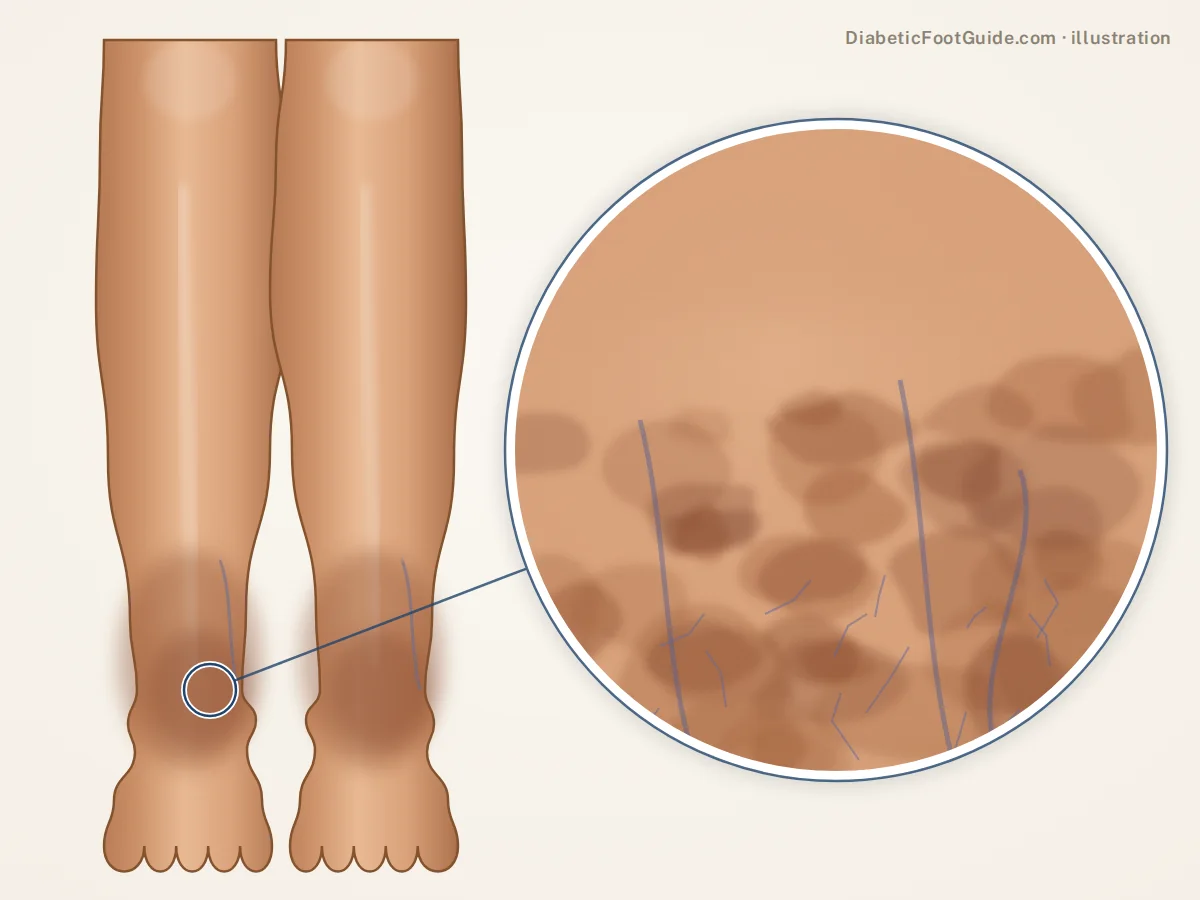
Spots on the shins rather than the feet?
Small, round, light-brown patches on the front of both shins are usually diabetic dermopathy, and they have a full guide of their own: diabetic dermopathy. This page is about brown marks on the feet themselves, from the toenails and soles to the ankles.
What brown marks on the feet and legs usually are
| Appearance | Usually | What to do |
|---|---|---|
| Small, round, shallow, light-brown patches on both shins, painless | Diabetic dermopathy | Nothing for the skin. Mention it at your next diabetes review. |
| Deeper brown or rust-colored staining around the ankles, with swelling and sometimes hardened skin | Hemosiderin staining from venous disease | Points at the veins rather than diabetes. Compression may help — but only after arterial supply has been checked. |
| Velvety, darkened, thickened skin in creases — neck, armpits, sometimes the top of the foot | Acanthosis nigricans | Associated with insulin resistance. Worth raising with whoever manages your diabetes. |
| Shiny, yellow-brown, depressed plaques with visible small vessels, usually on the shins | Necrobiosis lipoidica | Uncommon, strongly associated with diabetes, and it can ulcerate. Have it properly assessed. |
| A brown or black patch under a toenail | Usually old bleeding from pressure | On a numb foot that means something pressed hard enough to bruise unnoticed — see diabetic toenails. A bruise grows out with the nail over months. Pigment that stays put, widens, or runs onto the skin at the nail fold is the pattern that needs a specialist opinion rather than another year of waiting. |
| A new, single, irregular or changing pigmented lesion anywhere on the foot | Needs examining, not explaining away | Pigmented lesions on the foot deserve a proper look regardless of diabetes. The one this rule exists for is acral melanoma, which arises on soles, palms and nail beds, has nothing to do with diabetes, and is found late precisely because it appears where nobody looks. |
| Brown discoloration with a hot, spreading, one-sided rash | Not pigmentation — probably infection | Same day. |
Shin spots that reach the feet
Diabetic dermopathy lives mainly on the shins, but the same small, round, light-brown, slightly sunken patches can extend onto the top of the foot and around the ankle. They are harmless and painless, need no treatment, and each patch fades over one to two years as others appear.
They matter for what they travel with: they are more common the longer diabetes has been present, and they tend to appear alongside eye, kidney and nerve damage — a reason to check that your eye screening, kidney tests and a foot exam with sensation testing are current. The spots themselves, the leg conditions they are confused with, and what to do about them are on diabetic dermopathy.
What to do about them
Most brown marks on the feet need nothing done to them. What matters is telling the harmless ones from the three above, and not abrading skin that cannot afford it.
- Do not scrub, exfoliate or bleach them. The skin is already atrophic, and abrading skin on a diabetic leg is how you convert a harmless mark into a wound.
- Moisturize if the surrounding skin is dry — that helps the skin generally, not the patches. See dry and cracked feet.
- Look at the soles and between the toes. A mark you cannot see is a mark nobody is watching: use a mirror or a phone camera, and look at the nails while you are there.
- Glucose control matters for the underlying process, even though it does not clear existing patches.
Have it looked at rather than assumed if
- A patch is single, growing, changing color, or has an irregular border
- Any lesion has broken down, ulcerated, or is weeping
- The area is painful, hot, or spreading
- The plaques are shiny and yellow-brown with visible vessels — that is a different condition
- There is pigmentation under a nail that you cannot account for
Common questions
What is the brown or black mark under my toenail?
Usually old bleeding from pressure: a shoe, a stubbed toe, or a nail pressing on a bed that cannot feel it. It grows out with the nail over six to twelve months. A stripe that widens, runs onto the skin at the nail fold, or stays put while the nail grows needs a specialist opinion rather than another year of waiting — more on diabetic toenails.
Do brown marks on the feet go away?
Old bleeding under a nail grows out with the nail over six to twelve months. Dermopathy patches fade over one to two years while new ones appear elsewhere. Brown staining from vein disease usually stays, because the vein pressure that caused it is still there. Nothing has been shown to speed any of them up.
Are brown spots on the feet a sign of poor circulation?
They can be. Rust or brown staining specifically around the ankles, with swelling and skin thickening, is more suggestive of venous disease than of dermopathy. Arterial problems tend to show as color change that varies with position — deep red when the foot hangs down, pale when raised — along with cool, shiny, hairless skin.
Should I be worried about a dark spot on the bottom of my foot?
A dark spot inside a callus is the urgent one — that is bleeding or breakdown under a lid and usually an ulcer underneath. A new, single, irregular or changing pigmented lesion anywhere on the foot should also be examined properly rather than attributed to diabetes.
Can brown spots mean my diabetes is uncontrolled?
Dermopathy correlates with how long you have had diabetes and with the presence of other complications more than with any single reading. It is better read as a signal to check that your eye, kidney and foot screening are up to date than as a verdict on last month’s numbers.
Could a dark spot on my foot be melanoma?
It can be. Acral melanoma is the form that occurs on the soles, the palms and under the nails, and it has nothing to do with diabetes — but a foot that has lost sensation is a foot nobody inspects for its appearance, so it tends to be found later here than elsewhere. The features that warrant an opinion are the ordinary ones: a pigmented patch that is new, changing, asymmetric, has an irregular border or more than one color, or pigment under a nail that is not growing out. None of that means it is melanoma. It means the question gets settled by someone looking at it, not by reading about it.
Sources
Clinical literature retrieved from PubMed.
- Shemer A, Bergman R, Linn S, et al. Diabetic dermopathy and internal complications in diabetes mellitus. Int J Dermatol. 1998;37(2):113-115. doi:10.1046/j.1365-4362.1998.00273.x — diabetic dermopathy as the commonest cutaneous marker of diabetes, and its significant association with retinopathy, nephropathy and neuropathy.
- Morgan AJ, Schwartz RA. Diabetic dermopathy: A subtle sign with grave implications. Journal of the American Academy of Dermatology. 2008;58(3):447-451. doi:10.1016/j.jaad.2007.11.013 — the pretibial distribution and the microangiopathic associations.
- Duff M, Demidova O, Blackburn S, et al. Cutaneous Manifestations of Diabetes Mellitus. Clinical Diabetes. 2015;33(1):40-48. doi:10.2337/diaclin.33.1.40 — dermopathy being asymptomatic and needing no treatment, and the description of necrobiosis lipoidica for contrast.
- Mirhoseini M, Saleh N, Momeni A, et al. A study on the association of diabetic dermopathy with nephropathy and retinopathy in patients with type 2 diabetes mellitus. J Nephropathol. 2016;5(4):139-143. doi:10.15171/jnp.2016.26 — the association of dermopathy with nephropathy and retinopathy in type 2 diabetes.
- Reid SD, Ladizinski B, Lee K, et al. Update on necrobiosis lipoidica: A review of etiology, diagnosis, and treatment options. Journal of the American Academy of Dermatology. 2013;69(5):783-791. doi:10.1016/j.jaad.2013.05.034 — necrobiosis lipoidica, the lesion dermopathy is most often confused with.
Related guides
Rashes on diabetic feet
Where dermopathy sits among the other skin changes.
Dry and cracked feet
The other common skin finding, and the one that opens.
What diabetes does to feet
The small-vessel process these patches are marking.
The diabetic foot exam
What to have checked once dermopathy appears.
Skin changes on a diabetic foot, in Michigan?
Balance Foot & Ankle assesses diabetic skin changes and at-risk feet in Howell and Bloomfield Hills.

Dr. Tom Biernacki is a double board-certified podiatric foot and ankle surgeon practising in Michigan. He treats diabetic wounds, Charcot neuroarthropathy and at-risk feet daily, and writes here to put the clinical reasoning behind that care in front of the people living with it.