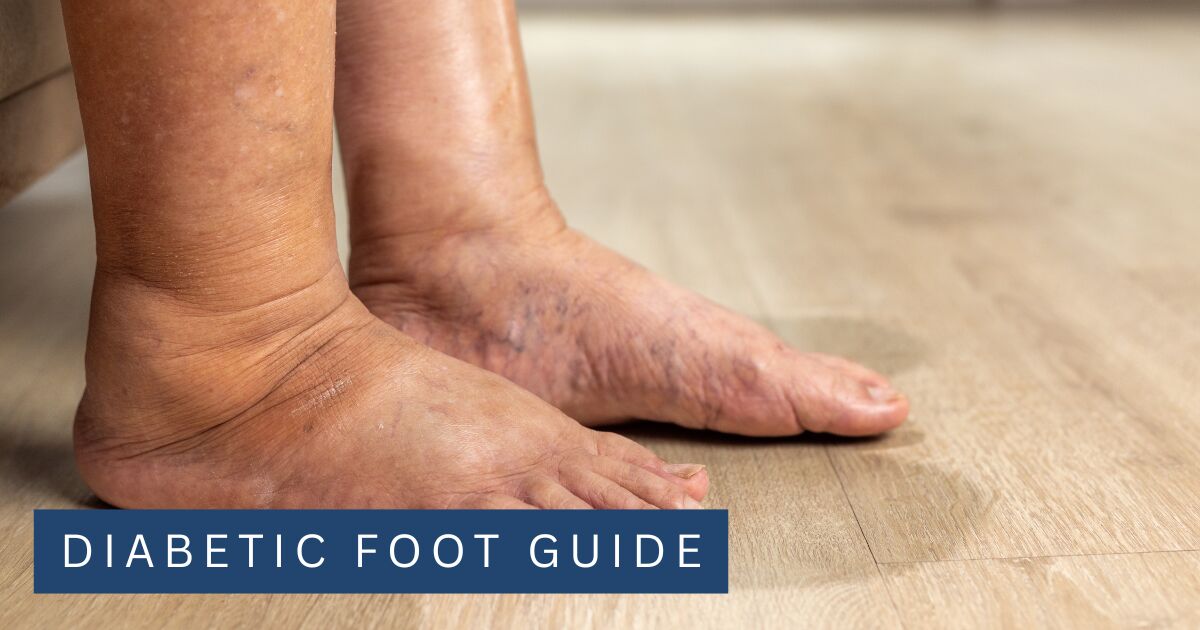
Swelling in both feet in diabetes usually points at the heart, kidneys, veins or a medication. Swelling in one foot is a different question entirely — and on a neuropathic foot it is the one that gets missed.
The short version
Both feet swelling together is usually systemic: heart failure, kidney disease, low albumin, venous insufficiency, or a drug — calcium channel blockers and some diabetes medications are common culprits. It needs working up, not ignoring, but it is rarely a foot emergency.
One foot swelling, especially if it is also warm and red, is the urgent pattern. In someone with diabetic neuropathy that is Charcot foot, infection, or a fracture nobody felt — and all three are measured in days.
Both feet, or one? Start there
One hot, swollen foot is Charcot until proven otherwise
Most swelling can wait for an appointment. These patterns cannot.
- One foot hot and swollen, and you have neuropathy. Even with no wound and no injury you remember, that is Charcot foot until an examination says otherwise. Be seen within days, and walk on it as little as possible until then.
- One calf swollen, tight or tender. A clot in the leg has to be ruled out the same day. With chest pain or sudden breathlessness as well, call 911.
- Swelling with breathlessness, or weight going up fast. Breathless lying flat, waking up short of breath, or a scale that climbs over a few days can mean the heart is not keeping up. Same-day medical review, and the emergency department if you are breathless at rest.
- Swelling with a wound, redness, a smell or a fever. That is a diabetic foot infection until proven otherwise. Same day, and the emergency department if the redness is spreading or you feel unwell.
- A foot that is cold, pale, blue or dusky. Blood is not getting through. Emergency department now, not an appointment.
| Pattern | Common causes | Urgency |
|---|---|---|
| Both feet and ankles, worse by evening, better overnight, pits when pressed | Venous insufficiency, heart failure, kidney disease, low protein, medication side effect, prolonged standing | Needs assessment, not an emergency — unless breathless or rapidly worsening |
| Both, with breathlessness lying flat, or sudden weight gain | Cardiac | Urgent medical review |
| One foot, warm and red, no wound, neuropathy present | Charcot neuroarthropathy until proven otherwise | Days, not weeks |
| One foot, with a wound, warmth, discharge or smell | Infection | Same day |
| One leg, calf swelling and tenderness | Deep vein thrombosis | Same day |
| One foot after an unremarkable knock or a long walk | Fracture or sprain — and on a numb foot it may not hurt much | Prompt imaging |
The comparison that takes ten seconds
Put the back of one hand on each foot at the same spot at the same time. If one is clearly hotter as well as more swollen, that is a finding, and on a foot with neuropathy it should be examined within days rather than watched.
The press test: is it pitting edema?
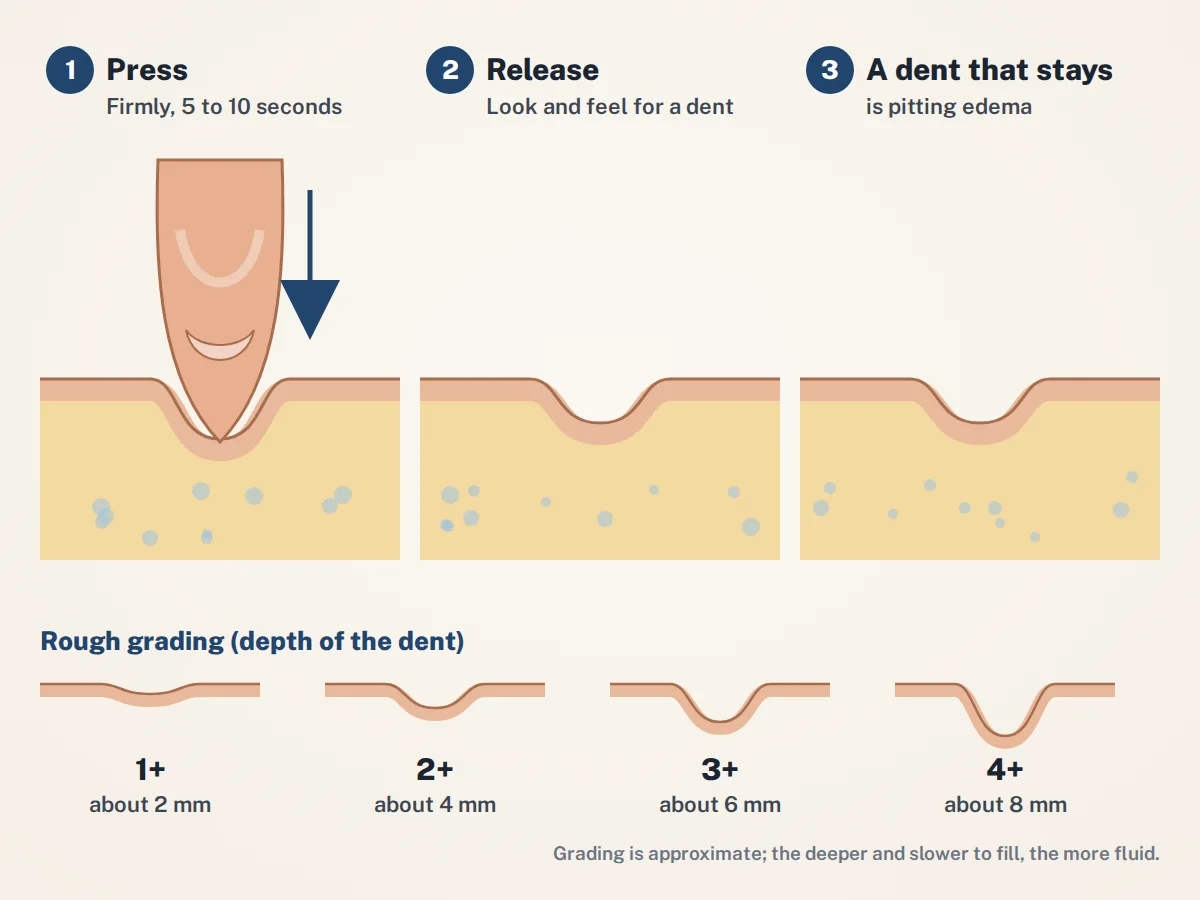
Most swelling in the feet and ankles is fluid collecting in the tissue under the skin, and fluid can be pushed aside. Pressing on it tells you whether that is what you are looking at. It is the same check a doctor makes in the exam room, and you can do it at home.
- Press. Push your thumb firmly into the skin over the shinbone, a couple of inches above the ankle, or into the top of the foot, where there is bone underneath to press against. Hold for 5 to 10 seconds: firm, not painful, and never over a wound.
- Release. Lift your thumb straight off and look right away, because a shallow dent can fill back in within seconds.
- Look and feel. A pit is a dent that stays behind, like a thumbprint in dough. It is easiest to see with light coming from the side, and easiest to feel by running a fingertip across the spot.
Do both legs, ideally in the evening, when swelling is at its worst. If your fingertips are numb too, trust your eyes, or a phone camera held low and to the side, rather than your touch. And if sock bands leave deep grooves that are still there long after the socks come off, you have already done the test: that is pitting, made by elastic instead of a thumb.
What a pit means
A pit means the swelling is mostly free fluid. That fits the both-feet causes in the table above, such as the heart, kidneys, veins, low protein or a medication, but it does not tell you which one, and it does not make the swelling safe: a clot or an infection can pit too. Pitting tells you what the swelling is made of. Whether it is one foot or both, and whether that foot is hot, tells you how urgent it is.
The 1+ to 4+ scale, in plain words
Clinicians grade a pit by how deep it is and how quickly it fills back in. The classic scale runs roughly like this:
| Grade | What you see | Depth, roughly | How fast it fills in |
|---|---|---|---|
| 1+ | A slight dent; the leg looks normal | 2 mm | Almost at once |
| 2+ | A clearer dent; the leg still looks normal | 4 mm | Over several seconds |
| 3+ | A deep dent; the ankle and foot look full and swollen | 6 mm | Noticeably slower |
| 4+ | A very deep dent; the leg is visibly misshapen | 8 mm | Slowest; the dent lingers |
Treat any grade as approximate. In a study of people with type 2 diabetes, experienced nurses grading the same legs often gave different scores, depth and fill-in time only partly agreed with each other, and the researchers described the classic assessment as unvalidated and subjective. If you want a number to track at home, the same study found a tape measure around the ankle far more repeatable, and it took about a minute. Mark the spot, and measure at the same time of day each time.
If it does not pit
Swelling that will not dent is not simply fluid. The usual explanations:
- Long-standing lymphedema. Early on it can pit, but with time the tissue thickens and stops denting. It tends to take in the top of the foot and the toes, and a fold of skin at the base of the second toe cannot be pinched up, which is called the Stemmer sign.
- Lipedema. Fat rather than fluid, in both legs, stopping in a cuff at the ankle and sparing the feet.
- Thyroid disease. It can cause a firm, non-pitting swelling called myxedema.
- Old venous disease. Years of venous swelling can harden the skin above the ankle into a tight, brownish band that no longer dents.
None of these is diagnosed with a thumb, and each is managed differently from fluid retention. Firm, hot swelling on one side is a different matter: it belongs with the red flags above, whether it pits or not.
Why swelling matters more on a diabetic foot
Shoes stop fitting
A swollen foot in yesterday’s shoe generates pressure points that the foot cannot report. A great many ulcers begin in a week when the feet swelled.
Skin stretches and splits
Edematous skin is fragile, tears easily, and heals slowly. Blisters over swollen skin are common.
It slows healing
Fluid in the tissue increases the distance oxygen and antibiotics have to travel. An existing wound will stall while the foot stays swollen.
It hides the important signs
Swelling masks deformity and makes early Charcot change harder to see, which is part of why that diagnosis is so often late.
What helps, and the caveat on compression
- Elevate above the level of the heart, genuinely — a footstool is not elevation. Twenty to thirty minutes several times a day does more than any product.
- Move. Calf muscle action is what pumps fluid out of the leg. Ankle pumps while sitting help.
- Check your shoes fit the feet you have today, not the ones you had last month. Adjustable closures matter here.
- Look at the skin twice a day while it is swollen — this is when new pressure points appear.
- Ask about your medications. Calcium channel blockers, some diabetes drugs, steroids and NSAIDs all cause fluid retention, and this is a fixable cause.
- Reduce salt and get the underlying cause treated — the foot is reporting something happening elsewhere.
Compression is not automatically the answer
Compression treats venous swelling well and can reduce an already marginal blood supply in significant arterial disease. In a diabetic leg, calcified vessels can make an ankle-brachial index read falsely normal, so perfusion should be established with toe pressures before compression goes on. This is a decision for someone who has measured, not a purchase. How compression socks differ from diabetic socks, and the levels sold, are in diabetic socks vs compression socks.
Free: the 30-Second Daily Foot Check. One foot that swells, or feels warmer than the other, is exactly the kind of change a daily check catches early. This one printable page from Dr. Tom Biernacki lists five steps to do before your socks go on, says when to call your foot doctor and when to go to the ER, and gives you a week of tick boxes for the fridge.
ER or 911 now, not a download: a foot or leg that is suddenly cold, pale, blue or very painful; any skin turning black; redness spreading fast, or fever or chills with a foot wound.
Download the Daily Foot Check (PDF, 1 page)
Coming fall 2026: The Diabetic Foot Care Guide, Dr. Tom’s book.
Common questions
Does diabetes cause swollen feet?
Not directly in most cases. Diabetes contributes through the conditions it drives — kidney disease, heart disease, venous problems — and through some of the medications used to treat it. What diabetes definitely does is make swelling more dangerous, because a swollen foot that cannot feel pressure is where ulcers start.
When is swelling in one foot an emergency?
When it is warm and red with no wound and you have neuropathy, that is Charcot until proven otherwise and needs seeing within days. With a wound, discharge, smell or fever, it is infection and needs seeing the same day. With calf tenderness it may be a clot. A cold, pale or dusky swollen foot is an emergency.
Should I wear compression socks for diabetic swelling?
Only after circulation has been assessed. Compression is the treatment for venous swelling and is potentially harmful with significant arterial disease. In diabetes, an ankle-brachial index can read falsely high because of arterial calcification, so toe pressures are the more reliable check before anything is fitted.
Why do my feet swell more in the evening?
Gravity. Fluid accumulates through the day and drains overnight, which is why evening swelling that has settled by morning usually points at venous or dependent causes rather than something acute. Swelling that does not settle overnight is the more concerning pattern.
Can swollen feet cause a diabetic ulcer?
Indirectly and often. Swelling changes how a shoe fits, creates new pressure points, stretches and weakens skin, and slows healing — all on a foot that cannot report any of it. Re-checking footwear during a swollen period is one of the more useful things you can do.
Is swelling in one foot a sign of diabetes?
Not of diabetes itself. Swelling in one foot points to something happening in that leg: an injury, an infection, a clot, or a vein or lymph problem on that side. What diabetes changes is the list and the stakes. With neuropathy, one warm, swollen foot adds Charcot foot, which hurts far less than it should and is easy to miss. If you have diabetes and one foot swells, compare the warmth of both feet: one clearly hotter foot should be examined within days, and a wound, spreading redness, a swollen or tender calf, or a cold, pale foot should be seen the same day or sooner.
What does pitting edema mean?
It means the swelling is mostly fluid. Press a thumb into it for 5 to 10 seconds and a dent stays behind, then fills back in. Clinicians grade it roughly from 1+, a slight dent that fills in almost at once, to 4+, a very deep dent that lingers, but the grading is subjective. Pitting tells you what the swelling is made of, not what caused it: heart, kidney and vein problems, medications, clots and infections can all pit. That is why one foot or both matters more than the grade.
Sources
Clinical literature retrieved from PubMed.
- Rogers LC, Frykberg RG, Armstrong DG, et al. The Charcot Foot in Diabetes. Diabetes Care. 2011;34(9):2123-2129. doi:10.2337/dc11-0844 — the warm, swollen, erythematous neuropathic foot that resembles cellulitis, DVT or gout.
- Makani H, Bangalore S, Romero J, et al. Peripheral edema associated with calcium channel blockers: incidence and withdrawal rate — a meta-analysis of randomized trials. Journal of Hypertension. 2011;29(7):1270-1280. doi:10.1097/HJH.0b013e3283472643 — peripheral edema as a calcium channel blocker effect.
- Nesto RW, Bell D, Bonow RO, et al. Thiazolidinedione Use, Fluid Retention, and Congestive Heart Failure. Circulation. 2003;108(23):2941-2948. doi:10.1161/01.CIR.0000103683.99399.7E — fluid retention and edema with thiazolidinediones.
- Abbade LPF, Frade MAC, Pegas JRP, et al. Consensus on the diagnosis and management of chronic leg ulcers – Brazilian Society of Dermatology. Anais Brasileiros de Dermatologia. 2020;95:1-18. doi:10.1016/j.abd.2020.06.002 — compression being contraindicated in severe arterial disease, and the ABI thresholds that govern it.
- Brodovicz KG, McNaughton K, Uemura N, et al. Reliability and Feasibility of Methods to Quantitatively Assess Peripheral Edema. Clinical Medicine & Research. 2009;7(1-2):21-31. doi:10.3121/cmr.2009.819 — the classic 0 to 4 pitting scale by depth (about 2, 4, 6 and 8 mm) and fill-in time; its description as unvalidated and subjective; low-to-moderate agreement between examiners, and only moderate correlation between depth and fill-in time, in people with type 2 diabetes; and ankle circumference as a far more repeatable measure that took about a minute.
Related guides
Diabetic leg ulcers
What years of ankle swelling and brown staining can turn into, and how it is treated.
Charcot foot
The one-sided hot swollen foot, in detail.
Diabetic foot infection
The other cause of one-sided swelling.
Diabetic shoes and inserts
Why a swollen foot needs its footwear rechecked.
What diabetes does to feet
How swelling turns into a pressure wound.
One swollen foot, in Michigan?
Balance Foot & Ankle assesses one-sided swelling, Charcot and diabetic wounds in Howell and Bloomfield Hills. Say it is one foot when you book.

Dr. Tom Biernacki is a double board-certified podiatric foot and ankle surgeon practising in Michigan. He treats diabetic wounds, Charcot neuroarthropathy and at-risk feet daily, and writes here to put the clinical reasoning behind that care in front of the people living with it.