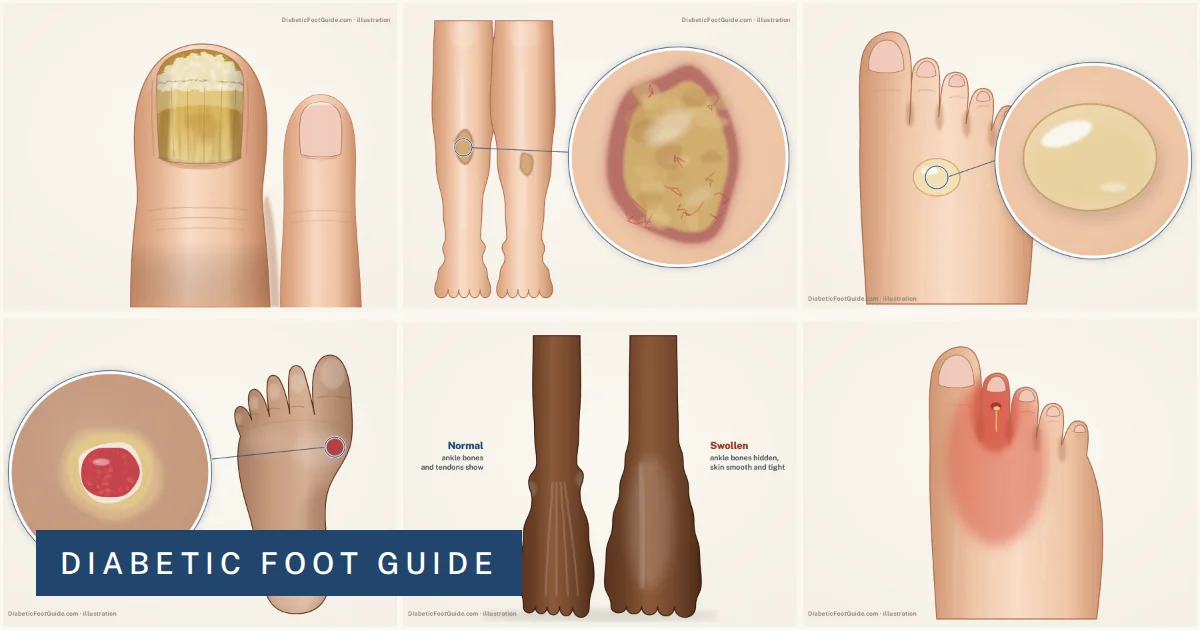
Most diabetic foot problems are found by looking rather than feeling, because nerve damage takes away the pain that would announce them. Here is what to look for, and how fast to act.
The short version
Early on, diabetic feet usually look like nothing much: dry, cracked heels, new callus and thicker nails, with shiny, hairless skin later if circulation suffers. The most important early change cannot be photographed: a normal-looking foot that has lost its feeling.
That is why pictures matter: neuropathy removes the pain that would stop you walking on an injury, so your eyes must do its job.
How to use this page: compare, don’t diagnose. Anything open, one-sided, hot or discolored gets seen.
How to look at your own feet
- Every day, in good light, ideally when your shoes come off.
- Soles and heels, with a mirror or phone camera, or ask someone to look.
- Between every pair of toes, spread apart.
- Compare the two feet for shape, color and swelling, and for warmth with the backs of your hands.
- Check your socks for blood or yellow staining.
- Photograph anything new and compare in a few days. Your own photo beats any picture here.
Pictures of diabetic foot problems, early to advanced
Sixteen pictures, from changes that come before any wound to problems that cannot wait.
About these pictures
The pictures on this page are medical illustrations drawn for this guide, so that each one shows the textbook features clearly. Real feet vary.
Early and beginning-stage changes
Changes that come before any wound: dry skin and callus usually first, shiny skin and shin spots later.
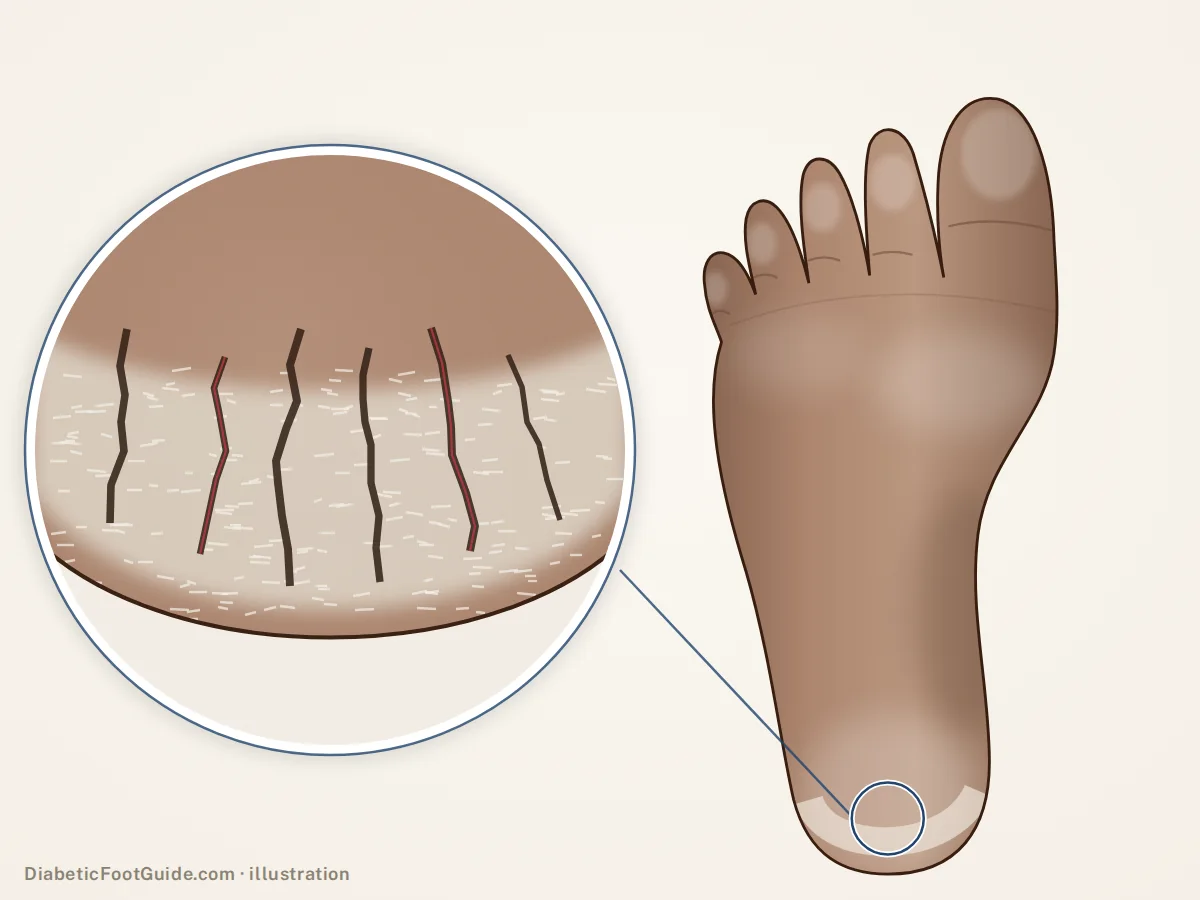
Dry, cracked heels
Thick, dry skin splitting at the heel rim, often because nerve damage has switched off sweating.
Urgency: Routine. Urea cream daily, thick edges reduced professionally. A crack that bleeds or reddens: this week.
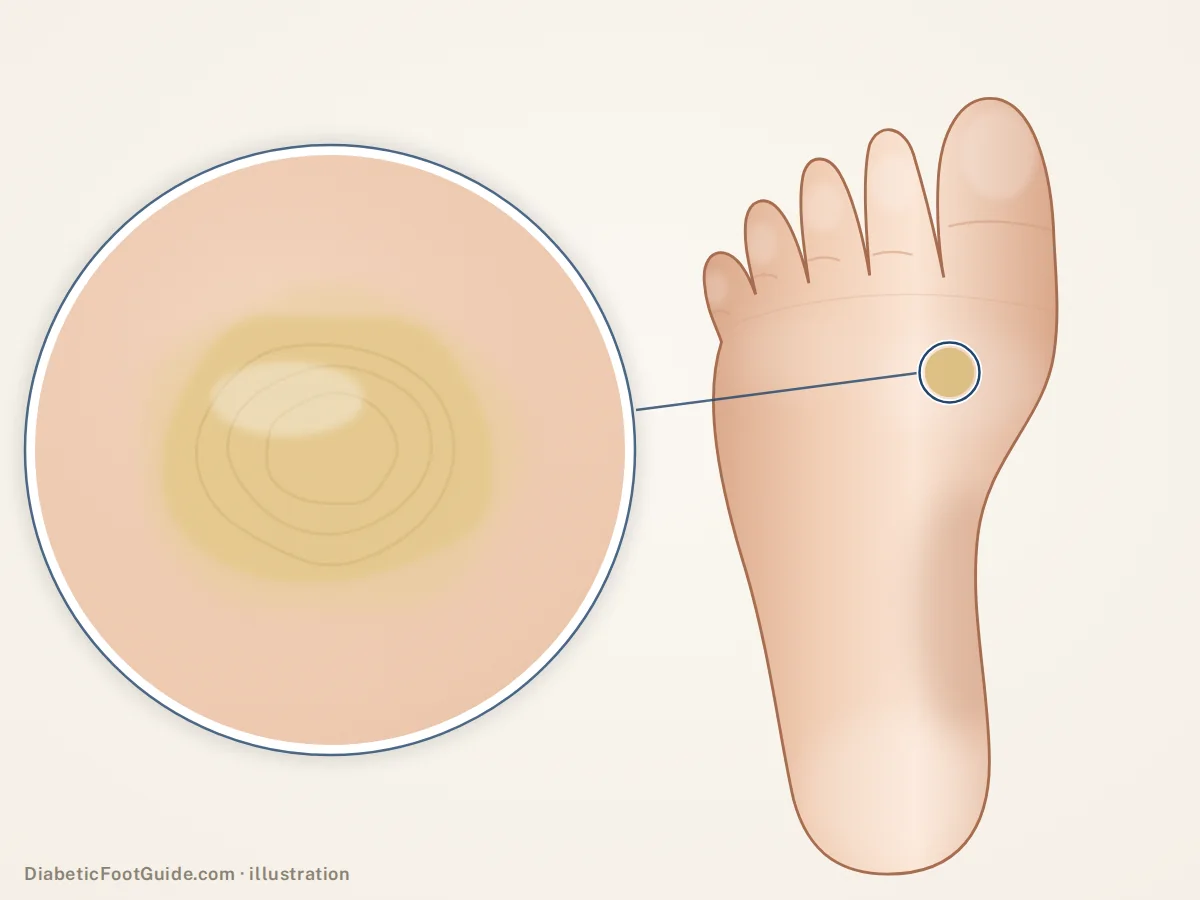
Callus under the ball of the foot
Thick yellow skin where load concentrates. On a numb foot, it is the warning before a wound.
Urgency: Routine professional reduction; nothing sharp or medicated at home. A dark spot inside is a warning sign.
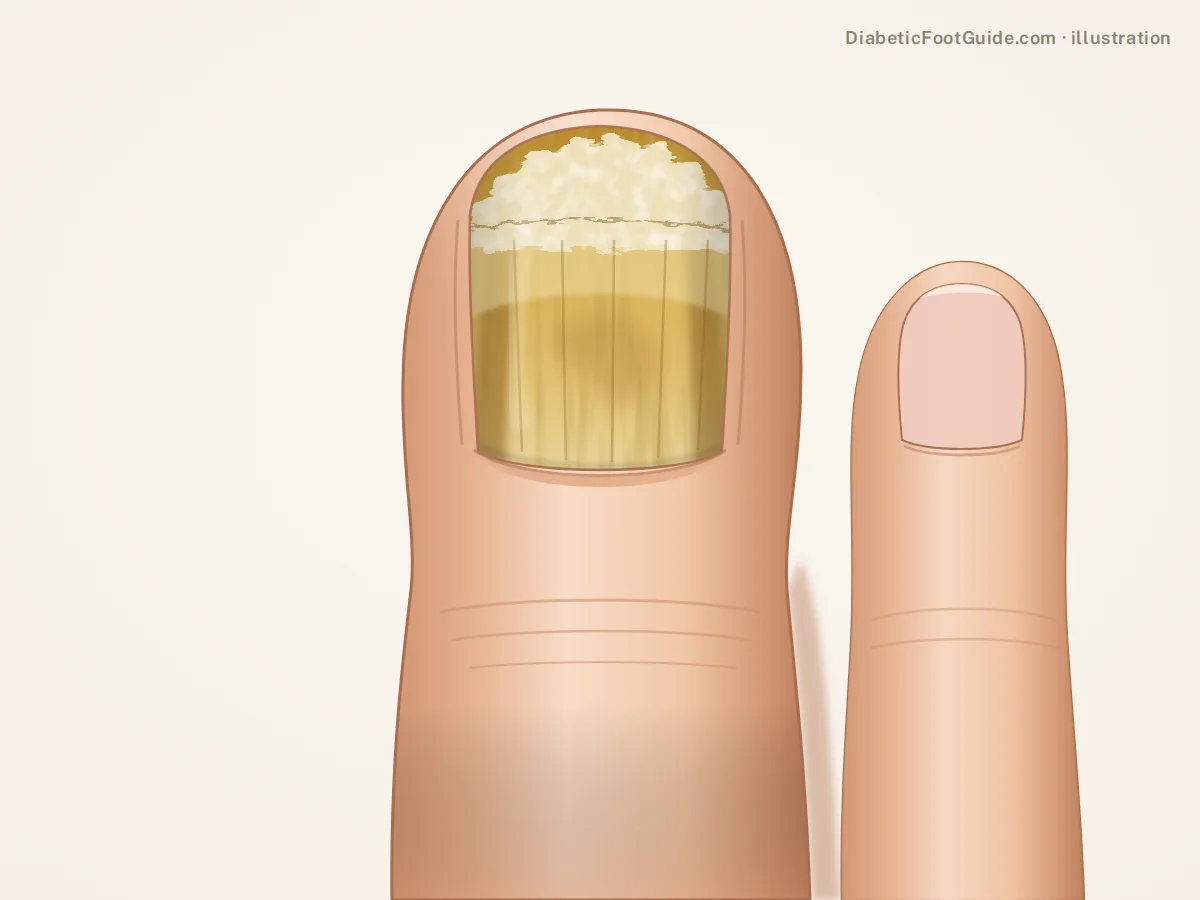
Thick, yellow toenails
Thick, yellow, crumbling nails, usually fungal, pressing on the nail bed like a stone in a shoe.
Urgency: Routine professional nail care, on a schedule set by your risk category.
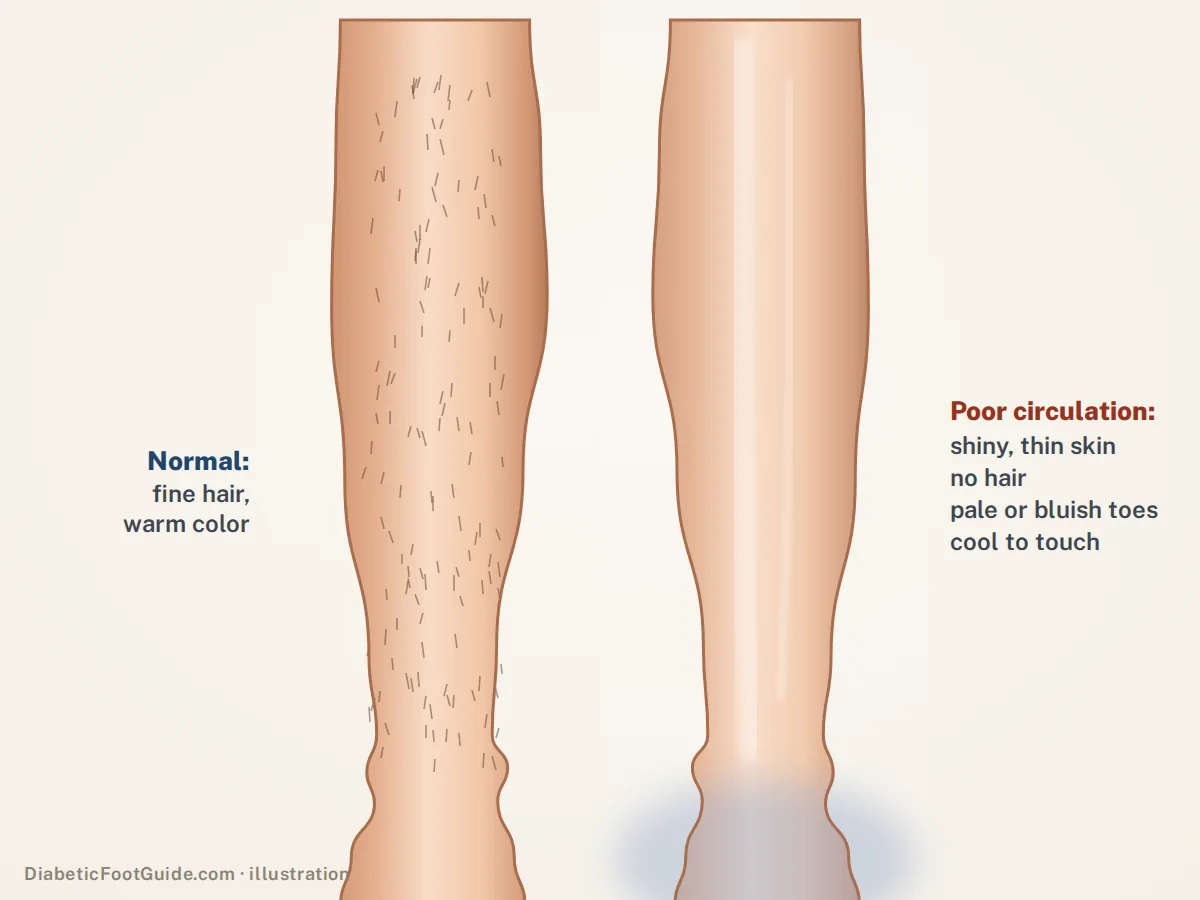
Shiny, hairless, pale skin
Thin, shiny, hairless skin, thick nails and a cool foot: a circulation picture, not a skin problem.
Urgency: Book a circulation check with toe pressures. Emergency if the foot turns cold, pale or dusky, or hurts at rest.
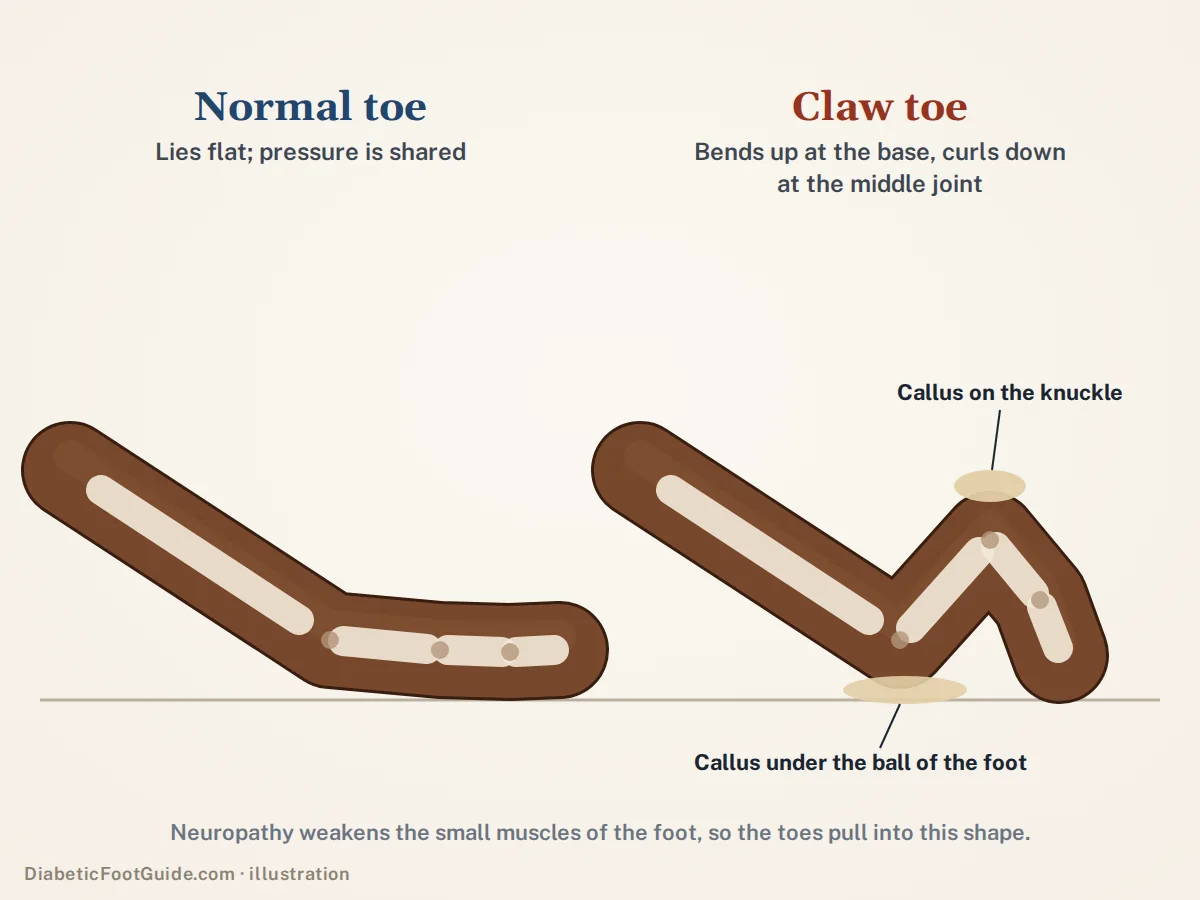
Clawed toes and a high arch
Toes buckled up at the knuckles, a high arch, and bones pushing through thinning padding under the ball of the foot, from motor nerve damage.
Urgency: Routine. A foot exam with sensation testing, and shoes deep enough for the toes.
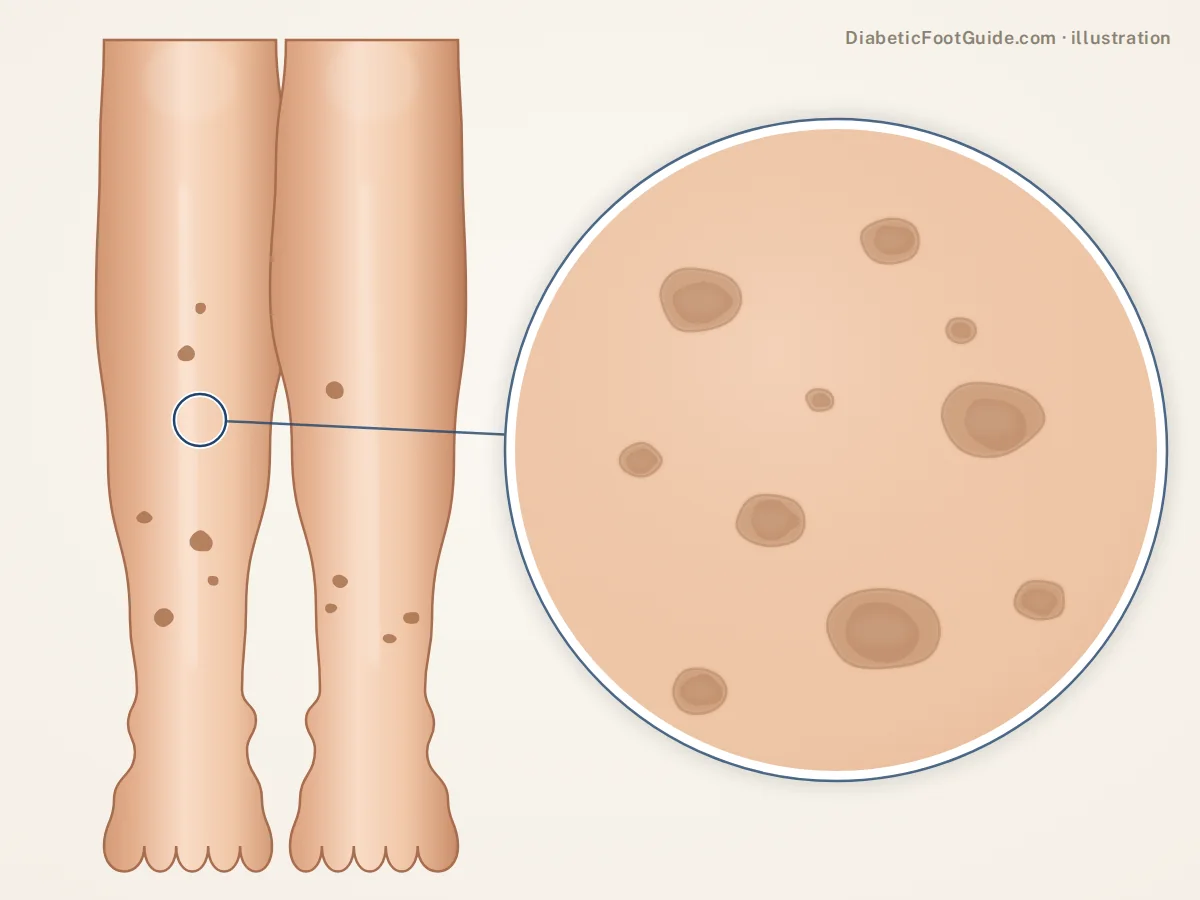
Shin spots (diabetic dermopathy)
Small, round, light-brown, slightly sunken patches on both shins. Harmless, and linked with longer-standing diabetes.
Urgency: None for the skin; check your eye, kidney and foot screening is current.
Warning signs: same day or this week
Skin about to break down, or just starting to. Several need seeing sooner.
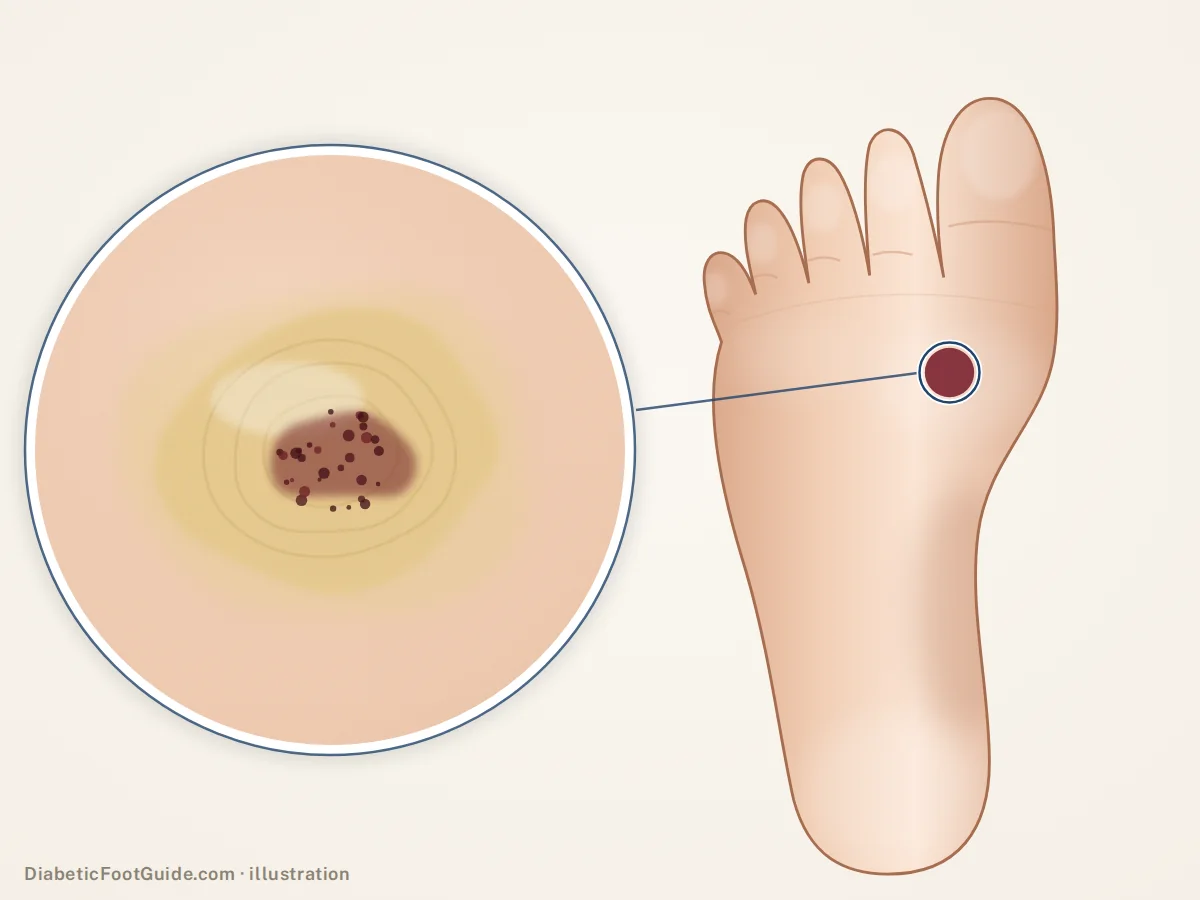
Blood inside a callus
A dark red, brown or black spot inside a callus: bleeding that often marks a wound forming beneath.
Urgency: Same day. Blood under a callus usually means a wound forming underneath. Keep off it, and never cut into it.
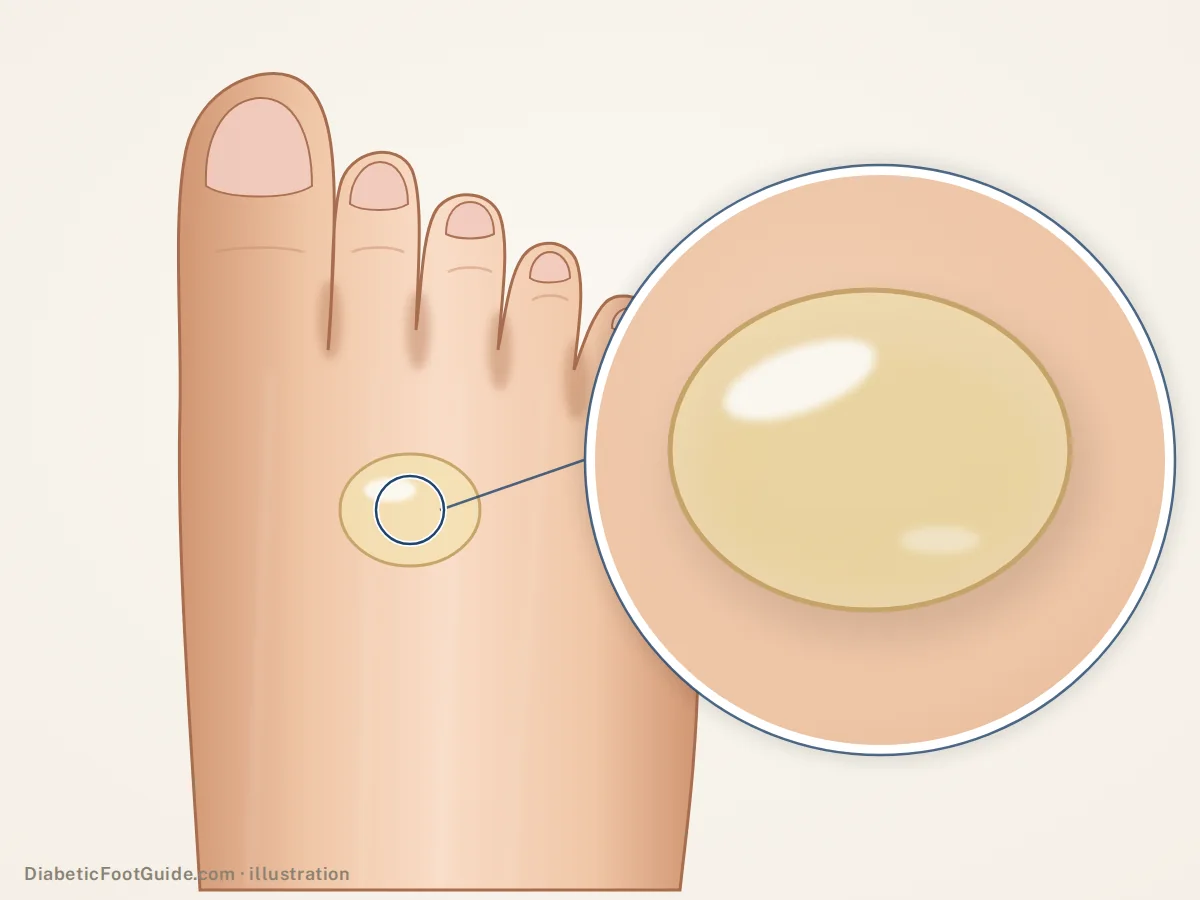
A blister
Clear fluid under intact skin, from a rub or appearing overnight: on a numb foot, a wound in waiting.
Urgency: Within days, roof on and covered; the same day if it breaks, is blood-filled, or is red, hot or draining.
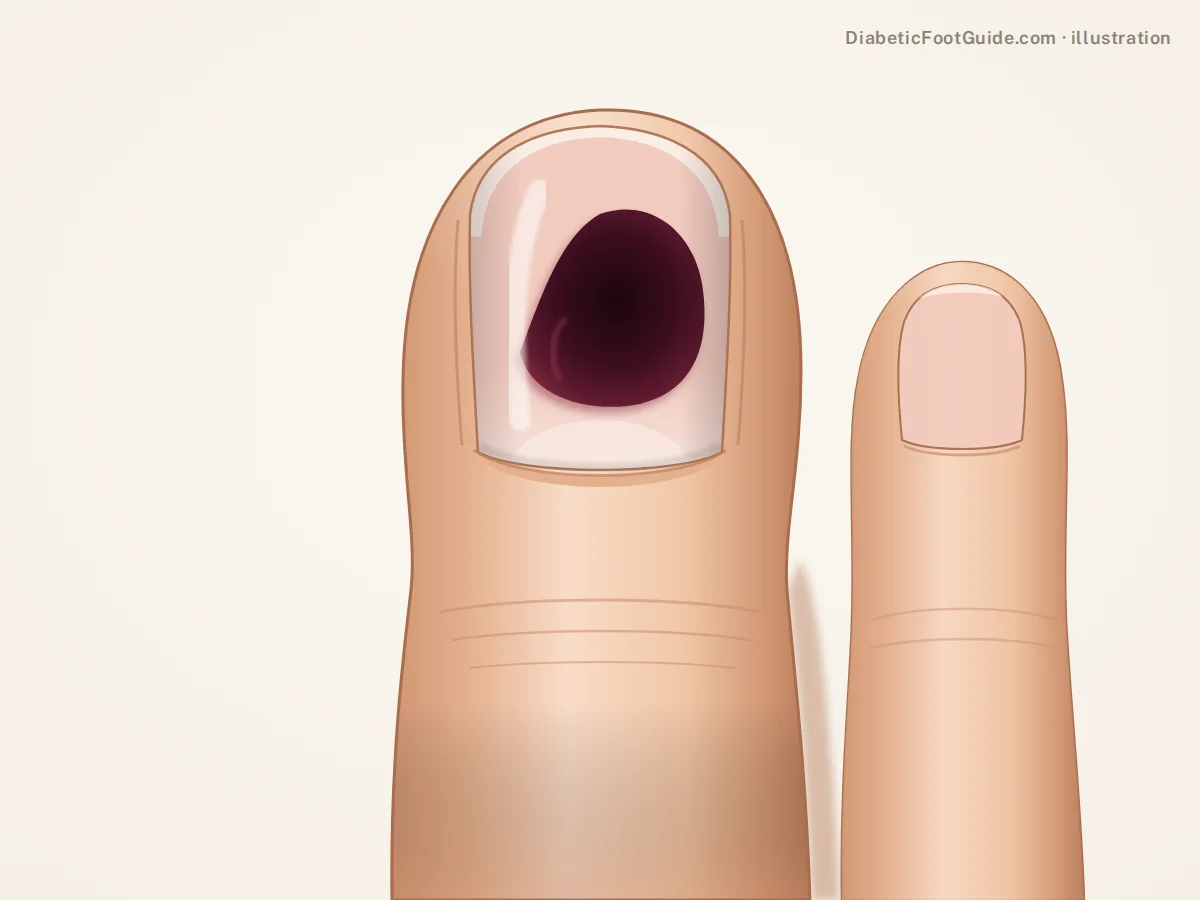
Blood under a toenail
A dark red, purple or black patch under the nail, usually from shoe pressure you never felt.
Urgency: Within days. Blood grows out with the nail; dark color that stays, widens or reaches the skin needs a specialist.
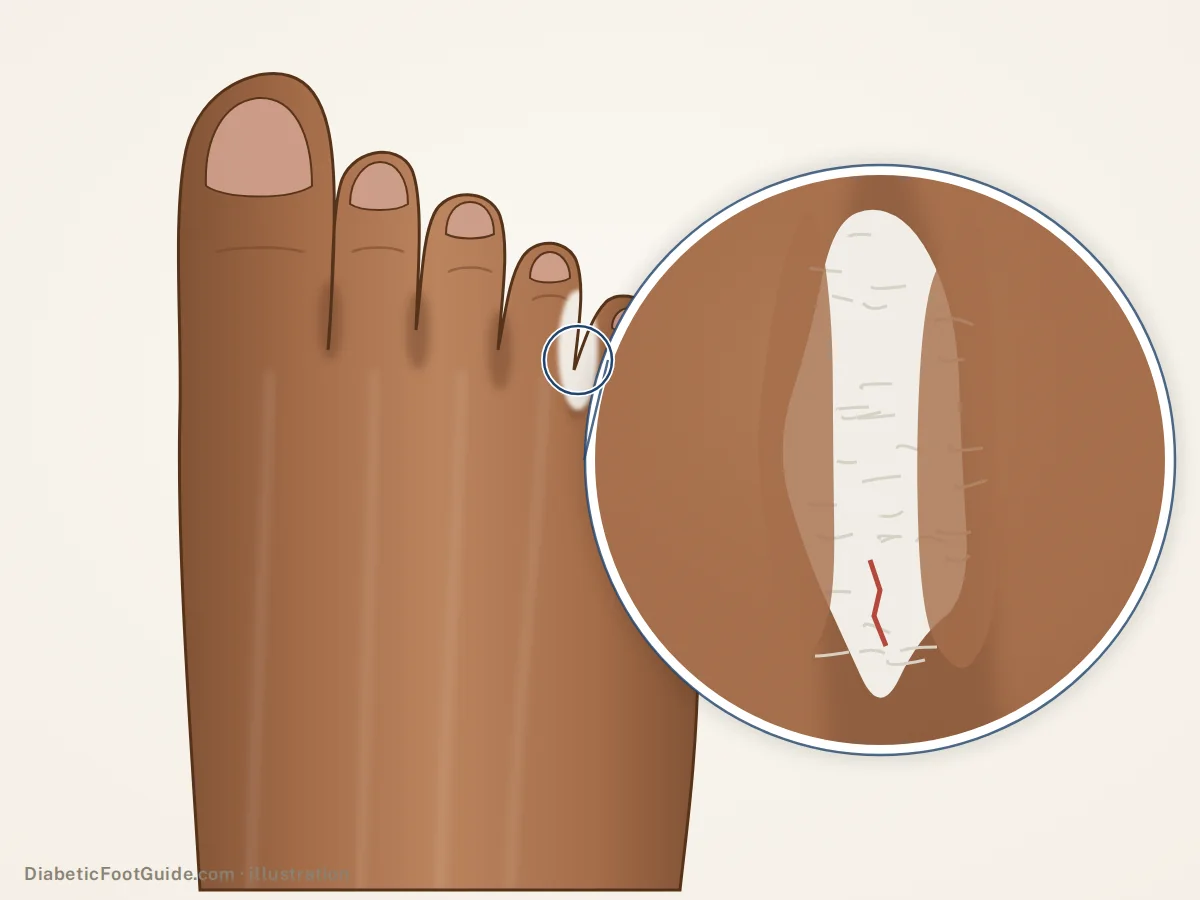
White, soggy skin between the toes
Damp, white, peeling or split skin, usually athlete’s foot: a common way in for bacteria.
Urgency: Treat it and keep it dry. Seen this week if split or weeping; the same day if redness spreads.
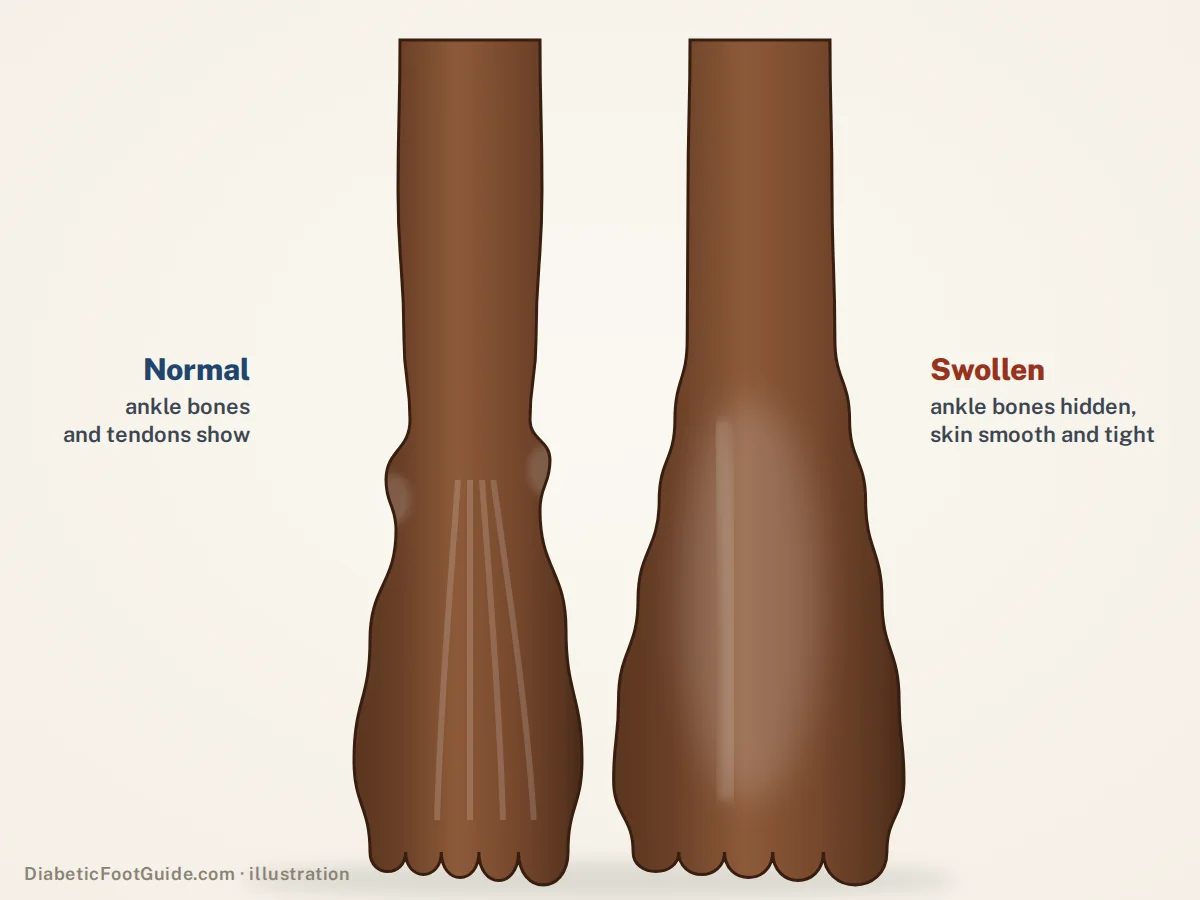
One swollen foot
One foot and ankle clearly bigger than the other: a different question from both feet swelling.
Urgency: Within days; the same day with a wound or a swollen, tender calf. If hot and red, see Charcot.
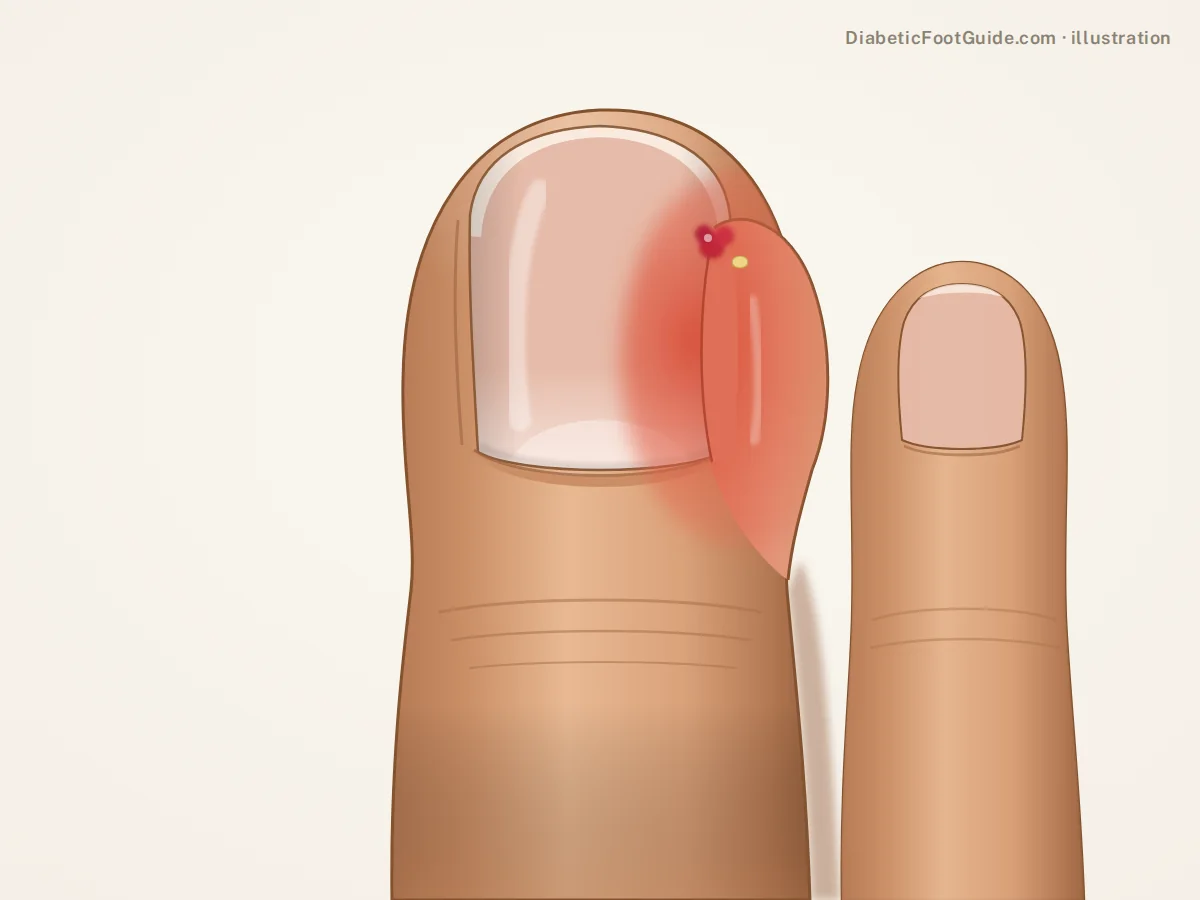
Red, swollen skin beside a nail
A nail edge growing into the toe, the skin beside it red and puffy: an easy route for infection.
Urgency: The same day on a diabetic foot: treat it as an infection. No digging at the corner.
Advanced problems: days, not weeks
Open, infected, collapsing or dead tissue, often painless. Spreading infection and black tissue mean the emergency department today.
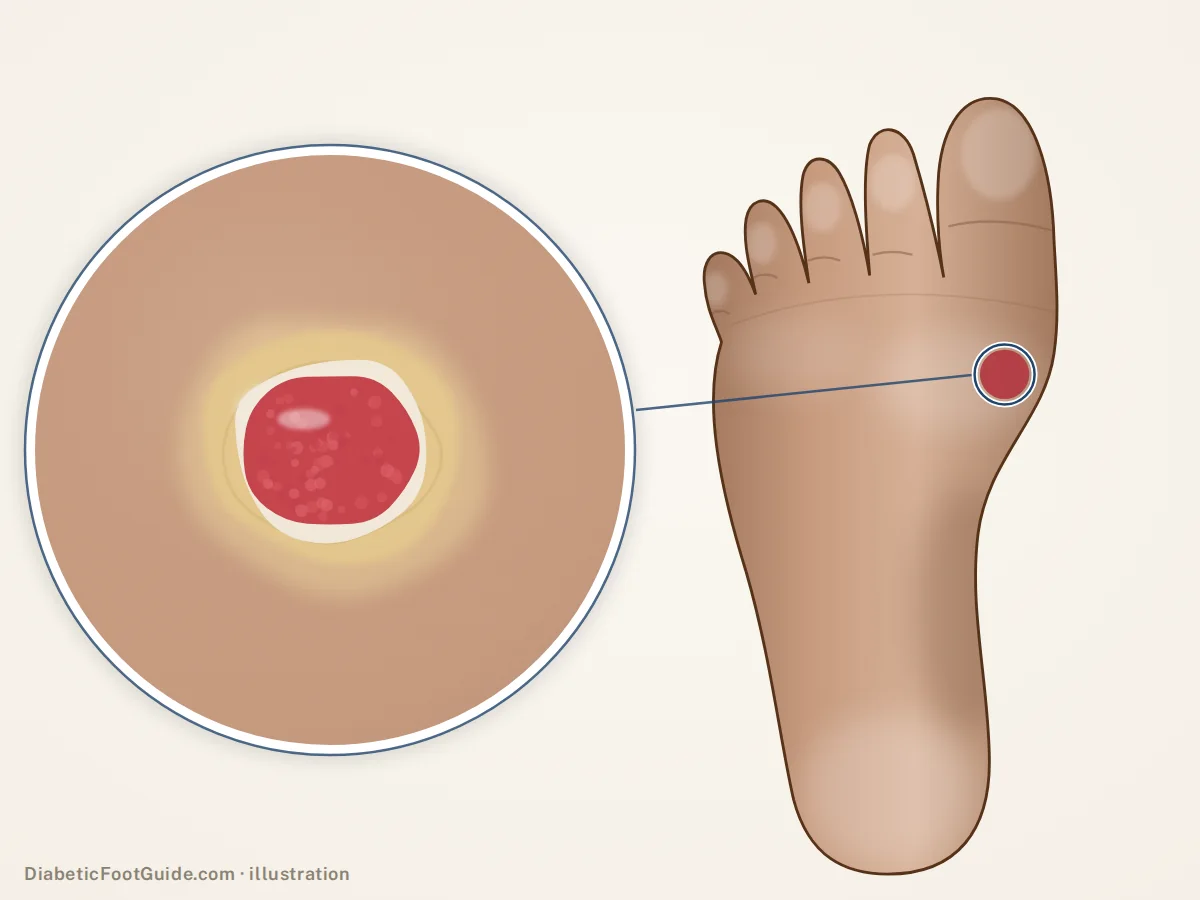
An open sore (ulcer)
A round, punched-out wound under the ball of the foot, ringed by callus and often painless.
Urgency: This week, however small. Red, hot or swollen skin around it: the same day. Pus or a foul smell: the emergency department.
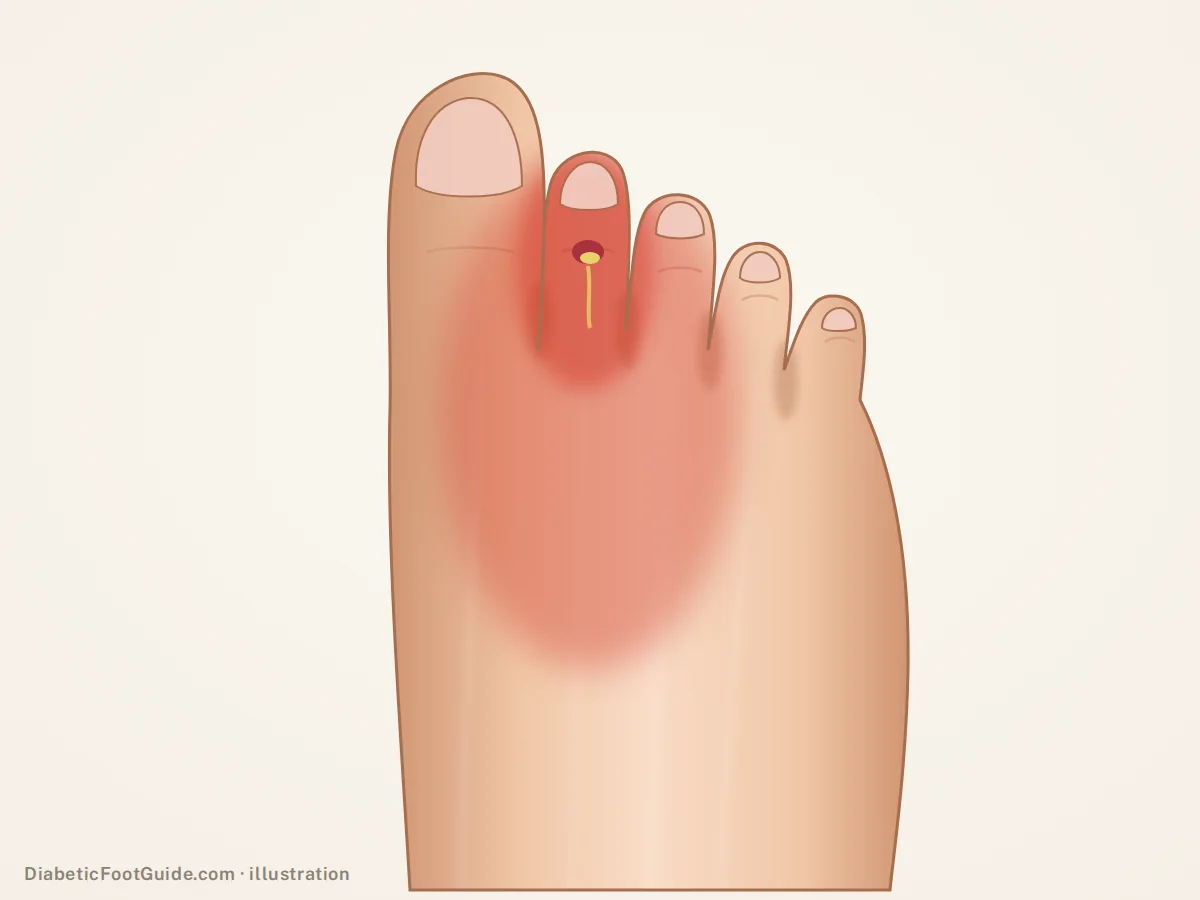
Redness spreading from a toe wound
A swollen, red toe, with redness spreading onto the foot from a small wound. Pain and fever are often absent.
Urgency: Emergency department today. Do not wait for a fever.
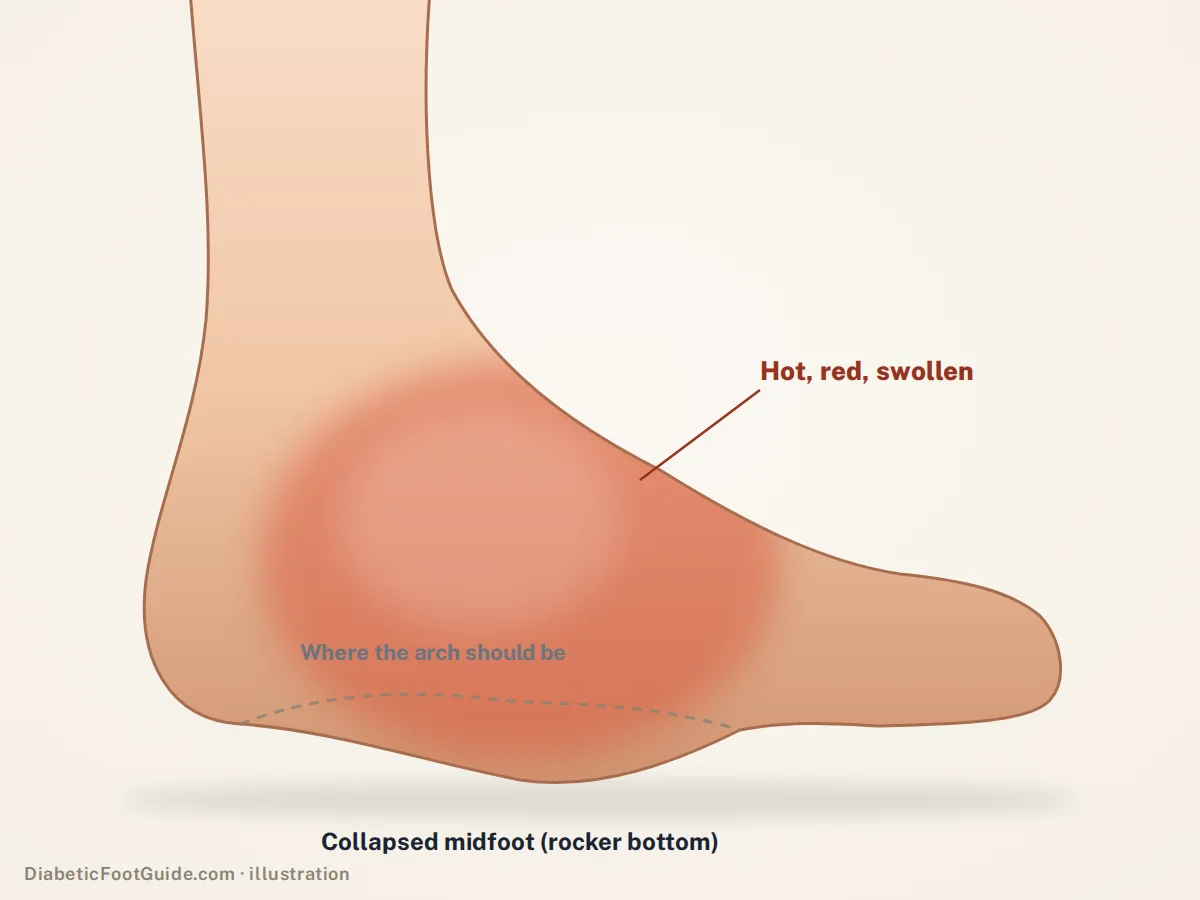
Hot, swollen midfoot (Charcot foot)
One foot hot, red and swollen through the arch, no wound, hurting less than it should. Walked on, the arch can collapse.
Urgency: Within days, and off your feet until examined. A normal X-ray does not rule it out.
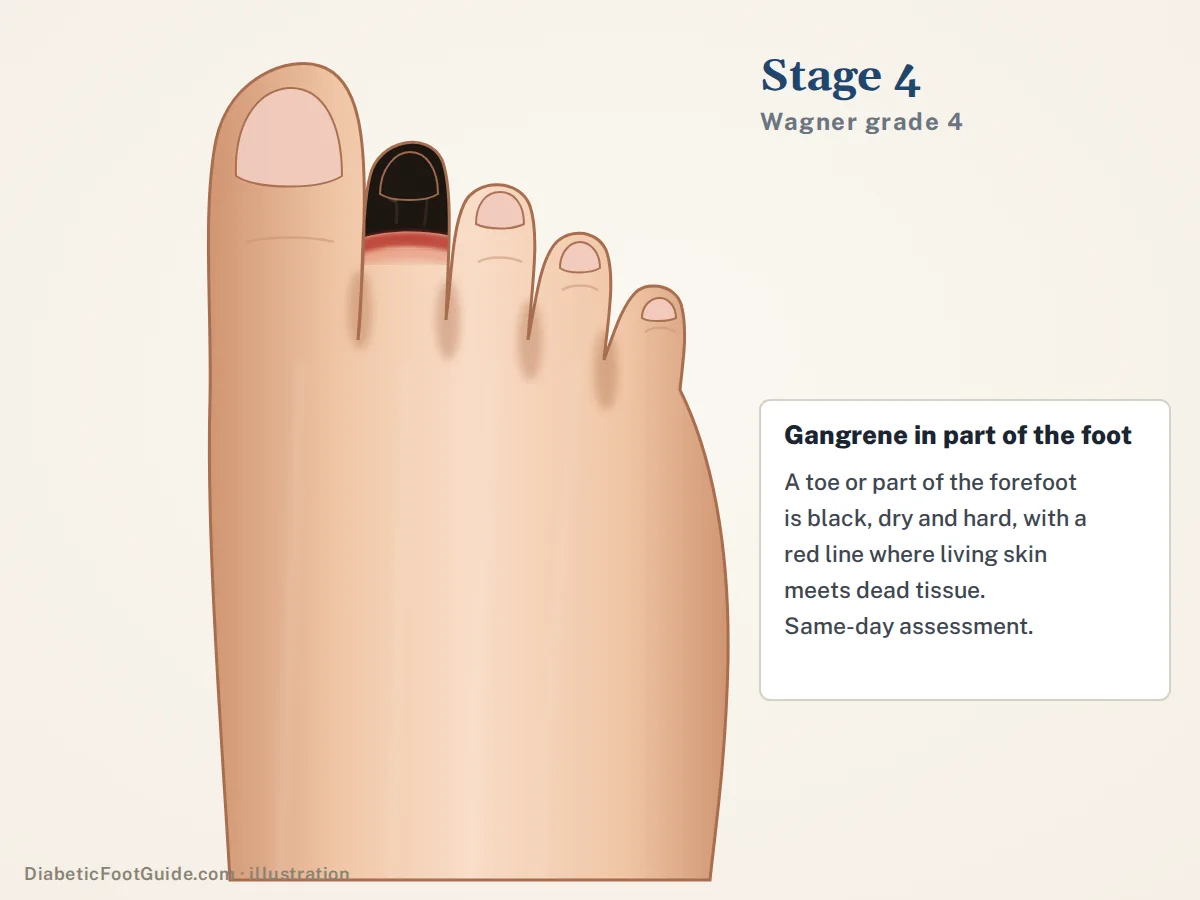
A black toe tip (gangrene)
Black, dry, shriveled tissue at the end of a toe, with a red rim where living tissue meets dead.
Urgency: Emergency department today, even if it is dry and painless.
What diabetic neuropathy looks like on the feet
Mostly, it doesn’t. Nerve damage is invisible, and up to half of people with diabetic peripheral neuropathy may have no symptoms. What shows are its consequences:
- Dry, cracking skin, as the nerves that drive sweating fail.
- Callus at pressure points, on a foot that cannot feel the rub.
- Clawed toes and prominent bones under the ball of the foot, from muscle wasting.
- Injuries and burns nobody felt: a blister from new shoes, a heating-pad burn, blood on a sock.
None of these proves neuropathy, and a normal-looking foot can still have lost protective sensation. Neuropathy is diagnosed by testing, not by looking: pinprick or temperature, vibration, and a 10-gram monofilament, the core of a diabetic foot exam.
On darker skin, color is a weaker clue
Where color is the main sign, the pictures above use lighter skin, where it shows most clearly. On darker skin, the redness of infection or Charcot can look purple, dark brown or barely different, and blood in a callus can look black. Pressure damage on darker skin also tends to be found at a later stage.
So compare what you can feel: warmth against the other foot, swelling, tight or shiny skin. One foot hotter or bigger matters more than color.
How urgent is what you are looking at?
Find the row that matches.
- Emergency department today
A black or dusky toe, redness spreading from a wound, pus or a foul smell, fever or chills, or a cold, pale foot.
This is not an appointment. Go now.
- Seen the same day
Red, swollen skin beside a nail, a blood-filled blister, blood inside a callus, or red, hot skin around a wound.
Call a podiatrist now; if nobody can see you today, the emergency department.
- Seen within days
One foot hot or swollen without a wound, a clear blister, or blood under a nail.
Call today, and keep weight off a hot, swollen foot.
- Seen this week
Any open sore, however small or painless, or split skin between the toes.
Book now, and bring a photo.
- Nothing wrong yet
Only the early pictures, with no open skin, heat or swelling.
Book a foot exam with sensation and circulation testing; keep up the daily check →
Common questions
What do diabetic feet look like in the early stages?
Usually unremarkable: dry, cracked heels, new callus and thicker nails, with shiny skin and shin spots later. The most important early change, lost feeling, is invisible; only testing finds it.
What does diabetic neuropathy look like on the feet?
The nerve damage itself is invisible. Its effects show: dry, cracking skin, callus at pressure points, clawed toes, and injuries or burns never felt. Testing, not looking, confirms it.
What are the first signs of diabetic foot problems?
Changed sensation usually comes first: numbness, tingling, burning, or feet that feel wrapped in cloth. The first visible signs are dry, cracked skin, new callus, and infections that are slow to clear.
What color are diabetic feet?
Usually normal. Red, hot and swollen suggests infection or Charcot (purple or dark brown on darker skin); pale when raised and deep red hanging down, poor circulation; brown shin patches, dermopathy; black, dead tissue or trapped blood.
Can you tell diabetes from someone’s feet?
No. No picture of a foot diagnoses diabetes, and every change here can happen without it. Diabetes is diagnosed with a blood test; if your feet show several of these changes and you have never had one, ask.
When should a diabetic foot be seen the same day?
Go to an emergency department today for black or dusky tissue, spreading redness, pus, a foul smell, fever or chills, or a cold, pale foot. Red, swollen skin beside a nail, a blood-filled blister, blood inside a callus, or red, hot skin around a wound needs seeing that day too.
Sources
Clinical literature retrieved from PubMed, plus the governing federal sources.
- Schaper NC, van Netten JJ, Apelqvist J, et al. Practical guidelines on the prevention and management of diabetes-related foot disease (IWGDF 2023 update). Diabetes Metab Res Rev. 2024;40(3):e3657. doi:10.1002/dmrr.3657 — callus leading to bleeding under the skin and then ulceration, the skin and deformity findings an at-risk foot is examined for, daily inspection including between the toes, infection signs blunted by neuropathy, and a red, hot, swollen foot raising active Charcot.
- American Diabetes Association Professional Practice Committee for Diabetes. 12. Retinopathy, Neuropathy, and Foot Care: Standards of Care in Diabetes—2026. Diabetes Care. 2026;49(Suppl 1):S261-S276. doi:10.2337/dc26-S012 — up to 50% of diabetic peripheral neuropathy being asymptomatic, dry and cracking skin as a sign of autonomic neuropathy, neuropathy assessed with pinprick or temperature, vibration and the 10-gram monofilament, rubor on dependency and pallor on elevation in arterial screening, and daily self-inspection with a mirror.
- Boulton AJM, Armstrong DG, Albert SF, et al. Comprehensive foot examination and risk assessment: a report of the Task Force of the Foot Care Interest Group of the American Diabetes Association, with endorsement by the American Association of Clinical Endocrinologists. Diabetes Care. 2008;31(8):1679-1685. doi:10.2337/dc08-9021 — the inspection findings (dryness, cracking, fungal infection between the toes, hemorrhage into callus, claw toes, prominent metatarsal heads, muscle wasting), and loss of protective sensation identified by testing.
- National Institute of Diabetes and Digestive and Kidney Diseases. Diabetes & Foot Problems. NIH. niddk.nih.gov — Diabetes & Foot Problems — checking the feet each evening, between the toes and with a mirror or a helper, a callus with dried blood inside as often the first sign of a wound under it, and burns from heating pads and hot water bottles on feet with nerve damage.
- Oozageer Gunowa N, Hutchinson M, Brooke J, Jackson D. Pressure injuries in people with darker skin tones: A literature review. J Clin Nurs. 2018;27(17-18):3266-3275. doi:10.1111/jocn.14062 — people with darker skin tones being more likely to develop higher-stage pressure injuries, possibly because early damage is not recognized.
Related guides
Toe color changes with diabetes
What red, purple, black or pale toes mean, and how urgent each one is.
The diabetic foot exam
The tests that find what no picture shows.
Brown spots on feet
Shin spots, and the dark marks that are not.
Non-diabetic foot ulcers
Venous, arterial and pressure ulcers look different.
Diabetic shoes and inserts
Where most pressure pictures here begin.
Seen something here, in Michigan?
Balance Foot & Ankle treats every stage shown here, from callus care to Charcot, in Howell and Bloomfield Hills. Bring your photos.

Dr. Tom Biernacki is a double board-certified podiatric foot and ankle surgeon practising in Michigan. He treats diabetic wounds, Charcot neuroarthropathy and at-risk feet daily, and writes here to put the clinical reasoning behind that care in front of the people living with it.