A free, printable 35-page guide from podiatrist Dr. Tom Biernacki: the 30-second daily foot check, the warning signs that can’t wait, what protects a foot that has stopped warning you, and four fillable pages to keep you on track.

Three speeds, so you never have to guess
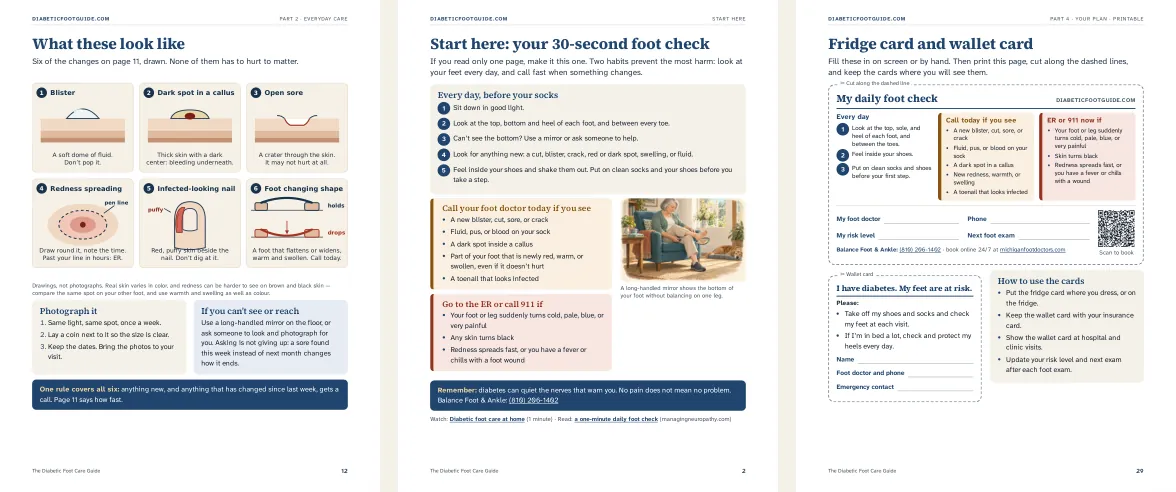
Most foot problems in diabetes start small and quiet. The guide sorts whatever you find into one of three speeds, on one page you can keep on the fridge.
- ER or 911 now
A foot that suddenly turns cold, pale or blue. Skin that turns black. Redness spreading fast, or fever or chills with a wound.
This is not an appointment. Go now.
- Call today
A blister, cut, crack or open sore. Fluid or pus on your sock. A dark spot inside a callus. New redness, warmth or swelling.
Call your foot doctor or diabetes team the same day.
- Next visit
New dry skin, corns, calluses or thick nails. Numbness or tingling that slowly gets worse.
Write it down and bring it to your next check-up.
Start with the one-page foot check
The 30-Second Daily Foot Check puts the guide’s daily habit on a single sheet: five steps before your socks go on, when to call your foot doctor and when to go to the ER, and a week of tick boxes for the fridge. Fill it in on screen or print it.
Download the Daily Foot Check (PDF, 1 page)
The full book, The Diabetic Foot Care Guide, is coming fall 2026.
What’s inside, in the order you’ll need it
| Topic | Pages |
|---|---|
| The 30-second daily foot check | 2 |
| When to call, and when to go to the ER | 4 |
| A hot, swollen foot, a new sore, and how wounds heal | 5–7 |
| Your risk level and what it means for check-ups | 9 |
| What the warning signs actually look like | 12 |
| Skin, nail, shoe and sock care | 13–15 |
| Foot pain: finding the cause, and what treatments show | 16–17 |
| Vitamins and supplements: what helps, what harms | 18 |
| Blood flow and healthy habits | 19–20 |
| What’s new: touch tests, sensors, GLP-1 medicines, and what to skip | 21–23 |
| A 7-day start, and four printable pages | 24–29 |
Who wrote it

Dr. Tom Biernacki, DPM, FACFAS, is a board-certified foot and ankle surgeon and the founder of Balance Foot & Ankle in Michigan. Ten years in practice, more than a hundred patients a week, and over two thousand surgeries, and most of his work goes into keeping people from needing one.
He wrote this guide for the patients he sees most: people whose feet have stopped warning them, and the families who help them check.
Questions people ask first
Is it really free?
Yes. There is no sign-up, nothing to buy in it, and no company paid to appear in it. Download it, print it, and share it with anyone who needs it.
I’m reading the book. Where are the printable pages?
Right here. If you have The Diabetic Foot Care Guide in paperback or on Kindle, the printable pages it mentions are all in this free PDF: the daily checklist (page 26), the 14-day habit tracker (page 27), the visit worksheet (page 28), and the fridge and wallet cards (page 29).
Do I have to be your patient?
No. Anyone can download it, anywhere. If you live near Howell or Bloomfield Township and want your feet checked, we’d be glad to see you, but that’s not the price of the guide.
Will it tell me what’s wrong with my foot?
No, and it doesn’t try to. It’s general education: it helps you spot changes early and know how fast to act. Anything new on a foot with diabetes should be looked at by your own care team. In an emergency, call 911.
Is it readable if my eyesight isn’t great?
That was a design requirement. It is set in Atkinson Hyperlegible, a typeface the Braille Institute designed for readers with low vision, with strong contrast throughout. The PDF also passes PDF/UA-1 accessibility validation, so a screen reader reads it in the right order, form fields included.
Need to be seen?
Balance Foot & Ankle checks feeling, blood flow, skin, nails, shoes and pressure points, then gives you a clear plan. Call (810) 206-1402.
Howell: 4330 E Grand River Ave, Howell, MI 48843
Bloomfield Township: 43494 Woodward Ave #208, Bloomfield Township, MI 48302