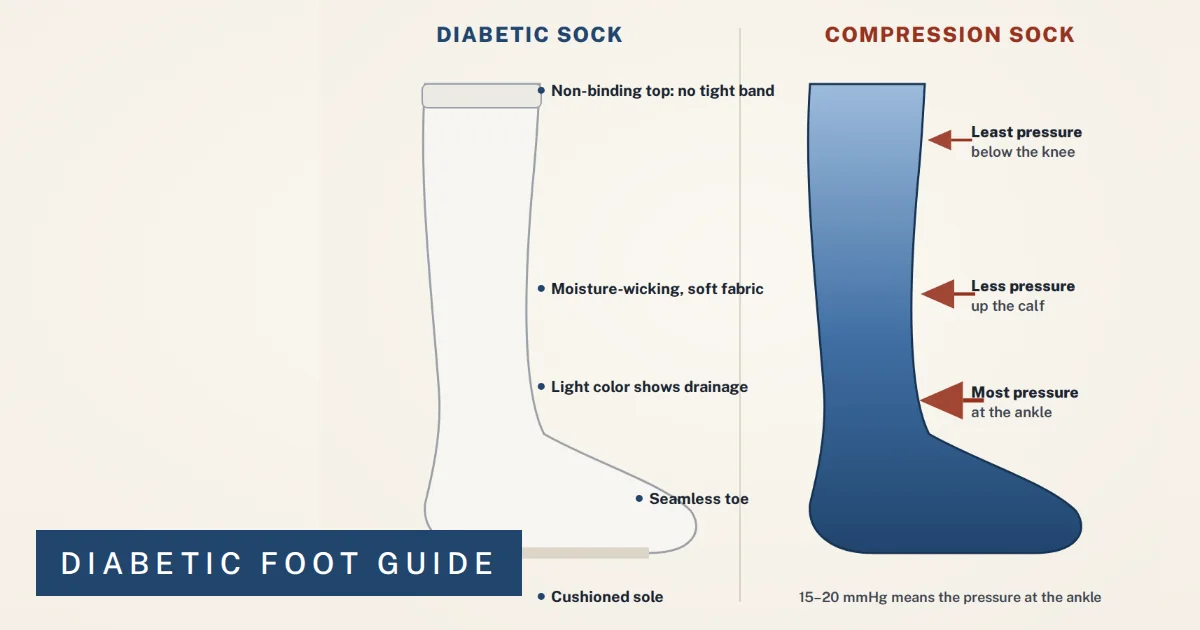
They sit on the same pharmacy shelf and do close to opposite jobs. A diabetic sock is built to leave the leg alone; a compression sock is built to squeeze it — and on a diabetic leg, the squeeze waits for a circulation check.
The short version
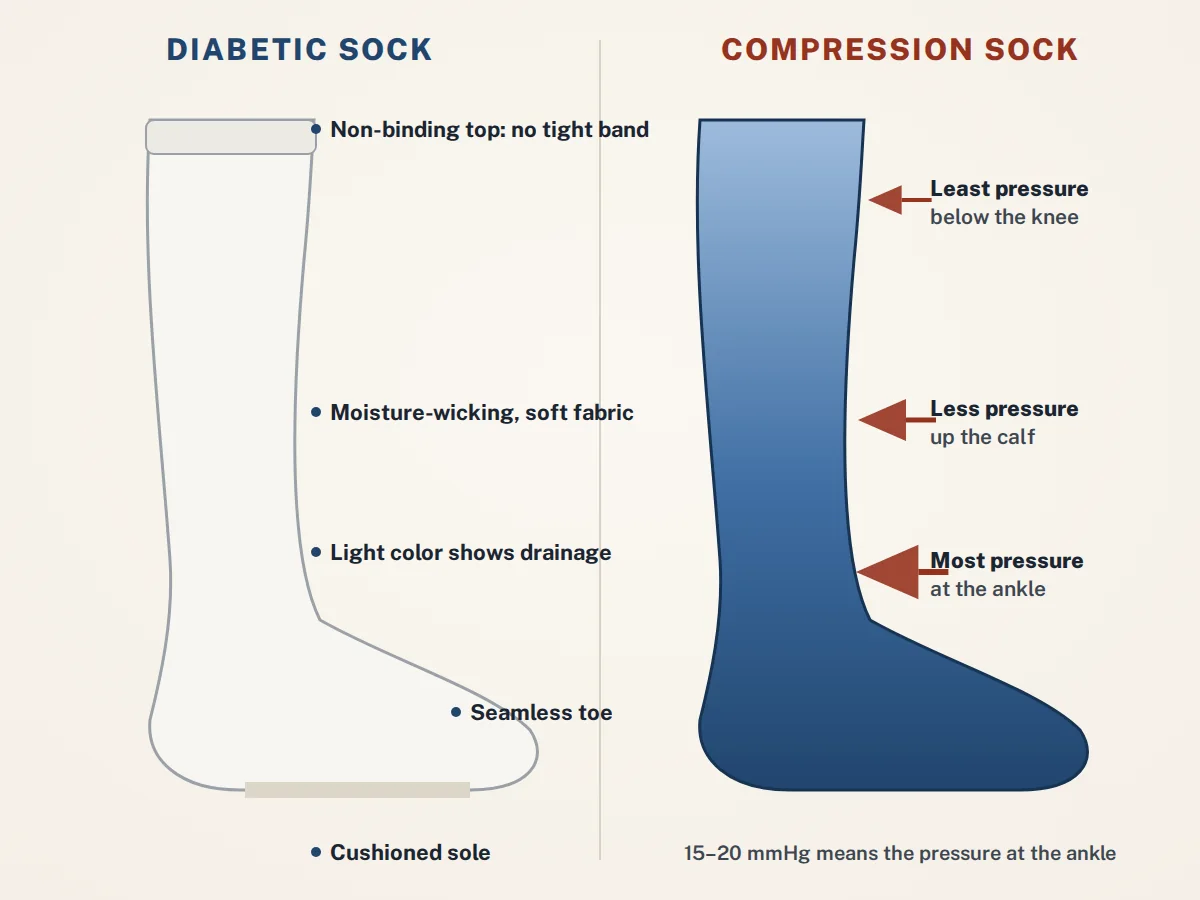
A diabetic sock protects skin that can no longer feel. It has no seam across the toes, a top that does not grip, a padded sole, fabric that stays dry, and usually a light color so drainage shows the day it appears.
A compression sock moves fluid. It applies graduated pressure, firmest at the ankle and easing up the calf, to push fluid back up the leg — a standard treatment for venous swelling, varicose veins, venous ulcers and lymphedema.
The safety line: compression goes on a diabetic leg only after circulation has been checked. Peripheral artery disease is common in diabetes and often painless, and calcified arteries can make an ankle-brachial index read normal when it is not — toe pressures and the toe-brachial index are the more trustworthy test.
Diabetic socks vs compression socks, side by side
| Diabetic sock | Compression sock | |
|---|---|---|
| Purpose | Protect skin that cannot feel rubbing, pressure or damp | Push venous fluid back up the leg |
| Pressure | None or minimal, deliberately | Graduated, printed in mmHg, firmest at the ankle |
| Fit and top band | Loose and non-binding; should leave no ring | Snug, usually knee-high, with a wide band that must lie flat |
| Fabric and build | Soft, wicking, seam-free toe, padded sole, light color | Firm elastic knit; may have a toe seam, usually no padding |
| Who it is for | Neuropathy, poor circulation, foot deformity or a past ulcer | Venous swelling, aching legs, varicose veins, a healed venous ulcer, lymphedema |
| Who should not wear it | No one, if it fits | Significant arterial disease, severe heart failure, an untreated leg infection — or circulation never checked |
| Cost and coverage | Out of pocket; Medicare’s shoe benefit does not include socks | Usually out of pocket; Medicare covers lymphedema garments and some stockings on an open venous ulcer |
And “diabetic compression socks”?
The hybrid: seam-free and padded, with mild graduated compression, usually 8–15 mmHg. Still compression, so the same condition applies.
Compression levels, and which need a clinician
Compression is labeled in millimeters of mercury (mmHg) at the ankle, in these US bands.
| Level | Often sold as | Typically used for | On a diabetic leg |
|---|---|---|---|
| 8–15 mmHg | Mild; “diabetic compression” | Tired legs, mild end-of-day puffiness | Reasonable once arterial disease has been ruled out |
| 15–20 mmHg | Moderate; support or travel socks | Standing jobs, long flights, mild swelling, early vein symptoms | After a circulation check; the usual starting point for swelling |
| 20–30 mmHg | Firm; often labeled medical grade | Varicose veins, venous swelling, after vein procedures | After a circulation check, chosen and measured with a clinician |
| 30–40 mmHg | Extra firm | Healed venous ulcers, severe venous disease, lymphedema | Prescribed and fitted, not a self-purchase |
The labels are tidier than the evidence: the international consensus would not tie most conditions to one exact pressure. In healthy volunteers, under 10 mmHg did nothing measurable; about 15 mmHg relieved symptoms and prevented swelling. After venous ulcers heal, firmer stockings trended toward fewer recurrences, but fewer people kept wearing them, and in every trial the people who wore theirs did best. The sock you put on every morning beats the stronger one in the drawer.
Should diabetics wear compression socks?
Can diabetics wear compression socks? Many can, and many should. Leg swelling is common in diabetes, and compression is the most effective treatment for swelling in people who are up and about. The obstacle is not the diabetes. It is the arteries.
Who usually benefits
- Ankles that swell by evening and settle overnight, once the cause has been looked into
- Heavy, aching legs and varicose veins
- A healed venous ulcer, which compression helps keep closed
- Some people with neuropathy whose feet swell from sitting — with a clinician’s agreement, low pressure and a nightly skin check
In a double-blind trial, 80 people with diabetes and leg swelling wore knee-high diabetic socks at 18–25 mmHg, or identical socks without compression, through waking hours for four weeks. Swelling fell modestly with compression, under a centimeter at calf and ankle, and ABI, TBI and skin perfusion held steady. The small print: only people with an ABI of at least 0.6 and a TBI of at least 0.3 could enroll, and the manufacturer paid for the study. It supports mild compression once severe arterial disease has been excluded — not compression for everyone.
Get assessed before compression if you have
- Peripheral artery disease. An international consensus treats an ABI below 0.6, ankle pressure below 60 mmHg or toe pressure below 30 mmHg as a contraindication to compression stockings. Below an ABI of 0.9, compression needs monitoring: non-healing skin breaks can develop even under low pressure.
- Severe or uncontrolled heart failure, such as breathlessness lying flat.
- A red, hot, swollen leg or foot. Infection needs treating; compression may be added alongside antibiotics, if the treating clinician agrees.
- An open wound or fragile skin under the sock. Venous ulcers are treated with compression — by a clinician, after the arteries are checked.
- Severe neuropathy with loss of sensation. The same consensus lists it as a contraindication to compression stockings: you cannot feel a band cutting in. Any compression becomes a clinician’s call.
The middle ground, stated plainly
Mild “diabetic compression” socks at 8–15 mmHg are a reasonable middle ground once arterial disease has been ruled out — and not before. Clinicians have traditionally capped diabetic socks at that band for exactly this reason.
Why a normal ABI is not enough
Peripheral artery disease affects 20 to 28% of people with diabetes and about half of those with a foot ulcer, often without the pain that would announce it, and palpable pulses do not rule it out. The ankle-brachial index has a blind spot: calcified artery walls resist the cuff, so the reading comes out higher than the blood flow justifies. Toe pressures are less affected. Disease is less likely with an ABI of 0.9 to 1.3, a toe-brachial index of 0.70 or more, and normal Doppler signals at the foot.
Which do I need?
Find the row that matches.
- Diabetic socks are enough
No swelling. The feet may be numb, dry or changing shape, but the legs are not puffy by evening.
Seam-free, non-binding, padded, light-colored socks. With normal feeling and circulation, a well-fitting regular sock does the same job.
- Compression, after the check
Ankles swell or legs ache, the cause has been looked into, and your circulation has been checked.
Graduated compression, often starting at 15–20 mmHg or a mild compression diabetic sock, chosen with whoever did the check.
- Get checked first
Swelling, and known artery disease — or nobody has ever checked.
Pulses, an ABI and toe pressures before anything tight goes on the leg. What the foot exam measures →
- A clinician decides
An open wound on the foot or leg, or one foot hot, red and swollen.
Do not start compression yourself. Be seen within days, and the same day with fever, spreading redness or discharge. One swollen foot →
How to wear compression socks safely
- Put them on first thing, before swelling builds: inside out to the heel, step in, ease up. Smooth every wrinkle; a fold becomes a ridge of pressure.
- Never fold or roll the top down: a doubled band acts as a tourniquet. And never wear two pairs at once, which has caused skin breakdown.
- Check your skin every evening, using a mirror if needed. A faint knit pattern is normal. A deep groove, a red or dark mark over the shin or ankle bone, or a blister means stop and get it checked.
- Expect the first week to feel tight. In the diabetic sock trial, comfort caught up with plain socks by week four. Pain, numbness or tingling is different — take them off.
- Take them off at night unless told otherwise. Lying flat removes the gravity they work against.
- Replace them when the elastic goes. A sock that slides on easily has stopped compressing; Medicare’s lymphedema benefit allows new daytime garments every six months.
How to choose diabetic socks
“Diabetic” on a label is a style, not a standard. Check what the sock does.
- No seam across the toes, or one flat enough to disappear; socks worn inside out work in a pinch.
- A top that does not grip. A ring by evening means too tight. International guidance advises against tight or knee-high socks unless compression has been prescribed with your foot care team.
- Padding under the heel and ball of the foot, if it does not crowd the shoe; it adds to a well-fitted shoe, never replaces one.
- Fabric that stays dry — merino wool, or blends made to wick. Damp skin splits and invites fungus.
- White or a light color, so blood or drainage shows the day it appears.
- A fit for the foot you have by evening: a swollen foot needs a wider sock, not a tighter one.
- A clean pair every day.
Does insurance cover them?
- Diabetic socks: generally not. Medicare’s therapeutic shoe benefit covers shoes and inserts, not socks.
- Lymphedema: since January 1, 2024, Medicare Part B has covered gradient compression garments prescribed for it, with the usual deductible and coinsurance.
- An open venous ulcer: certain stockings are covered as a dressing while it is treated — not for venous insufficiency alone, or to keep a healed ulcer closed.
- Everything else is usually out of pocket under Original Medicare; other plans vary, so ask before you order.
If you are buying today
For everyday protection, look for a seam-free toe, a cuff that leaves no ring, a cushioned sole and a light color.
See non-binding diabetic crew socks, light color on Amazon →
For the middle ground once your circulation has been checked, look for the pressure printed in mmHg, not just the word “compression.”
See mild 8–15 mmHg diabetic compression socks on Amazon →
For swelling, again only after a circulation check, look for graduated 15–20 mmHg knee-highs with a wide, flat top band, sized by ankle and calf measurement, not shoe size.
See 15–20 mmHg graduated compression socks (only after a circulation check) on Amazon →
Want names rather than criteria? The specific brands we recommend in clinic are on our practice site.
Common questions
What are diabetic socks?
Socks for feet that have lost some feeling or circulation: no toe seam, a non-constricting top, a padded sole, dry fabric, a light color and little or no pressure. Next to regular socks, those features matter once sensation, circulation or foot shape has changed.
What is the difference between diabetic socks and compression socks?
Diabetic socks protect the skin and avoid pressure on purpose. Compression socks apply graduated pressure, firmest at the ankle, to move fluid out of a swollen leg. Mild compression diabetic socks combine the two, and belong on a leg whose circulation has been checked.
Should diabetics wear compression socks?
Many should. Once the cause of the swelling has been looked into and circulation checked with pulses, an ABI and toe pressures, compression is the most effective treatment for it. In a randomized trial, mild compression diabetic socks reduced swelling modestly without reducing blood flow.
Can compression socks cut off circulation?
Very unlikely on a leg with healthy arteries, in the right size. The risk lies with significant artery disease and with misuse: a rolled top, two pairs at once, a size too small.
Are compression socks good for neuropathy?
They treat swelling, not the nerves, and that matters on a numb foot: a swollen foot outgrows its shoe. Numb skin cannot report a band that is too tight, so pressure stays low and the skin is checked nightly; with severe loss of sensation, stockings are generally avoided.
Can I sleep in compression socks?
Not unless told to. Lying flat removes the gravity compression works against, and a band that bunches overnight goes unnoticed. The exceptions: anti-clot stockings in hospital, and milder night garments prescribed for lymphedema.
Does Medicare cover diabetic socks?
Generally no: the therapeutic shoe benefit covers shoes and inserts, not socks. Medicare does cover compression garments prescribed for lymphedema, since January 1, 2024, and certain stockings used as a dressing on an open venous ulcer.
How many hours a day should I wear compression socks?
From getting up until bedtime, as in the diabetic sock trial, then off, with a skin check. If they still hurt after the first week or leave deep marks, the size or pressure is wrong.
Sources
Clinical literature retrieved from PubMed, plus the governing federal sources.
- Rabe E, Partsch H, Morrison N, et al. Risks and contraindications of medical compression treatment – A critical reappraisal. An international consensus statement. Phlebology. 2020;35(7):447-460. doi:10.1177/0268355520909066 — arterial checks before compression; the ABI, ankle and toe pressure contraindications; severe heart failure, compression alongside antibiotics in infection, and severe diabetic neuropathy; monitoring below an ABI of 0.9; injuries from rolled or doubled stockings; compression as the most effective edema treatment in mobile patients.
- Rabe E, Partsch H, Hafner J, et al. Indications for medical compression stockings in venous and lymphatic disorders: An evidence-based consensus statement. Phlebology. 2018;33(3):163-184. doi:10.1177/0268355516689631 — the uses of compression, and the pressure and adherence findings under the levels table.
- Wu SC, Crews RT, Skratsky M, et al. Control of lower extremity edema in patients with diabetes: Double blind randomized controlled trial assessing the efficacy of mild compression diabetic socks. Diabetes Res Clin Pract. 2017;127:35-43. doi:10.1016/j.diabres.2017.02.025 — 18–25 mmHg diabetic socks modestly reducing swelling without lowering ABI, TBI or skin perfusion; the entry criteria, funding and comfort ratings; working up the cause of swelling first; the traditional 8–15 mmHg ceiling.
- Fitridge R, Chuter V, Mills J, et al. The intersocietal IWGDF, ESVS, SVS guidelines on peripheral artery disease in people with diabetes and a foot ulcer. Diabetes Metab Res Rev. 2024;40(3):e3686. doi:10.1002/dmrr.3686 — how common PAD is, neuropathy masking it, calcification raising ankle pressures, and the ABI and TBI values that make PAD less likely.
- Schaper NC, van Netten JJ, Apelqvist J, et al. Practical guidelines on the prevention and management of diabetes-related foot disease (IWGDF 2023 update). Diabetes Metab Res Rev. 2024;40(3):e3657. doi:10.1002/dmrr.3657 — seam-free socks, no tight or knee-high socks, and compression prescribed only with the foot care team.
- Centers for Medicare & Medicaid Services. Lymphedema Compression Treatment Items: Implementation. MLN Matters MM13286 (revised July 18, 2024). CMS MLN Matters MM13286 (PDF) — Part B coverage of lymphedema compression garments from January 1, 2024, night garments, and six-monthly replacement.
- Centers for Medicare & Medicaid Services. Surgical Dressings — Policy Article A54563. CMS Policy Article A54563 — compression stockings covered as a dressing only on an open venous stasis ulcer, not for venous insufficiency, prevention or healed ulcers.
Related guides
Swollen feet and diabetes
When one swollen foot is urgent.
The diabetic foot exam
The toe pressures that clear you for compression.
Non-diabetic foot ulcers
Why compression helps one ulcer and harms another.
Diabetic shoes and inserts
What the sock sits inside.
Diabetic foot care products
The short list that does the work.
Swollen legs and diabetes, in Michigan?
Balance Foot & Ankle checks circulation, including toe pressures, and works out why legs are swelling before compression goes on, in Howell and Bloomfield Hills.

Dr. Tom Biernacki is a double board-certified podiatric foot and ankle surgeon practising in Michigan. He treats diabetic wounds, Charcot neuroarthropathy and at-risk feet daily, and writes here to put the clinical reasoning behind that care in front of the people living with it.