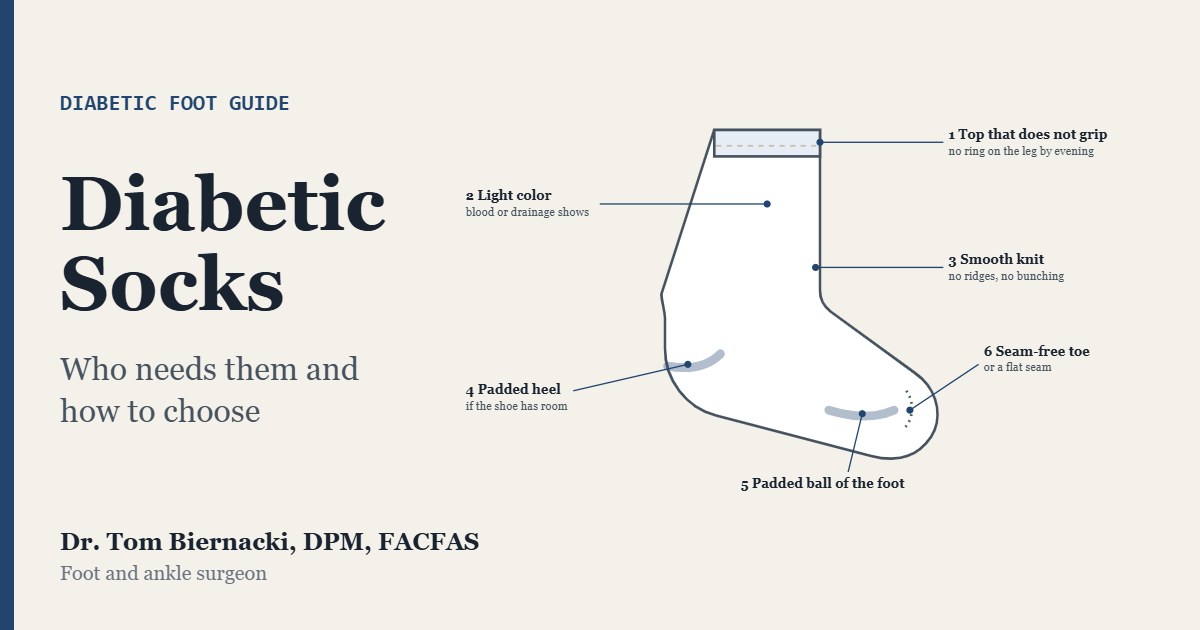
Diabetic socks are socks built not to hurt a foot that may not feel: no ridge of seam across the toes, a top that does not grip the leg, padding under the heel and ball, fabric that stays dry, and usually a light color so blood or drainage shows. If diabetes has dulled the feeling or circulation in your feet, they are worth wearing every day. If your feet test normal, a well-fitting, seam-free regular sock does the same job.
The short version
“Diabetic” on a sock label is a style, not a standard: there is no agreed definition of which features a diabetic sock must have, and a 2026 systematic review found the clinical evidence behind them limited and of poor quality. What the guidance does agree on is simple. Wear socks with your shoes at all times, never go barefoot or in socks alone, choose clean, lightly padded socks that fit well with no seams, and avoid tight tops and elastic that squeeze the leg.
Who benefits most: anyone with nerve damage (lost feeling), poor circulation, a foot deformity, or a past ulcer or amputation. A diabetic sock is not a compression sock; compression on a diabetic leg waits for a circulation check. And a sock is also a daily report: a spot of blood or a dark stain on it is a same-day call to your foot doctor.
What makes a sock a diabetic sock
Each feature closes off one way a sock can injure a foot that cannot feel a problem starting: rubbing over a seam, pressure under a bony spot, damp skin splitting, or a band cutting into a swollen leg.
| Feature | Why it matters | What the evidence says |
|---|---|---|
| No seam across the toes, or a flat one | A raised seam rubs the same spot on the toes with every step; on a numb foot nothing tells you to stop. | Federal (NIDDK) and international (IWGDF) foot-care advice both call for socks without seams; worn inside out, a seamed sock works in a pinch. |
| A top that does not grip | A tight band or elastic squeezes a leg that may already swell or be short of blood. | NIDDK: no tight socks or elastic stockings, and no rubber bands to hold up loose socks. IWGDF: no tight or knee-high socks unless compression is prescribed with your foot care team. |
| Padding under the heel and ball | High pressure under the forefoot is a known path to ulcers on a neuropathic foot. | Small studies: padded socks cut peak forefoot pressure by 15 to 18% over six months, and multilayer socks cut total foot pressure by 9%. No good-quality trial has shown fewer ulcers. |
| Fabric that stays dry | Damp skin softens, splits between the toes and invites athlete’s foot. | Laboratory work only: fiber blend and knit change how socks handle moisture. No clinical comparison of fibers. |
| White or a light color | A blister that breaks or a sore that drains leaves a mark you see the day it happens, even if you feel nothing. | A practical clinic rule, not a trial result. |
| A fit for your foot by evening | Too small bunches or squeezes; too big folds into ridges. | NIDDK: clean, lightly padded socks that fit well. |
What the label does not tell you
A 2026 systematic review examined 17 socks sold for people with diabetes and found no common agreement on which combination of fibers, yarns and knit makes a diabetic sock. Antimicrobial finishes on yarns can limit germ growth in laboratory tests, but socks marketed with new types of fiber had no clinical evidence behind their claims. Buy the features above, not the claim.
Do you need diabetic socks?
It depends on your feet, not on the diagnosis. The international guideline sorts people with diabetes by foot risk, mainly loss of protective sensation (nerve damage that stops you feeling injuries) and peripheral artery disease (poor circulation). Find your row:
| Your feet | Socks |
|---|---|
| Normal feeling and circulation, no deformity, no past ulcer | Any clean, well-fitting, seam-free sock with a soft top. Diabetic socks are optional. |
| Lost feeling, or poor circulation | Diabetic socks every day: seam-free, non-binding, padded, light-colored. |
| Either of those plus a bunion, hammertoes, Charcot foot or other deformity | Diabetic socks thin enough to fit inside extra-depth shoes; padding must not crowd the shoe. |
| A past ulcer or amputation, or on dialysis | Diabetic socks, white or light, checked for marks every night; socks and shoes chosen with your podiatrist. |
| Swollen ankles or legs | A wider, non-binding sock, never a tighter one. Compression only after your circulation has been checked; see diabetic socks vs compression socks. |
“My feet feel fine” is not the test. Nerve damage can be present without symptoms, and the only way to know your row is a diabetic foot exam: a 10-gram monofilament or similar touch test, plus a check of your foot pulses, at least once a year.
Do diabetic socks actually work?
They do what they are designed to do, which is remove friction and pressure. Whether that prevents ulcers has not been shown in any good-quality trial. The honest summary:
Padding lowers pressure
Ten people with neuropathy and high foot pressures wore padded socks for six months: peak forefoot pressure stayed 15.5% lower at three months and 17.6% lower at six. Padded sports socks, tested once against bare feet, lowered pressure by 10 to 17%.
Layers spread the load
In 19 people with neuropathy, multilayer socks increased the area of the sole in contact inside the shoe by 11 cm² and lowered total foot pressure by 9%, compared with ordinary socks.
The gap
Two systematic reviews, in 2015 and 2026, found the evidence limited and the trials small or of poor quality. Nobody has shown fewer ulcers or amputations from socks alone.
So socks are one layer of protection, not a substitute for the others: well-fitting or diabetic shoes, a daily look at your feet, and nail and callus care by a podiatrist if your feet have lost feeling or circulation.
How to choose diabetic socks for your feet
Numb feet (neuropathy)
Seam-free toe, padding under the heel and ball, light color. Check inside each sock for lint balls or snags before it goes on; you will not feel them.
Sweaty feet or athlete’s foot
Wool or a synthetic wicking blend rather than all-cotton, and a fresh pair every day, twice if they get damp. Dry between the toes before socks go on; see itchy feet with diabetes.
Swelling
A wide, soft top and a sock sized for your foot at the end of the day. A deep ring on the leg means too tight. For compression, see swollen feet and diabetes.
Poor circulation
Warmth without squeeze: a thicker, non-binding sock, and socks in bed if your feet get cold. No heating pads or hot-water bottles. See poor circulation in the feet.
Dry, cracked heels
A soft, padded heel, and cream on the soles and tops at night, never between the toes. See dry and cracked feet.
Deformity or a past ulcer
Thin enough to fit your extra-depth shoe or inserts without crowding them. If your shoes were fitted with one sock, keep wearing that thickness.
Men’s or women’s, crew or ankle, cotton or wool
- Men’s vs women’s is mostly a size range and a color choice. Buy by the brand’s size chart for your shoe size, and size up if your feet swell or are wide.
- Crew vs ankle: crew socks protect the shin and ankle from the shoe collar and are warmer; ankle socks suit warm weather and low shoes. Either works if the top does not grip.
- Cotton vs wool vs synthetic: cotton is soft but holds sweat; merino wool and wicking synthetics stay drier. Many diabetic socks are blends.
- White vs dark: white or light shows blood and drainage. If you prefer dark socks, check the inside of each sock at night.
- Toe socks: they keep skin between the toes apart and dry, but each toe has its own seams; fine on feeling feet, a question for your podiatrist on numb ones.
How to wear them
- Socks with shoes at all times, indoors too. NIDDK warns against walking barefoot or in socks alone, and the international guideline adds no thin-soled slippers on at-risk feet.
- A clean pair every day, and more often if they get damp. About seven to ten pairs covers a week plus wash days.
- Smooth before your shoe goes on: no wrinkles under the foot, the heel of the sock on your heel. A fold becomes a pressure ridge.
- Never hold socks up with rubber bands, and do not fold or roll the top down.
- Socks in bed if your feet get cold, as NIDDK suggests; a loose, non-binding pair.
- Replace them when they thin, pill or lose shape. A hole worn in the same spot on every pair points to a pressure spot in your shoe or foot: have it looked at.
- Check the socks when they come off, as well as your feet. That is the point of a light color.
What a sock can tell you
Blood, a dark stain or yellow-green drainage on the sock: something under it has broken open; look, and call your foot doctor the same day. A deep ring or groove on the leg: too tight; change the sock and watch the skin. A red or shiny mark that is still there 30 minutes after the shoe comes off: pressure; the shoe or the sock needs changing before it becomes a blister.
Diabetic socks vs compression socks
They do close to opposite jobs. A diabetic sock is built to leave the leg alone; a compression sock squeezes it, firmest at the ankle, to move fluid back up the leg. “Diabetic compression socks” combine the two at a mild pressure, often 8–15 or 15–20 mmHg. In a double-blind trial, 80 people with diabetes and leg swelling wore knee-high diabetic socks at 18–25 mmHg or identical socks without compression; swelling at the calf and ankle fell with compression and measures of circulation held steady, but only people without severe artery disease could take part.
So compression on a diabetic leg comes after a circulation check, never before. Which one you need, the pressure levels, and who should not wear compression are in diabetic socks vs compression socks.
Cost, Medicare and HSA
- Original Medicare: generally no. The Part B therapeutic shoe benefit for people with diabetes and severe diabetic foot disease covers one pair of extra-depth or custom shoes and two or three pairs of inserts a year. Socks are not part of it. See diabetic shoes and Medicare.
- Medicare Advantage and other plans: some offer over-the-counter allowances that can include diabetic socks; check your plan’s catalog before you buy.
- HSA and FSA: diabetic socks are often eligible; ask your plan administrator, and keep the receipt.
- Price: a multi-pack usually costs a few dollars a pair. Paying more buys durability and fit, not protection the features above do not already give.
How soon to be seen
Find the first row that matches.
- Emergency department now
Redness spreading up the foot or leg, fever or chills, a foul smell, skin turning black or blue, or a foot that is suddenly cold, pale or very painful.
Go now and say you have diabetes. A suddenly cold, pale foot is a 911 call.
- Seen the same day
Blood, a dark stain or drainage on your sock; a blood blister, or blood or a dark spot inside a callus; any open spot on a foot with nerve damage or poor circulation; or new swelling, warmth or redness in one foot or leg.
Call a podiatrist or your doctor today, or urgent care if nobody can see you. Keep it covered and stay off it until then.
- Seen within days
A red mark or blister from a sock or shoe that is not settling, or a sock that wears through in the same spot every time.
Call now and be seen this week; bring the socks and shoes you wear. In Michigan? Book here →
- At a routine visit
You have never had your feet tested for feeling and pulses, or you are not sure which socks and shoes suit your feet.
Book a diabetic foot exam and ask which risk group you are in.
Free: the 30-Second Daily Foot Check. Your socks are the second half of the nightly check; your feet are the first. This one printable page from Dr. Tom Biernacki lists five steps to do before your socks go on, says when to call your foot doctor and when to go to the ER, and gives you a week of tick boxes for the fridge.
ER or 911 now, not a download: a foot or leg that is suddenly cold, pale, blue or very painful; any skin turning black; redness spreading fast, or fever or chills with a foot wound.
Download the Daily Foot Check (PDF, 1 page)
Coming fall 2026: The Diabetic Foot Care Guide, Dr. Tom’s book.
Common questions
What are diabetic socks?
Socks designed not to injure a foot with reduced feeling or circulation: no raised toe seam, a top that does not grip, padding under the heel and ball, moisture-handling fabric and usually a light color. There is no official standard, so check the features rather than the label.
What is the difference between diabetic socks and regular socks?
A regular sock may have a raised toe seam, a tight elastic top and no padding. On a foot that feels normally that rarely matters; on a numb foot the seam and the band can rub or squeeze unnoticed. A seam-free regular sock with a soft top is close to a diabetic sock.
Who should wear diabetic socks?
Anyone with diabetes whose feet have lost feeling or circulation, or who has a foot deformity, a past ulcer or amputation, or swelling. With normal foot exams, they are optional.
Can people without diabetes wear diabetic socks?
Yes. They suit anyone with swollen feet, sensitive skin, neuropathy from another cause, or a dislike of tight sock tops.
Do diabetic socks help neuropathy?
They do not treat the nerve damage or its pain. They protect a numb foot from friction and pressure it cannot feel, which is where neuropathic ulcers start.
Are diabetic socks compression socks?
No. Standard diabetic socks are deliberately non-compressive. “Diabetic compression socks” add mild compression and should be worn only after your circulation has been checked.
Should diabetics wear socks to bed?
Yes, if your feet get cold: a loose, non-binding pair is safer than a heating pad or hot-water bottle, which can burn a numb foot.
Does Medicare pay for diabetic socks?
Original Medicare generally does not; its therapeutic shoe benefit covers shoes and inserts, not socks. Some Medicare Advantage plans include them in an over-the-counter allowance.
Who should not wear diabetic socks?
A plain, non-binding diabetic sock that fits suits almost everyone. The caution is for the compression versions, which need a circulation check first in anyone with diabetes, and for bulky padding that crowds a tight shoe.
Sources
Clinical guidelines, systematic reviews, trials and the federal source cited on this page.
- National Institute of Diabetes and Digestive and Kidney Diseases. Diabetes and Foot Problems. NIH. niddk.nih.gov — Diabetes and Foot Problems — shoes and socks at all times, no barefoot or socks-only walking; clean, lightly padded, well-fitting socks, seamless best; no tight socks, elastic stockings or rubber bands; socks in bed for cold feet; no heating pads or hot-water bottles.
- Schaper NC, van Netten JJ, Apelqvist J, et al. Practical guidelines on the prevention and management of diabetes-related foot disease (IWGDF 2023 update). Diabetes Metab Res Rev. 2024;40(3):e3657. doi:10.1002/dmrr.3657 — risk groups; socks without seams or worn inside out; no tight or knee-high socks unless compression is prescribed with the foot care team; changing socks daily; no barefoot walking, socks alone or thin-soled slippers.
- Venkatraman PD, Orlando G, Culmer PR, et al. Diabetic socks: a systematic review of the literature and commercially available products. Diabetes Metab Res Rev. 2026;42(2):e70138. doi:10.1002/dmrr.70138 — 17 commercial socks; no common understanding of required features; limited evidence and poor-quality trials; antimicrobial finishes in the laboratory; no clinical evidence for new-fiber claims.
- Otter SJ, Rome K, Ihaka B, et al. Protective socks for people with diabetes: a systematic review and narrative analysis. J Foot Ankle Res. 2015;8:9. doi:10.1186/s13047-015-0068-7 — 7 of 81 articles eligible; limited support for padded socks, mainly through plantar pressure reduction.
- Veves A, Masson EA, Fernando DJ, Boulton AJ. Studies of experimental hosiery in diabetic neuropathic patients with high foot pressures. Diabet Med. 1990;7(4):324-326. doi:10.1111/j.1464-5491.1990.tb01398.x — 10 patients; forefoot pressure 15.5% lower at 3 months and 17.6% at 6 months; commercial padded sports socks 17.4% and 10.4% (high- and medium-density padding) versus barefoot.
- Garrow AP, van Schie CHM, Boulton AJM. Efficacy of multilayered hosiery in reducing in-shoe plantar foot pressure in high-risk patients with diabetes. Diabetes Care. 2005;28(8):2001-2006. doi:10.2337/diacare.28.8.2001 — 19 patients with neuropathy; contact area up 11 cm²; total foot pressure down 9%; effect on ulcers untested.
- Wu SC, Crews RT, Skratsky M, et al. Control of lower extremity edema in patients with diabetes: double blind randomized controlled trial assessing the efficacy of mild compression diabetic socks. Diabetes Res Clin Pract. 2017;127:35-43. doi:10.1016/j.diabres.2017.02.025 — 80 randomized; 18–25 mmHg knee-high socks reduced calf and ankle swelling without compromising circulation.
- Centers for Medicare & Medicaid Services. Therapeutic shoes & inserts. Medicare.gov. medicare.gov — Therapeutic shoes & inserts — one pair of extra-depth or custom shoes and two or three pairs of inserts a year for diabetes with severe diabetic foot disease; 20% after the Part B deductible. The benefit lists shoes, inserts and shoe modifications only.
Related guides
Diabetic socks vs compression socks
Which you need, and the circulation check that comes first.
Diabetic shoes and inserts
What the sock sits inside, and what Medicare pays for.
The diabetic foot exam
The test that tells you which row you are in.
Blisters on diabetic feet
What to do when a sock or shoe has rubbed.
Swollen feet and diabetes
When one swollen foot is urgent.
Diabetic foot care products
The short list that does the work.
Socks, shoes and a foot exam in Michigan
A foot exam tells you whether you need diabetic socks and shoes at all, and which ones. Balance Foot & Ankle sees patients in Howell and Bloomfield Township.

Dr. Tom Biernacki is a double board-certified podiatric foot and ankle surgeon practising in Michigan. He treats diabetic wounds, Charcot neuroarthropathy and at-risk feet daily, and writes here to put the clinical reasoning behind that care in front of the people living with it.