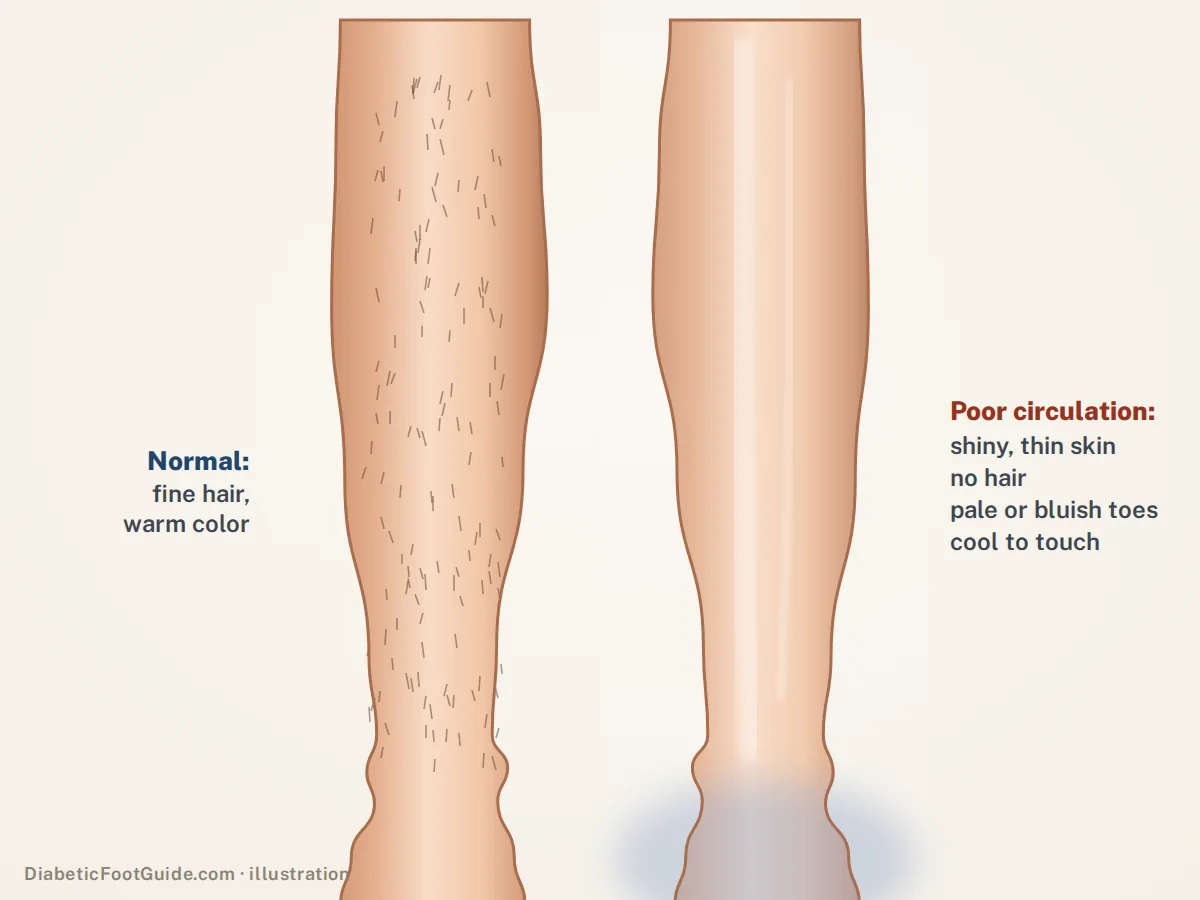
On a numb foot, color is often the first warning. Red, purple, black, yellow and pale point to different problems — on clocks that run from your next routine visit to a 911 call.
The short version
Red usually means inflammation. One warm, red, swollen area or foot is infection or Charcot foot until proven otherwise — same day if it is spreading, there is a wound, or you feel unwell. The exception is a foot that is red when it hangs down and pale when raised: a sign of severely reduced blood supply.
Purple, blue and pale mean blood is not getting through. Black means dead tissue or trapped blood. Yellow is usually callus, nails or diet — unless the whites of your eyes are yellow too.
A toe that darkens over hours or days needs to be seen the same day. A foot that suddenly turns cold, pale, painful or numb is an emergency: call 911.
What each toe color usually means
Color is a clue, not a diagnosis. Three questions sharpen it: one foot or both, warm or cool, sudden or gradual. On darker skin, redness can look purple or brown, so warmth and swelling are more reliable. Photographs are in diabetic feet pictures.
| Color | What it usually means | How urgent | Guide |
|---|---|---|---|
| Red, warm, swollen, one foot | Infection; Charcot if numb with no wound | Same day if spreading or a wound; Charcot within days | Infection, Charcot |
| Red hanging down, pale raised | Dependent rubor: severe arterial disease | Urgent vascular assessment | Foot exam |
| Pink-red, warm, dry, both feet | Autonomic neuropathy | Next routine visit | Diabetic feet |
| Red patch where a shoe presses | Pressure or friction | Change the shoe today | Early ulcers |
| Purple or blue, cool | Peripheral arterial disease | Prompt check; urgent with a wound | Foot exam |
| Toe suddenly blue or purple | Tiny emboli in small arteries | Same day | Pictures |
| Black toe or black skin | Gangrene | Emergency | Gangrene |
| Dark spot in callus or under nail | Bleeding from pressure you did not feel | Within days | Early ulcers, Toenails |
| Yellow, eyes still white | Callus, fungal nails or diet | Routine | Toenails |
| Suddenly pale, white and cold | Acute limb ischemia: a blocked artery | Call 911 | — |
Why diabetes changes the color of your feet
Four processes cause most of it, often together. More in what diabetes does to feet.
Narrowed arteries
Less blood reaches the toes: pale, dusky or purple, cool, hairless skin. About half of people with a diabetic foot ulcer have it.
Nerve damage
No pain to warn you. Autonomic nerve damage also stops sweating and alters small-vessel control, leaving feet warm, pink and dry.
Infection
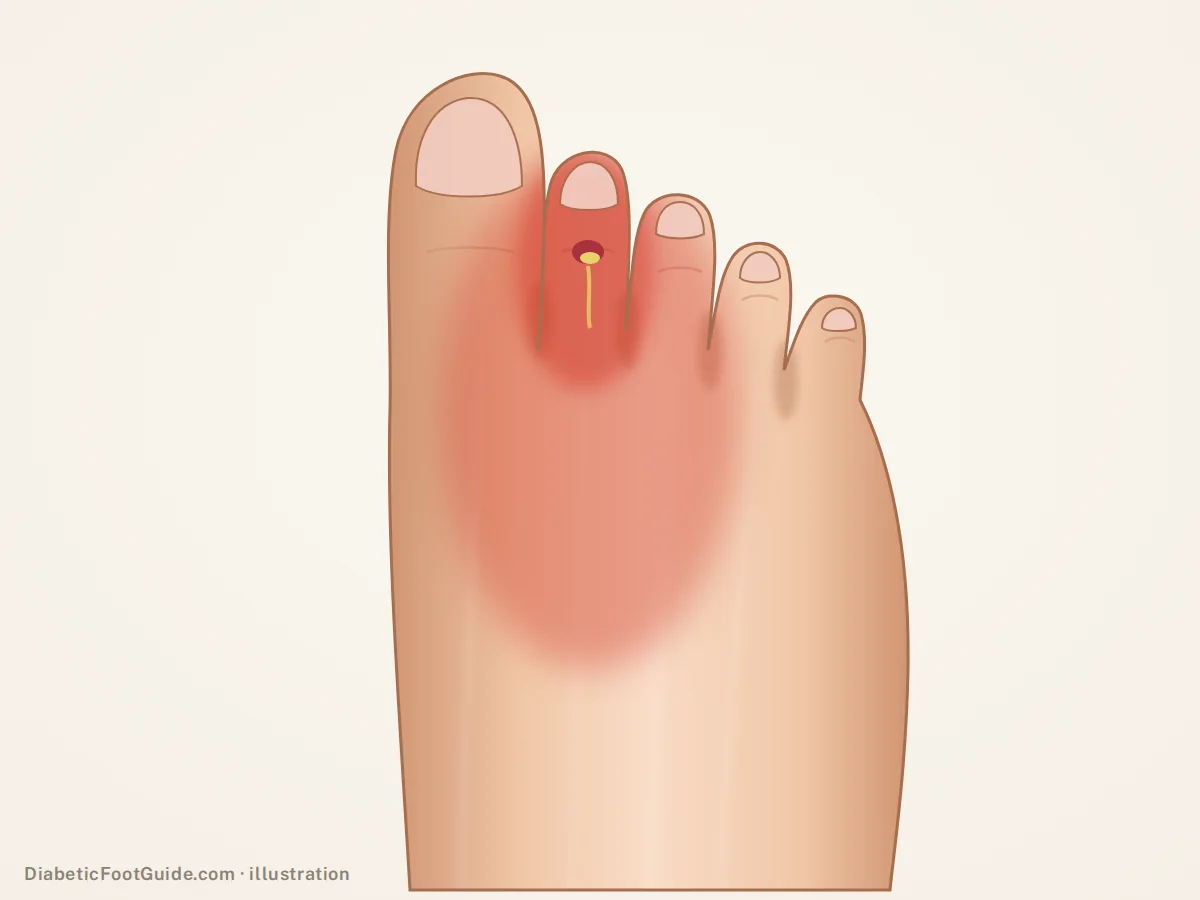
Redness, warmth and swelling spreading from a break in the skin, often with little pain and no fever.
Charcot foot
Inflamed bones and joints in a numb foot: hot, red and swollen, and easily mistaken for infection or gout.
Red toes, red feet and red soles
One warm, red, swollen area or foot. Redness spreading from a crack, blister, nail edge or wound is infection until proven otherwise: same day, or an emergency department if you have a fever or feel unwell. With no wound, on a numb foot, think Charcot foot: hot and swollen, yet often only mildly painful. Keep weight off it and be seen within days; walking on it can collapse the arch. A hot, very painful big-toe joint is often gout, though infection must be ruled out.
Red hanging down, pale when raised. This is dependent rubor: starved of blood, the foot’s small vessels stay wide open, filling red when it hangs and draining when it is raised. It can look healthy, especially in someone who dangles the leg over the bed at night to ease pain. It means severe arterial disease and needs urgent vascular assessment.
Warm, pink, dry feet on both sides. Autonomic neuropathy stops sweating and alters blood flow in the skin. Not an emergency, but a sign the neuropathy is established: check daily, and moisturize, though not between the toes.
Red soles. Usually pressure on the ball and heel. Redness that fades once the shoes are off is ordinary load; redness that returns to one spot, or will not fade, is how an ulcer begins. Red soles can also be a rash, athlete’s foot, or a heating-pad burn a numb foot did not feel — if it is not clearly pressure, have it looked at.
Early stage red feet with diabetes: what it usually means
Red feet are not a reliable early sign of diabetes itself — that takes a blood test. On a diabetic foot, though, redness is often the earliest visible stage of three problems, and the easiest point to stop each. (Dependent rubor is the exception: a late sign.)
- Pressure — redness comes before callus, blister and ulcer.
- Charcot foot — warm, red and swollen while X-rays can still look normal. MRI shows it first, and offloading now aims to prevent deformity.
- Infection — redness around a small crack, before pus or fever.
Compare both feet daily
Put the back of a hand on each foot at the same spot. One foot redder or warmer than the other is a finding; on a numb foot, have it examined within days.
Purple, blue or dark toes: is it circulation?
Gradual purple or blue. Cool, dusky or purple feet that are slow to pink up after pressing, with shiny skin, lost hair and weak pulses, have poor arterial flow until measured otherwise. In diabetes, calcified arteries can make an ankle-brachial index read falsely normal, so toe pressures and Doppler waveforms are added. Feet that feel cold are not always circulation; neuropathy can do it too (see Does diabetes make you cold?).
Sudden blue or purple toe. A toe that turns blue or purple over hours, often painfully and with pulses still present, can be blue toe syndrome: fragments of cholesterol or clot lodging in the smallest arteries, sometimes after a catheter procedure. Be seen the same day; more can follow.
A bruise or blood under a nail on a numb foot usually means a knock or shoe pressure you did not feel — which is the real finding. See diabetic toenails.
Two checks a clinician may do
Elevation test: lying flat, your leg is raised to about 45 degrees for a minute. A poorly supplied foot drains pale, then colors slowly and flushes deep red once you sit and let it hang. A clearly positive test suggests more severe disease.
Capillary refill: a toe is pressed until it blanches, and color should return within a few seconds. Both checks are rough — a cold room or darker skin can mislead — and neither replaces measured pressures.
For swollen legs, the video covers what helps — but on a cool, purple foot, arterial supply should be checked before any compression (see diabetic socks vs compression socks).
Black or very dark toes
Black skin or a black toe is gangrene until proven otherwise. Dry gangrene is hard and shrunken. Wet gangrene is swollen, discharging or foul-smelling, with spreading redness, and can move within hours. Wet or spreading gangrene means the emergency department today; new dry gangrene, the same day.
A dark spot inside a callus is bleeding under it — a pre-ulcer, and there may be a wound underneath. No cutting and no corn plasters: have it removed professionally within days.
Black under a nail is usually dried blood. A new or widening dark streak along a nail is usually harmless pigment, but needs examining, not waiting out.
Yellow feet with diabetes
- Callus — thick yellow skin over pressure points; a professional job to remove.
- Fungal nails — thick, yellow-brown and crumbling, pressing on the nail bed.
- Carotenemia — yellow-orange soles and palms from lots of carrots, sweet potato or squash. The eyes stay white; harmless.
- Necrobiosis lipoidica — shiny, yellow-brown patches, usually on the shins, more common in diabetes; a dermatologist should see it. Small brown shin spots are more often diabetic dermopathy.
- Yellow skin and yellow eyes — jaundice. See a doctor promptly.
Call 911: a foot that suddenly turns pale or cold
Sudden coldness, paleness, pain, numbness or weakness in a foot can mean a blocked artery — acute limb ischemia. Treatment is measured in hours. Do not book an appointment or wait for it to pass.
When to be seen
- Same day: spreading redness, a wound, pus, a smell or a fever
- Same day: a toe turning blue, purple or black
- Urgently, within days: red hanging down and pale raised, or night pain eased by dangling the leg
- Within days, weight off it: one hot, red, swollen foot with no wound
- Within days: a dark spot in a callus
Common questions
Why are my toes red with diabetes?
Usually shoe pressure, infection from a small break in the skin, or Charcot foot. One warm, red, swollen toe or foot needs seeing promptly; toes red only when the feet hang down point to arterial disease.
What does a purple toe mean with diabetes?
Gradual purple with a cool foot usually means poor arterial flow, which needs measuring. Sudden, painful purple can mean tiny emboli: same day. After an unnoticed knock, it may be a bruise.
Is a change in toe color always a circulation problem?
No. Infection, Charcot foot, bruising, callus, fungal nails, diet and neuropathy all change the color of feet. Circulation is the cause that cannot be judged by eye, so it is measured.
Are dark toes with diabetes always gangrene?
No — black under a nail or in a callus is usually blood. But black skin, or a toe darkening over days, is gangrene until proven otherwise: same day, sooner if wet or spreading.
Why are the soles of my feet yellow?
Usually callus over pressure points, or harmless carotenemia from orange vegetables. If the whites of your eyes are yellow too, that is jaundice and needs a doctor promptly.
Sources
Clinical literature retrieved from PubMed, plus the governing guidance.
- Fitridge R, Chuter V, Mills J, et al. The intersocietal IWGDF, ESVS, SVS guidelines on peripheral artery disease in people with diabetes and a foot ulcer. Diabetes Metab Res Rev. 2024;40(3):e3686. doi:10.1002/dmrr.3686 — PAD in about half of foot ulcers, and why toe pressures and waveforms are measured.
- Schaper NC, van Netten JJ, Apelqvist J, et al. Practical guidelines on the prevention and management of diabetes-related foot disease (IWGDF 2023 update). Diabetes Metab Res Rev. 2024;40(3):e3657. doi:10.1002/dmrr.3657 — hemorrhage as a pre-ulcerative sign, no plasters, and the red, hot, swollen foot.
- Senneville É, Albalawi Z, van Asten SA, et al. IWGDF/IDSA guidelines on the diagnosis and treatment of diabetes-related foot infections (IWGDF/IDSA 2023). Diabetes Metab Res Rev. 2024;40(3):e3687. doi:10.1002/dmrr.3687 — the clinical signs of infection.
- Rogers LC, Frykberg RG, Armstrong DG, et al. The Charcot Foot in Diabetes. Diabetes Care. 2011;34(9):2123-2129. doi:10.2337/dc11-0844 — the warm, red, mildly painful Charcot foot, early MRI and offloading.
- Hirschmann JV, Raugi GJ. Blue (or purple) toe syndrome. J Am Acad Dermatol. 2009;60(1):1-20. doi:10.1016/j.jaad.2008.09.038 — the causes of a blue or purple toe.
- Björck M, Earnshaw JJ, Acosta S, et al. Editor’s Choice – European Society for Vascular Surgery (ESVS) 2020 Clinical Practice Guidelines on the Management of Acute Limb Ischaemia. Eur J Vasc Endovasc Surg. 2020;59(2):173-218. doi:10.1016/j.ejvs.2019.09.006 — acute limb ischemia as an emergency.
- Insall RL, Davies RJ, Prout WG. Significance of Buerger’s Test in the Assessment of Lower Limb Ischaemia. J R Soc Med. 1989;82(12):729-731. doi:10.1177/014107688908201209 — a positive elevation test signalling more severe ischemia.
Related guides
Gangrene in the diabetic foot
When a dark toe means dead tissue.
Charcot foot
The hot, red foot that is not infected.
Diabetic foot infection
Spreading redness, and how severity is judged.
Diabetic feet pictures
These color changes on real feet.
Swollen feet and diabetes
Why one red, swollen foot is urgent.
A toe that changed color, in Michigan?
Balance Foot & Ankle checks circulation, sensation and skin in Howell and Bloomfield Hills. A cold, pale foot is an emergency — call 911 rather than booking.

Dr. Tom Biernacki is a double board-certified podiatric foot and ankle surgeon practising in Michigan. He treats diabetic wounds, Charcot neuroarthropathy and at-risk feet daily, and writes here to put the clinical reasoning behind that care in front of the people living with it.