
A diabetic wound that won’t heal is rarely missing a better cream. It is usually being walked on, short of blood or quietly infected — and fixing those is what speeds healing.
The short version
What speeds healing, roughly in order of impact: take the pressure off the wound, make sure enough blood reaches it, treat infection properly, get blood glucose under control, and keep it clean, moist and covered while a clinician regularly removes dead tissue and callus.
What slows it: walking on it, daily hydrogen peroxide or iodine, leaving it open to ‘air out’, soaking, and trusting an antibiotic cream with anything deeper than a scrape.
The benchmark: an ulcer that has not shrunk by about half in four weeks of good care needs a new plan. On a numb foot, any wound not clearly smaller within a few days needs a foot specialist.
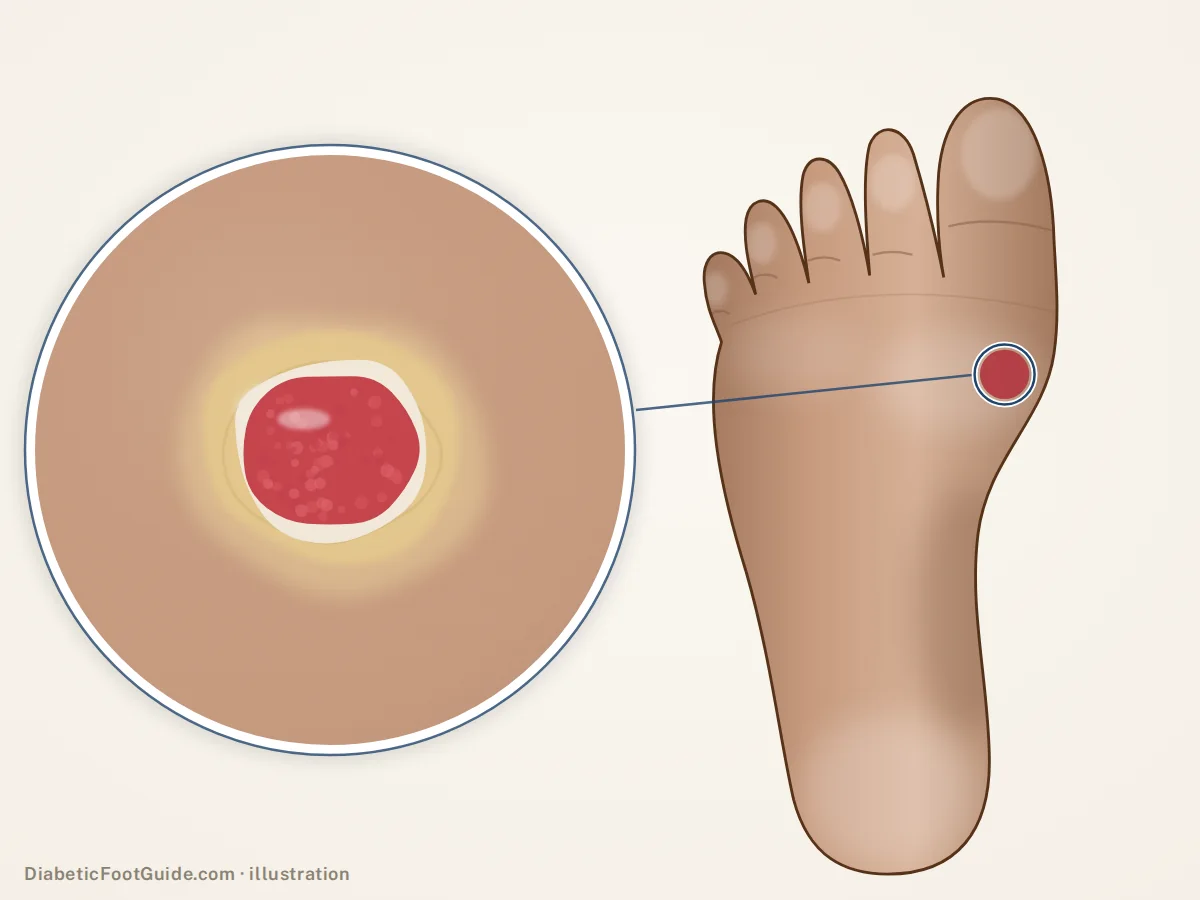
What actually makes a diabetic wound heal faster
In order of impact; most stalled wounds lack one of the first three.
- Take the pressure off it. The international guideline (IWGDF 2023) calls offloading arguably the most important treatment for a diabetic foot ulcer. For a neuropathic ulcer under the ball or middle of the foot, the first choice is a knee-high cast or boot that cannot be removed, so it is worn for every step. A shoe-caused wound needs a different shoe.
- Make sure blood can reach it. About half of people with a diabetic foot ulcer have peripheral artery disease, and no dressing replaces a missing supply. Every foot wound needs a circulation check — pulses plus measured pressures, including at the toes, since calcified ankle arteries can read falsely normal. If flow is poor, revascularization — reopening or bypassing the artery — often decides whether it heals.
- Treat infection properly. It is diagnosed by examining the foot — spreading redness, warmth, swelling, pus — not by a swab, and treated by removing dead tissue plus antibiotics your clinician chooses for its depth and severity. A cream does not reach it. See diabetic foot infection.
- Get blood glucose under control. High glucose weakens the defense against infection, though its direct effect on healing speed is debated: one study of 310 wounds linked higher HbA1c with slower shrinkage, a later one of 584 ulcers found no meaningful link. Worth getting right; no substitute for the first three.
- Keep it clean, moist and covered — and have it debrided. Regular clinician removal of callus, slough and dead tissue helps restart a stalled wound; the dressing between visits keeps it moist, not soggy. Home dressings maintain a wound; they do not fix one.
Two more matter. Eat enough protein, from proper meals — undernourished people heal slowly, but IWGDF advises against protein or vitamin supplements given purely to speed healing. And stop smoking, which narrows the small vessels a wound depends on.
The stages of wound healing, and where diabetes stalls them
Every wound heals in four overlapping stages. Diabetes rarely stops the process outright.
Hemostasis
Minutes to hours. Bleeding stops and a clot seals the gap.
Inflammation
The first few days. White cells clear bacteria and debris; brief pinkness and warmth at the edge are normal.
Proliferation
Days to weeks. Red, moist, slightly bumpy new tissue fills the base, and skin creeps in from the edges.
Remodeling
Weeks to a year or more. The scar firms and flattens but never regains the skin’s full strength, so a healed ulcer site needs protecting.
A stalled diabetic wound is stuck in stage two: pressure re-injures it, poor circulation starves it, high glucose blunts the white cells and bacteria keep it inflamed. Instead of red, granular tissue you see a pale, gray or yellow base, a thick callus rim and little change week to week. See how these look in diabetic feet pictures.
Types of diabetic wounds
The type decides which lever matters most.
| Type | Where, and what it looks like | What it needs most |
|---|---|---|
| Neuropathic ulcer | Under a pressure point — ball of the foot, big toe, toe tips. Painless, punched-out, thick callus rim. | Offloading; callus removed by a clinician |
| Ischemic ulcer | Toe tips, foot edges, heel. Pale or dusky base, cool foot; painful unless nerves are damaged too. | Circulation restored, urgently |
| Neuro-ischemic ulcer | Foot and toe margins, often from shoe pressure; features of both. | Both of the above |
| Heel pressure ulcer | Back of the heel after days in bed; may start as a dark, dry patch. | Heel floated off the mattress; circulation check |
| Venous leg ulcer | Above the inner ankle; shallow and wet, in a swollen, brown-stained leg. | Compression, once the arteries are checked |
| Traumatic wound | A cut, a burn, a new-shoe blister, a nail-care slip. | Cleaning, protection, removing the cause |
Other causes are compared in non-diabetic foot ulcers, wounds above the ankle in diabetic leg ulcers, and compression in diabetic socks vs compression socks. Brown shin spots are usually harmless diabetic dermopathy, not wounds.
Myths that slow diabetic wound healing
| Myth | What actually happens | Do this instead |
|---|---|---|
| Clean it daily with hydrogen peroxide, iodine or alcohol | They harm the cells rebuilding the wound, with little or no proven benefit | Rinse with clean water or saline |
| Leave it open to air out | Dry wounds scab and resurface more slowly than moist, covered ones | Cover it with a non-stick dressing |
| Soak the foot | Softened skin at the edge breaks down, and hot water can burn a numb foot unnoticed | A brief rinse, pat dry, fresh dressing |
| Keep walking on it to stay active | Every step re-injures a wound on the sole, and a numb foot gives no warning | Wear the offloading device for every step, even at night |
| Trim the callus around it yourself | Callus raises pressure on the wound, but blades on a numb foot cut living tissue too | Leave it to the clinician |
| An antibiotic cream will fix it | Creams do nothing for pressure, blood flow or deep infection, and IWGDF advises against antimicrobial dressings for healing ulcers | Fine on a superficial scrape. An ulcer needs to be seen |
What to put on a small diabetic wound tonight
For a small, shallow scrape, cut or broken blister with none of the warning signs below:
- Rinse it with clean running water or saline.
- Pat the skin around it dry with clean gauze.
- Apply a thin layer of plain petroleum jelly — or an antibiotic ointment, on a superficial scrape only.
- Cover it with a non-stick dressing; change it daily, or sooner if it gets wet or dirty.
- Keep weight and shoe pressure off it. No barefoot walking.
- Check it daily, and photograph it in the same light beside a ruler to see whether it is shrinking.
The rule: on a foot with reduced feeling, a wound that is not clearly smaller within a few days needs a foot specialist. Early warning signs are in early-stage diabetic foot ulcers; a sensible home kit is in diabetic foot care products.
Be seen today if
- Spreading redness, warmth, swelling, pus or a new smell
- A wound suddenly larger or deeper, or tendon or bone showing
- A toe or the wound edge turning pale, blue, dusky or black — see toe color changes
- Blood glucose suddenly hard to control
- Emergency department for fever, chills, vomiting or confusion, redness climbing the leg, or a foot turned cold, pale or blue
The four-week rule: when the plan needs to change
Watch the trend rather than the calendar. In a trial of 203 people with diabetic foot ulcers, those whose wound area shrank by more than 53% in four weeks had a 58% chance of healing by 12 weeks; below that line, 9%.
If the area has not roughly halved by four weeks, the plan changes — usually back to the first three levers. Is it truly offloaded? Is the blood supply adequate? Is there infection, or bone involvement?
Advanced therapies, honestly
For wounds that good standard care has not healed, IWGDF 2023 gives conditional support to a few add-ons: one dressing type for non-infected neuro-ischemic ulcers, negative-pressure wound therapy for wounds after surgery, and hyperbaric oxygen for ischemic and neuro-ischemic ulcers. It rates the evidence as still poor overall, and none is a shortcut past offloading and blood flow.
A healed ulcer is in remission, not cured: recurrence is common, so footwear and foot checks matter as much afterwards. More in diabetic foot ulcers.
Common questions
Why do diabetic wounds heal slowly?
Usually several reasons at once: a numb foot keeps being walked on, reduced blood flow limits oxygen, high glucose blunts the white cells, and low-grade infection keeps the wound inflamed rather than rebuilding. Remove those brakes and healing usually restarts.
What is the best ointment for a diabetic wound?
On a superficial scrape, plain petroleum jelly under a non-stick dressing keeps it moist and protected; an antibiotic ointment is a reasonable alternative there. For an ulcer there is no best antibiotic cream: an infected ulcer needs antibiotics chosen for its depth and severity, and an uninfected one needs none.
Should a diabetic wound be kept covered or left open to air?
Covered. Wounds kept moist under a dressing resurface faster than wounds left to dry and scab, and the dressing keeps out friction and dirt. Moist is not wet: white, soggy skin around the wound means the dressing needs changing more often.
Is hydrogen peroxide good for diabetic wounds?
Not for routine cleaning. Hydrogen peroxide, iodine and alcohol damage the healthy cells a wound needs, with little or no proven benefit to healing. Clean running water or saline is enough at home.
How long should a diabetic wound take to heal?
It depends on size, depth, blood supply and infection, so watch the trend. A small, shallow wound on a well-supplied foot should look clearly better within days; an ulcer should have lost about half its area after four weeks of good care, or the plan needs changing.
Can I soak a diabetic foot wound?
No. Soaking softens the skin at the wound edge so it breaks down, and on a numb foot, water hot enough to burn may not feel hot. Rinse briefly, pat dry and redress, and ask before showering — a cast usually rules it out.
Sources
Clinical literature retrieved from PubMed, plus the governing IWGDF guidance.
- Bus SA, Armstrong DG, Crews RT, et al. Guidelines on offloading foot ulcers in persons with diabetes (IWGDF 2023 update). Diabetes Metab Res Rev. 2024;40(3):e3647. doi:10.1002/dmrr.3647 — offloading as arguably the most important intervention, and the non-removable knee-high device.
- Fitridge R, Chuter V, Mills J, et al. The intersocietal IWGDF, ESVS, SVS guidelines on peripheral artery disease in people with diabetes and a foot ulcer. Diabetes Metab Res Rev. 2024;40(3):e3686. doi:10.1002/dmrr.3686 — peripheral artery disease in about half of diabetic foot ulcers.
- Chen P, Vilorio NC, Dhatariya K, et al. Guidelines on interventions to enhance healing of foot ulcers in people with diabetes (IWGDF 2023 update). Diabetes Metab Res Rev. 2024;40(3):e3644. doi:10.1002/dmrr.3644 — debridement, antimicrobial dressings, supplements and the add-on therapies.
- Sheehan P, Jones P, Caselli A, et al. Percent Change in Wound Area of Diabetic Foot Ulcers Over a 4-Week Period Is a Robust Predictor of Complete Healing in a 12-Week Prospective Trial. Diabetes Care. 2003;26(6):1879-1882. doi:10.2337/diacare.26.6.1879 — the four-week benchmark.
- Christman AL, Selvin E, Margolis DJ, et al. Hemoglobin A1c Predicts Healing Rate in Diabetic Wounds. J Invest Dermatol. 2011;131(10):2121-2127. doi:10.1038/jid.2011.176 — higher HbA1c linked with slower healing across 310 wounds.
- Fesseha BK, Abularrage CJ, Hines KF, et al. Association of Hemoglobin A1c and Wound Healing in Diabetic Foot Ulcers. Diabetes Care. 2018;41(7):1478-1485. doi:10.2337/dc17-1683 — no clinically meaningful association across 584 ulcers.
- Wilkins RG, Unverdorben M. Wound Cleaning and Wound Healing: A Concise Review. Adv Skin Wound Care. 2013;26(4):160-163. doi:10.1097/01.ASW.0000428861.26671.41 — antiseptics being locally toxic, with little proven benefit to healing.
- Winter GD. Formation of the Scab and the Rate of Epithelization of Superficial Wounds in the Skin of the Young Domestic Pig. Nature. 1962;193(4812):293-294. doi:10.1038/193293a0 — the original evidence for moist, covered wound healing.
Related guides
Early-stage diabetic foot ulcers
What a wound looks like as it starts.
Diabetic foot ulcers
Grading, offloading and the full treatment picture.
Diabetic foot infection
The signs that turn a slow wound into an urgent one.
Non-diabetic foot ulcers
Venous, arterial and pressure ulcers, and how they differ.
Diabetic leg ulcers
Wounds above the ankle, where veins change the plan.
A wound that isn’t healing, in Michigan?
Balance Foot & Ankle treats diabetic foot wounds in Howell and Bloomfield Hills — offloading, debridement and a circulation check at the first visit.

Dr. Tom Biernacki is a double board-certified podiatric foot and ankle surgeon practising in Michigan. He treats diabetic wounds, Charcot neuroarthropathy and at-risk feet daily, and writes here to put the clinical reasoning behind that care in front of the people living with it.