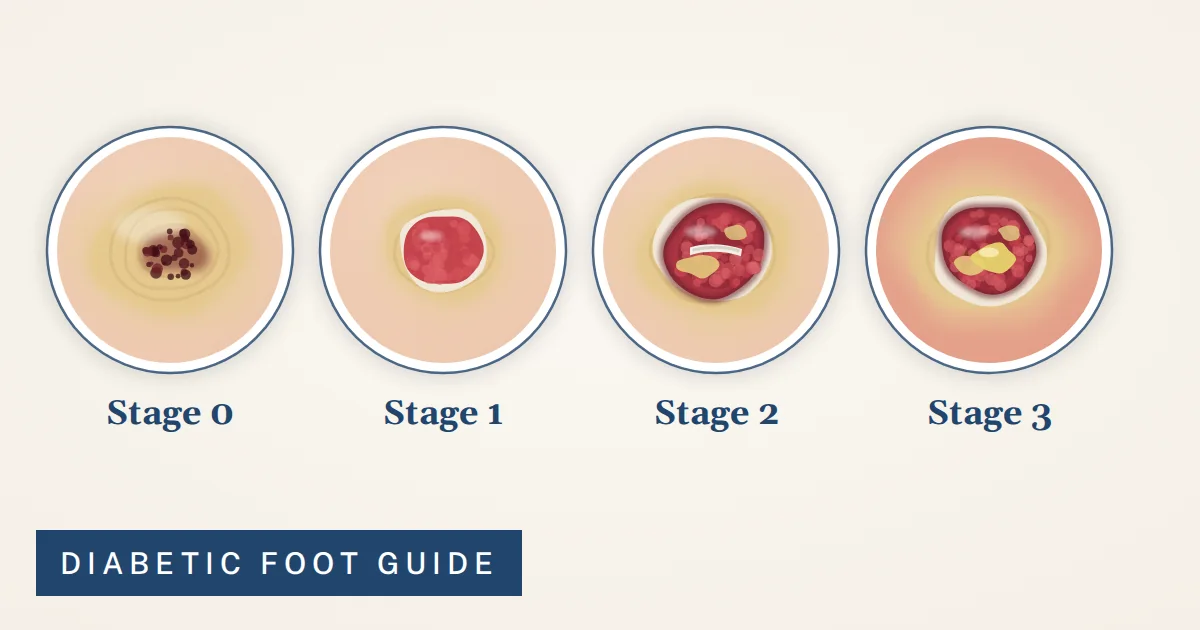
An early diabetic foot ulcer rarely looks like much: a dark spot inside a callus, a blister that has opened, a crack that will not close, a stain on a sock. It usually does not hurt, which is why it gets walked on for another week.
The short version
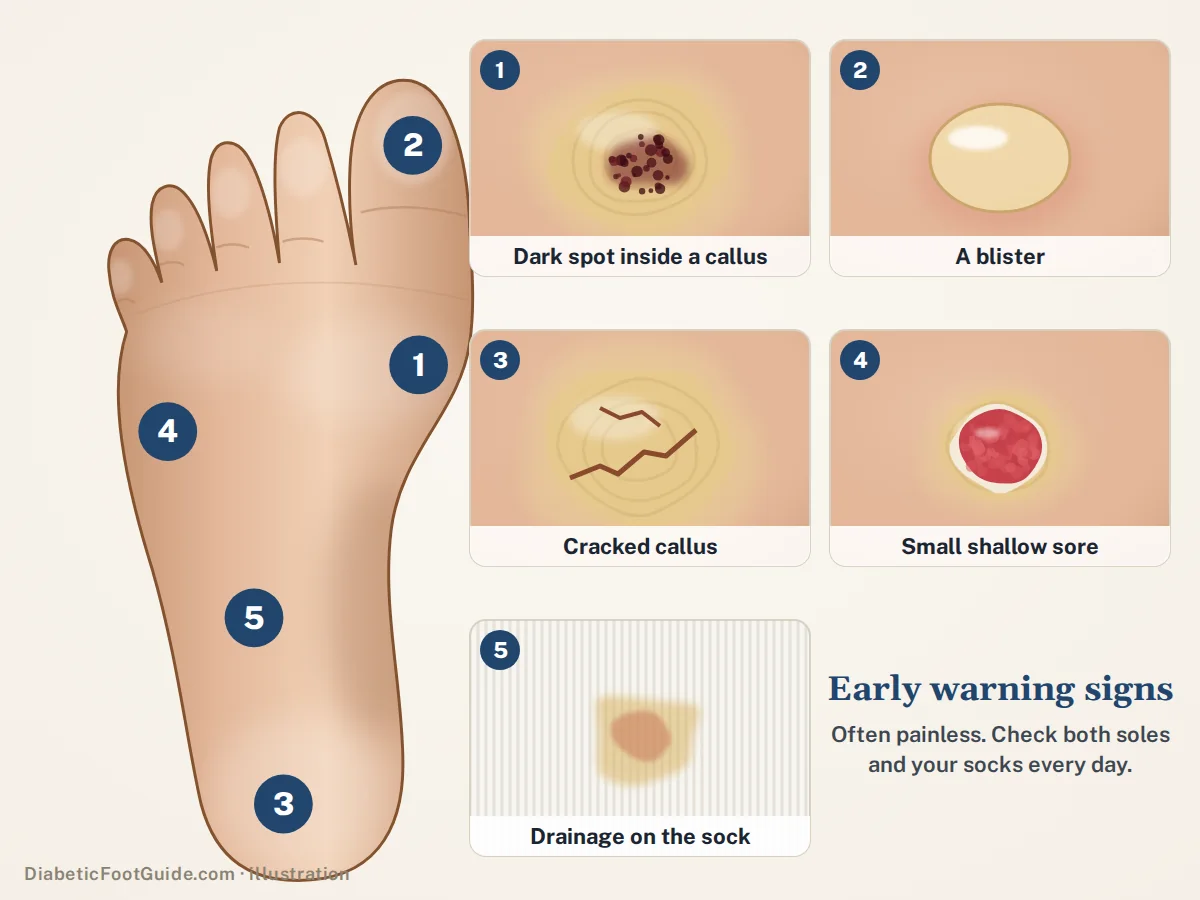
Most early ulcers start at a pressure point — the ball of the foot, the big toe, the heel — and often under a callus. Look for a red, brown or black spot inside a callus, a blister, a crack in a callus, a small shallow sore with a pink or yellowish base, or a spot of fluid or blood on your sock. Pain is often absent.
Get the pressure off it today and have it seen this week. Stop wearing the shoe that caused it and walk as little as possible until a podiatrist has looked at it. A dark spot or blood inside a callus, or a blood-filled blister, is same day: there is usually a wound under the lid. Red, hot, swollen or smelly, pus, a fever, or blood sugars that have jumped: that is the same day, in the emergency department if nobody else can see you.
The five early signs, and what each one means
| What you see | What it means |
|---|---|
| A callus with a red, brown or black spot inside it | Bleeding under the callus from repeated pressure. When we pare one of these down in clinic, there is often an ulcer underneath. Have it seen the same day. |
| A blister, clear or blood-filled | Skin lifted by friction; blood inside means deeper damage. Do not pop it — see blisters on diabetic feet. |
| A crack in a callus or a dry heel | A fissure, and an open door for bacteria. See dry, cracked feet. |
| A small, shallow sore, often with a white rim | The skin has broken: a superficial ulcer, however small or painless. |
| A spot of fluid or blood on a sock or insole | Something is open and draining. Find the matching spot on the sole today. |
Check the pressure points: under the big toe joint, the big toe, the tips and knuckles of clawed toes, the heel and the outer edge of the foot. A phone camera or a floor mirror shows you the sole.
See long-handled foot inspection mirror on Amazon →
On brown and black skin, redness can hide
Inflammation may look darker brown, purple or gray, or barely show. Feel for warmth or swelling, comparing the same spot on both feet.
The stages, from pre-ulcer to gangrene
People searching for diabetic foot ulcer stages almost always mean the Wagner grades, 0 to 5: the oldest system and still the most widely studied. The stage numbers below follow it.

Pre-ulcer: the skin is still closed
Looks like: a callus with red, brown or black speckling inside it, a blister, a crack, an old ulcer scar, or hard skin over a bunion, a clawed toe or a dropped metatarsal head.
Means: no wound yet, but tissue is being damaged. Guidelines treat blisters, cracks and bleeding in the skin as strong predictors of an ulcer; they need prompt professional treatment.
Today: change the shoe, do not cut or file it, and be seen the same day if there is blood or a dark spot inside the callus or the blister is blood-filled. Otherwise book a podiatry visit this week.
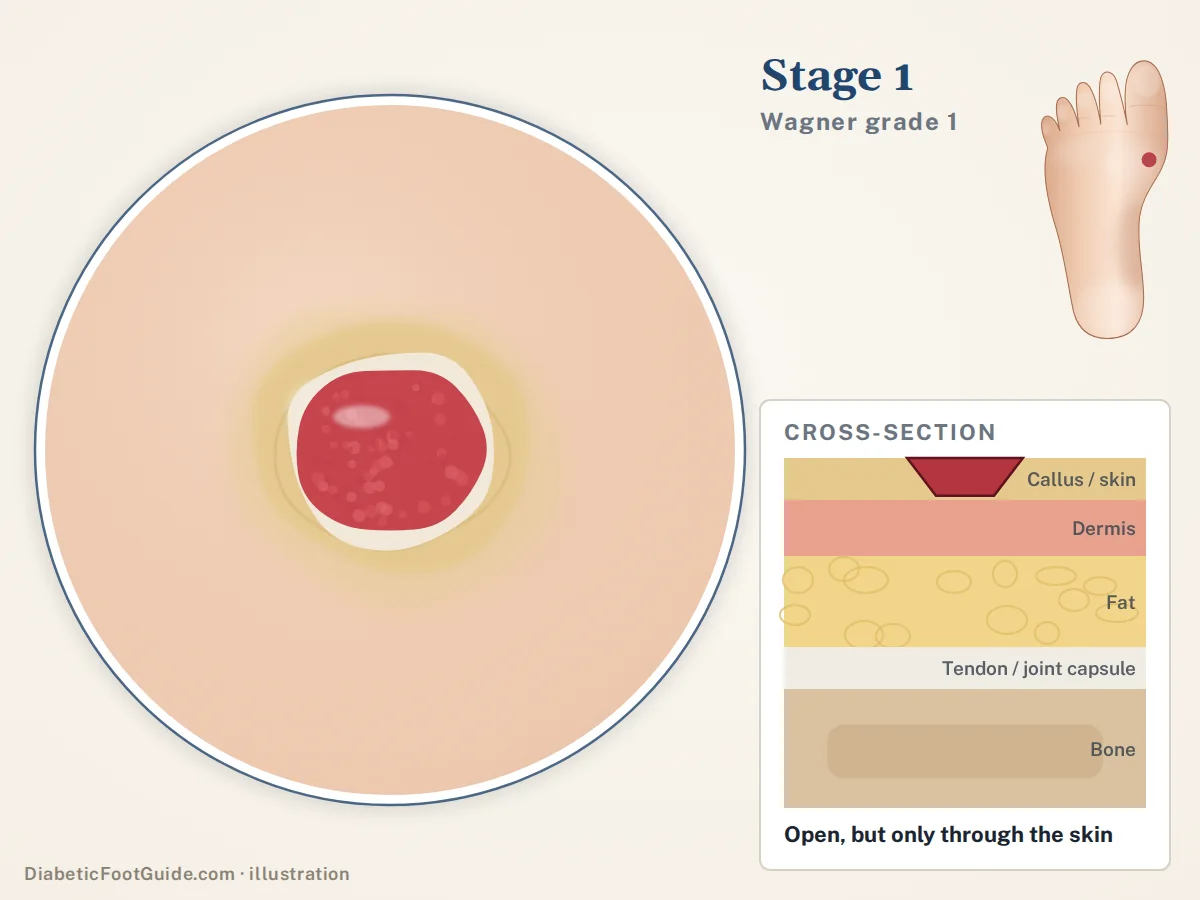
Superficial ulcer
Looks like: a shallow, usually round sore with a pink, red or yellowish base, often ringed by white or thick callus. It goes through the skin but not down to tendon, joint or bone, and often does not hurt.
Means: this is now a wound, and the stage where treatment works best.
Today: rinse it, cover it with a non-stick dressing, stay off it, and be seen this week — sooner if it is growing or your circulation is poor.
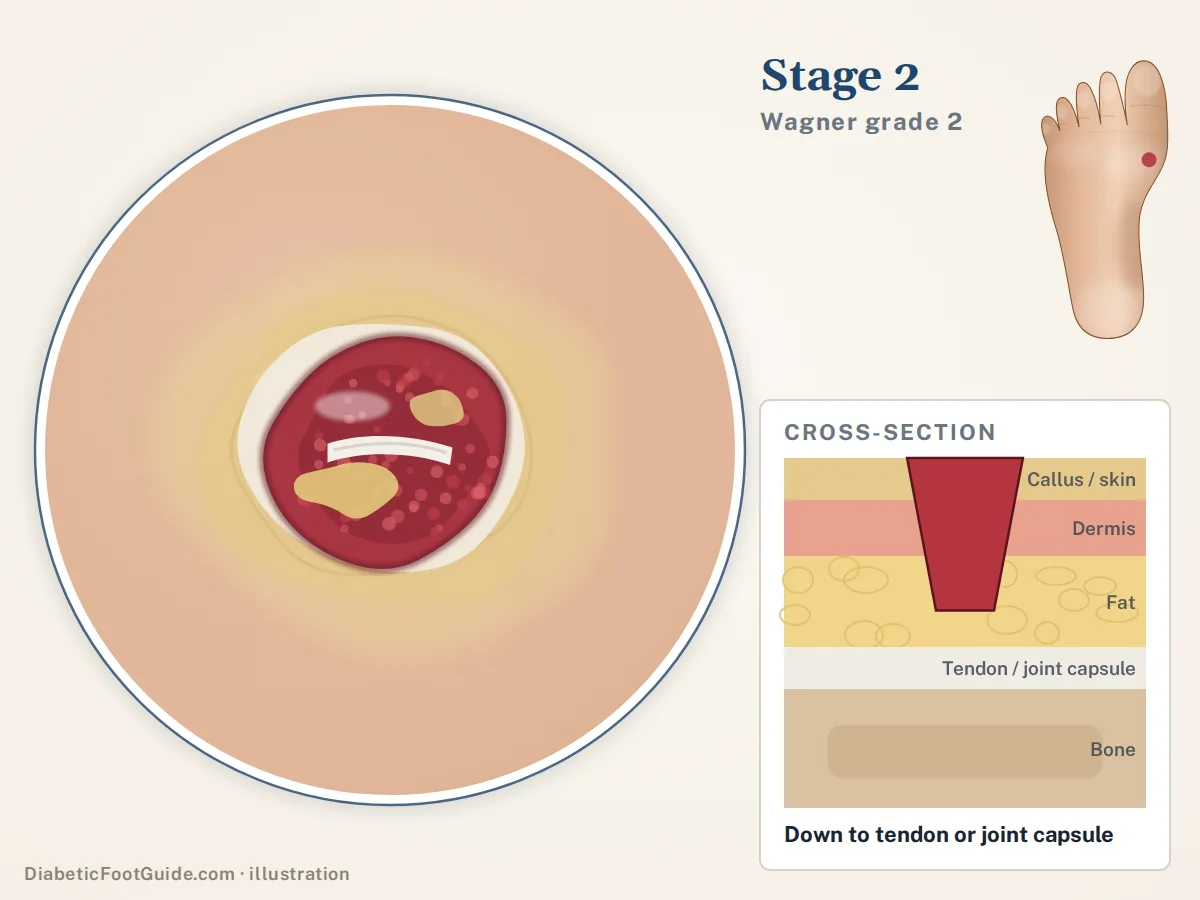
Deep ulcer, no abscess or bone infection
Looks like: a crater rather than a scrape, sometimes with white, glistening tendon or joint capsule at the bottom, and edges wider underneath than at the surface.
Means: the path to joint and bone is now short. It needs debridement, a check for bone involvement and serious offloading.
Today: be seen within 24–48 hours. Keep it covered, and do not soak it or pack it with anything.

Deep ulcer with abscess or bone infection
Looks like: swelling, redness and warmth around the wound, pus, often a smell, sometimes a red, sausage-shaped toe. The opening can still look small; the infection is underneath.
Means: infection in deep tissue, a joint or bone, usually needing drainage, imaging, antibiotics and often surgery — see diabetic foot infection.
Today: the emergency department or a same-day foot and ankle surgeon. Do not wait for a fever; most diabetic foot infections do not cause one.
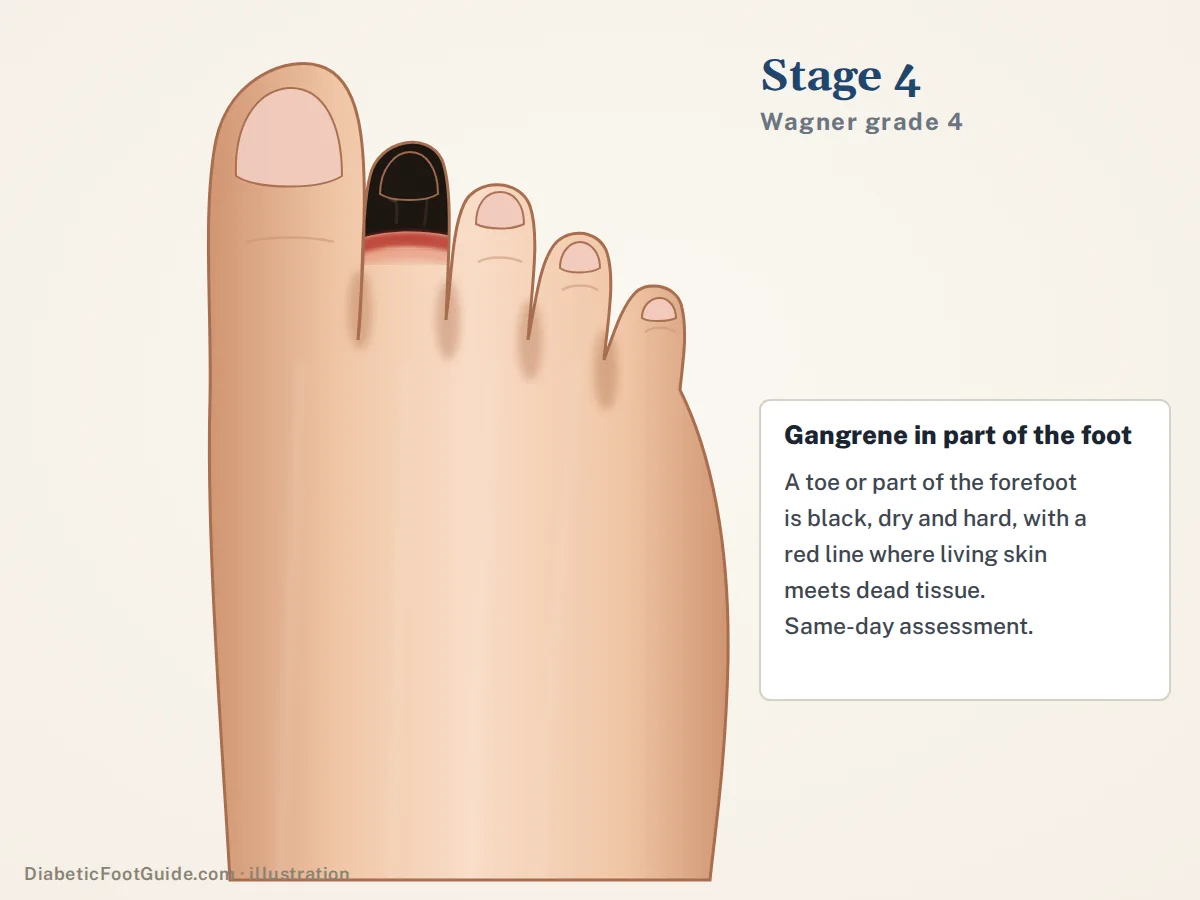
Gangrene of a toe or the forefoot
Looks like: a toe or part of the forefoot turned black, blue-gray or deep purple — hard and shrunken if dry, swollen and foul-smelling if wet.
Means: tissue has died from lost blood supply, infection or both, and the plan starts with those two. More on gangrene in the diabetic foot.
Today: the emergency department. If it is wet or smells, go now.
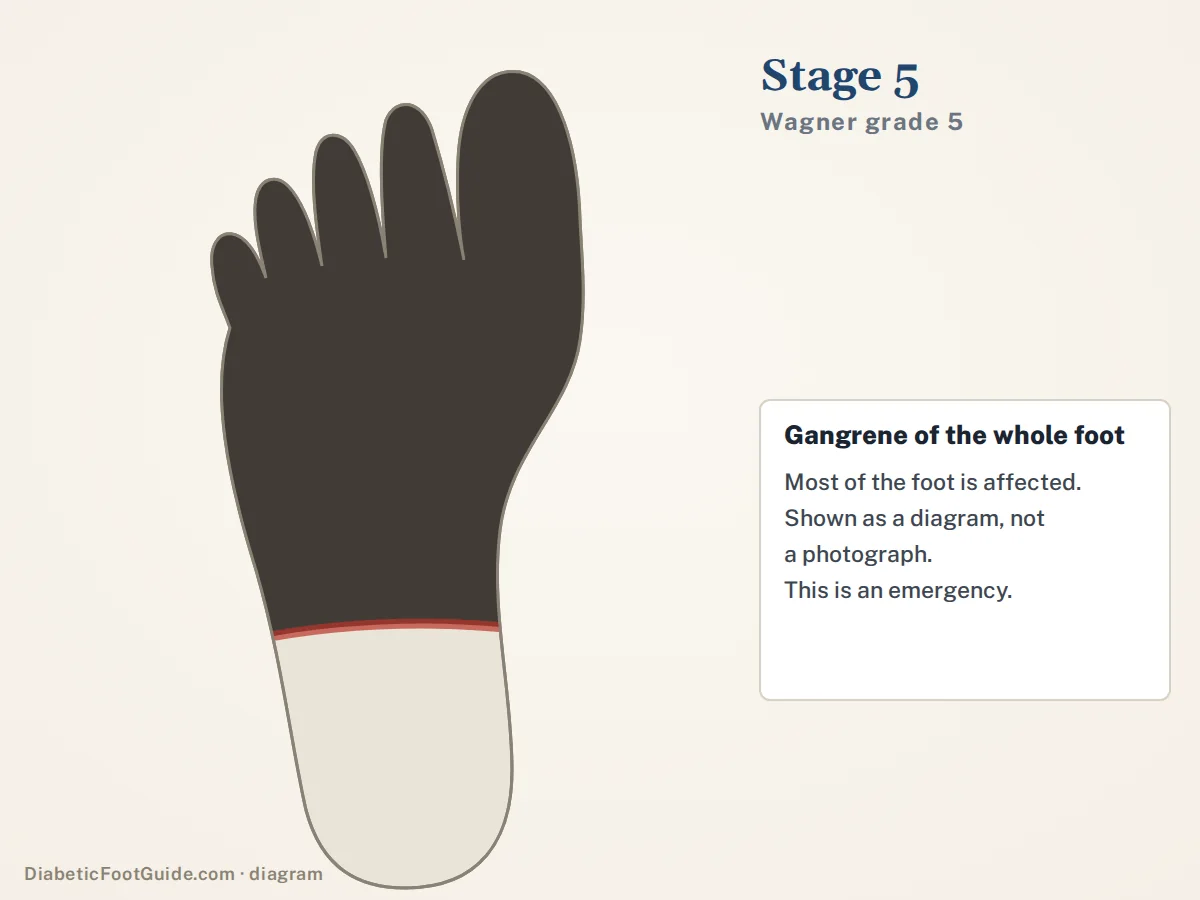
Gangrene of the whole foot
Looks like: most of the foot dark and no longer living.
Means: the foot itself cannot be saved. Treatment protects the person — controlling infection and, usually, a below-knee or higher amputation.
Today: the emergency department, now.
Why a small, shallow ulcer can still be an emergency
Wagner measures depth, and depth is only one of three questions. The other two: is the wound infected, and does the foot have the blood supply to heal it?
The University of Texas system adds a letter to each depth grade: A clean, B infected, C ischemic, D both. In the 360-patient study that validated it, no uninfected, non-ischemic ulcer led to amputation within six months, while patients with infected, ischemic wounds were nearly 90 times more likely to have a midfoot or higher amputation than those with less advanced wounds. The 2023 international guideline judged Wagner too blunt for clinical use; for a person with poor circulation it suggests WIfI, which scores wound, ischemia and foot infection separately to estimate healing likelihood and amputation risk.
A shallow ulcer is urgent if either of these is present
- Infection: spreading redness, warmth, swelling, pus, a smell, new pain in a numb foot, or blood sugars rising for no clear reason.
- Poor blood supply: cold, pale or bluish toes, a pale wound base that is not changing, foot pain at night that eases when the leg hangs down, or pulses nobody can feel.
Grading, circulation testing and treatment in depth are in our main guide to diabetic foot ulcers.
Blood sugar and an early ulcer
No blood sugar number starts an ulcer; pressure on a numb foot does. Glucose decides how well the foot defends and repairs itself once the skin breaks.
It weakens the defense
High glucose impairs the white cells that kill bacteria; the international infection guideline lists this neutrophil dysfunction as a factor predisposing to foot infection.
It slows the repair
In a Johns Hopkins wound-center study of 183 people with diabetes, A1C was the only clinical measure significantly linked to healing speed: the higher it was, the slower wounds shrank. Not every study agrees.
It can be the first warning
A sudden rise in readings, with no change in food or medication, can mean infection — in clinic, sometimes before the foot looks different. The same guideline lists worsening hyperglycemia among the signs of a more serious infection.
Glucose control does not replace offloading; the two work together. With an open wound, call whoever manages your diabetes this week and ask:
- What range they want your readings in while the wound is open.
- At what reading or trend they want a call.
- Whether your medication needs adjusting, since infection itself pushes glucose up.
Offloading: taking the pressure off, in plain words
Offloading means taking the pressure off the wound, as near to zero as possible, with every step. It is the treatment, not an extra: pressure made the ulcer, and each step reopens it. The international offloading guideline calls it arguably the most important healing intervention.
What you can do today
- Walk as little as possible until it has been seen: short trips only, foot up otherwise.
- Do not try to toughen it up. On a numb foot, pain is no guide to damage.
- Retire the shoe that caused it. Wear a roomy, closed shoe, and never go barefoot, in socks alone or in thin slippers, even indoors.
- No corn plasters, medicated pads or cut-out pads. Acid burns numb skin, and a badly placed pad shifts pressure onto the wound edge.
What a clinician will use
For a neuropathic ulcer under the forefoot or midfoot, the guideline’s first choice is a knee-high device you cannot take off: a total contact cast, or a walker boot wrapped so it stays on. Next come removable boots worn for every step, then felt padding with a well-fitting shoe. If those fail, surgery can remove the pressure source. Ordinary and extra-depth diabetic shoes keep a healed foot healed; they do not replace offloading.
What not to do at home
- Soaking it. It softens the skin around the wound, and a numb foot cannot judge water temperature. Guidelines advise against soaking feet even to wash them.
- Peroxide, alcohol or strong antiseptics. They damage the new tissue the wound is trying to grow.
- Cutting or filing the callus. Paring is part of treatment, but done wrong it creates the wound; it belongs with a trained professional.
- Popping a blister. The roof protects the raw skin underneath. Any draining is done in a clinic.
- “Letting it breathe.” An uncovered wound dries, scabs over a base that is still open, and collects whatever is on the floor.
- Walking on it to test it. No pain proves nothing on a numb foot.
Tonight, instead
Rinse it with saline or clean water, pat it dry, and cover it with a non-stick dressing held by paper tape. Clean sock, foot up. Photograph it beside a coin so changes can be compared, check your blood sugar, and call in the morning.
How soon to be seen
Find the row that matches.
- Emergency department today
Redness spreading up the foot, pus, a foul smell, black or blue tissue, a cold or dusky toe, crackling under the skin, fever, or blood sugars suddenly out of control.
Go now, and say you have diabetes and a foot wound.
- Seen within 24–48 hours
A wound you can see into, a blood blister, an ulcer that is growing or draining more, or any open wound if you have poor circulation or a past ulcer or amputation.
Call a podiatrist today and say “open wound on a diabetic foot.” Stay off it until then.
- Seen this week
A callus with a dark spot, a clear blister, a crack, or a small shallow sore with no redness, warmth, swelling or smell.
Call today and keep the pressure off it meanwhile. In Michigan? Book here →
Common questions
What does an early-stage diabetic foot ulcer look like?
Usually like a callus that has changed: a dark spot inside it, a blister, a crack, or a small shallow sore with a pink base and a white rim, usually painless. Closed skin is stage 0, a pre-ulcer; any opening makes it stage 1.
What are the stages of a diabetic foot ulcer?
Usually the Wagner grades, 0 to 5: a pre-ulcer on intact skin, a superficial ulcer, a deep ulcer to tendon or capsule, a deep ulcer with abscess or bone infection, gangrene of a toe or forefoot, and whole-foot gangrene. Clinicians also record infection and blood supply.
Can an early-stage diabetic foot ulcer heal on its own?
A pre-ulcer can settle once the pressure is gone, but the same shoe or deformity will recreate it. An open ulcer that is still walked on rarely closes, and in clinic the one that “healed on its own” is often still there under new callus.
How fast can a diabetic foot ulcer get worse?
An uninfected shallow ulcer can sit unchanged for weeks. Once infection sets in, it tends to progress, sometimes rapidly, and in clinic a quiet ulcer can become a hot, swollen foot in a day or two.
Does a diabetic foot ulcer hurt?
Usually not, which is why it gets walked on. The nerve damage that let it form removes the pain and can mask the signs of infection too. New aching or throbbing in a numb foot deserves a same-day call.
Should I put anything on it tonight?
Clean and covered, nothing more: rinse, pat dry, non-stick dressing. Skip creams, peroxide, soaks and corn plasters until it has been seen. Red, hot, swollen, pus, a smell or feeling unwell means the emergency department tonight.
Does high blood sugar stop an ulcer healing?
It slows healing rather than stopping it, and weakens the white cells that fight infection. But an ulcer that will not close is usually still being walked on or short of blood supply, so glucose, pressure and circulation need fixing together.
Sources
Clinical literature retrieved from PubMed.
- Wagner FW Jr. The dysvascular foot: a system for diagnosis and treatment. Foot Ankle. 1981;2(2):64-122. doi:10.1177/107110078100200202 — the original grades 0 to 5, from intact but at-risk skin to gangrene of the whole foot.
- Armstrong DG, Lavery LA, Harkless LB. Validation of a diabetic wound classification system: the contribution of depth, infection, and ischemia to risk of amputation. Diabetes Care. 1998;21(5):855-859. doi:10.2337/diacare.21.5.855 — the University of Texas system in 360 patients: no amputations among uninfected, non-ischemic ulcers over six months, and infected, ischemic wounds nearly 90 times more likely to end in a midfoot or higher amputation.
- Monteiro-Soares M, Hamilton EJ, Russell DA, et al. Guidelines on the classification of foot ulcers in people with diabetes (IWGDF 2023 update). Diabetes Metab Res Rev. 2024;40(3):e3648. doi:10.1002/dmrr.3648 — the Wagner grade definitions, Wagner judged too blunt for clinical use, the Texas stage letters, and WIfI suggested for people with peripheral artery disease to stratify healing likelihood and amputation risk.
- Bus SA, Sacco ICN, Monteiro-Soares M, et al. Guidelines on the prevention of foot ulcers in persons with diabetes (IWGDF 2023 update). Diabetes Metab Res Rev. 2024;40(3):e3651. doi:10.1002/dmrr.3651 — blisters, fissures and bleeding in the skin as strong predictors of ulceration, to be treated promptly and only by trained professionals, and the advice against soaking feet, chemical agents or plasters for callus, and walking barefoot, in socks or in thin slippers.
- Bus SA, Armstrong DG, Crews RT, et al. Guidelines on offloading foot ulcers in persons with diabetes (IWGDF 2023 update). Diabetes Metab Res Rev. 2024;40(3):e3647. doi:10.1002/dmrr.3647 — offloading as arguably the most important healing intervention, the order of devices from a non-removable cast or walker to felted foam with footwear, surgical offloading, and not relying on standard footwear to heal a plantar ulcer.
- Senneville É, Albalawi Z, van Asten SA, et al. IWGDF/IDSA guidelines on the diagnosis and treatment of diabetes-related foot infections (IWGDF/IDSA 2023). Diabetes Metab Res Rev. 2024;40(3):e3687. doi:10.1002/dmrr.3687 — neutrophil dysfunction predisposing to infection, worsening hyperglycemia as a sign of more serious infection, fever being uncommon, signs masked by neuropathy, and infections that tend to progress, sometimes rapidly.
- Christman AL, Selvin E, Margolis DJ, Lazarus GS, Garza LA. Hemoglobin A1c predicts healing rate in diabetic wounds. J Invest Dermatol. 2011;131(10):2121-2127. doi:10.1038/jid.2011.176 — higher A1C associated with slower wound-area healing in 183 people treated at a wound center, the only clinical measure studied with a significant link.
Related guides
Healing a diabetic wound faster
What speeds an ulcer up once it has opened: offloading, blood flow, infection control and glucose.
Diabetic foot ulcers
Why ulcers form, and how they are graded and treated.
Blisters on diabetic feet
Clear, blood-filled and spontaneous blisters.
Diabetic foot infection
Stage 3 from the inside, and the bone question.
Gangrene in the diabetic foot
Dry, wet and gas gangrene: stages 4 and 5.
Dry, cracked feet
Heel fissures, the pre-ulcer almost nobody treats as one.
Diabetic feet pictures
A visual guide to diabetic skin, nail and foot-shape changes.
An early ulcer, in Michigan?
Balance Foot & Ankle sees diabetic wounds in Howell and Bloomfield Hills, from pre-ulcerative callus to open ulcers. Say it is an open wound when you book.

Dr. Tom Biernacki is a double board-certified podiatric foot and ankle surgeon practising in Michigan. He treats diabetic wounds, Charcot neuroarthropathy and at-risk feet daily, and writes here to put the clinical reasoning behind that care in front of the people living with it.