A black toenail with diabetes is most often blood under the nail from a knock or a shoe you did not feel. Most often is not always: fungus, bacteria, a pigment band and, rarely, melanoma can darken a nail too, and a toe whose skin is turning black is an emergency.
The short version
The commonest cause is a bruise under the nail, a subungual hematoma, often with no injury anyone remembers; it grows out with the nail over months. A brown or black line along the nail is usually harmless pigment, but a single band that is new, widening or spreading onto the skin needs examining: that is often how melanoma under the nail first shows.
With diabetes, what matters is the cause and what the nail hides: on a numb foot, something pressed hard enough to bleed and you did not feel it. Have a new dark nail looked at within days, the same day if there is redness, swelling, drainage or a smell, and go to an emergency department now if the skin of the toe itself is turning black.
Black toenail with diabetes: which one is it?
The urgency column assumes a foot with reduced feeling. If a nail fits two rows, act on the more urgent.
| What it looks like | Usual cause | How urgent on a diabetic foot |
|---|---|---|
| A dark red, purple or black patch, after a stub, a long walk or nothing you remember | Blood under the nail (subungual hematoma) from a knock or repeated shoe pressure | Within days. Same day if it throbs after an injury, the toe is swollen, or the skin around it is red or draining. |
| Thick, crumbly and yellow-brown, with brown or black streaks or patches | Fungal infection; some fungi make dark pigment | Next routine visit, with a lab test before treatment. Sooner if the skin beside it is red or broken. |
| Green, green-brown or green-black where the nail has lifted | Pseudomonas bacteria under a lifted nail, sometimes alongside fungus | Within days. Same day if the skin around it is red, swollen or draining. |
| Even brown or black lines on several nails, unchanged for years | Pigment from the nail’s growth center (longitudinal melanonychia), common in darker skin | Next routine foot check. |
| One band on one nail that is new, changing, 3 mm or wider, or with pigment on the skin around it | A band that needs melanoma under the nail (subungual melanoma) ruled out | Within a few weeks. Only a biopsy confirms or rules out melanoma. |
| The skin of the toe itself black, blue-black or gray | Gangrene: tissue dying from lost blood supply, infection or both | Emergency department now. |
| Several nails darkening together, or a band running across the nail | Some medicines, staining, or a body-wide condition | Next routine visit, with your medicine list. |
Whatever your skin color, feel for warmth and swelling around the nail as well as looking for redness. Skin and wound changes are pictured in diabetic feet pictures.
Blood under the nail: the commonest cause
Black under the toenail is most often old blood, collected between the nail and the nail bed after one hard knock or many small ones, such as a toe tapping the end of a shoe that is too short or too shallow. It starts dark red or purple and turns brown-black as it ages. Many people remember no injury, which with neuropathy is expected: nerve damage can stop you feeling a pebble in your sock, let alone a toe pressing on a shoe. Diabetic foot guidelines rank ill-fitting shoes among the major causes of injury to an at-risk foot.
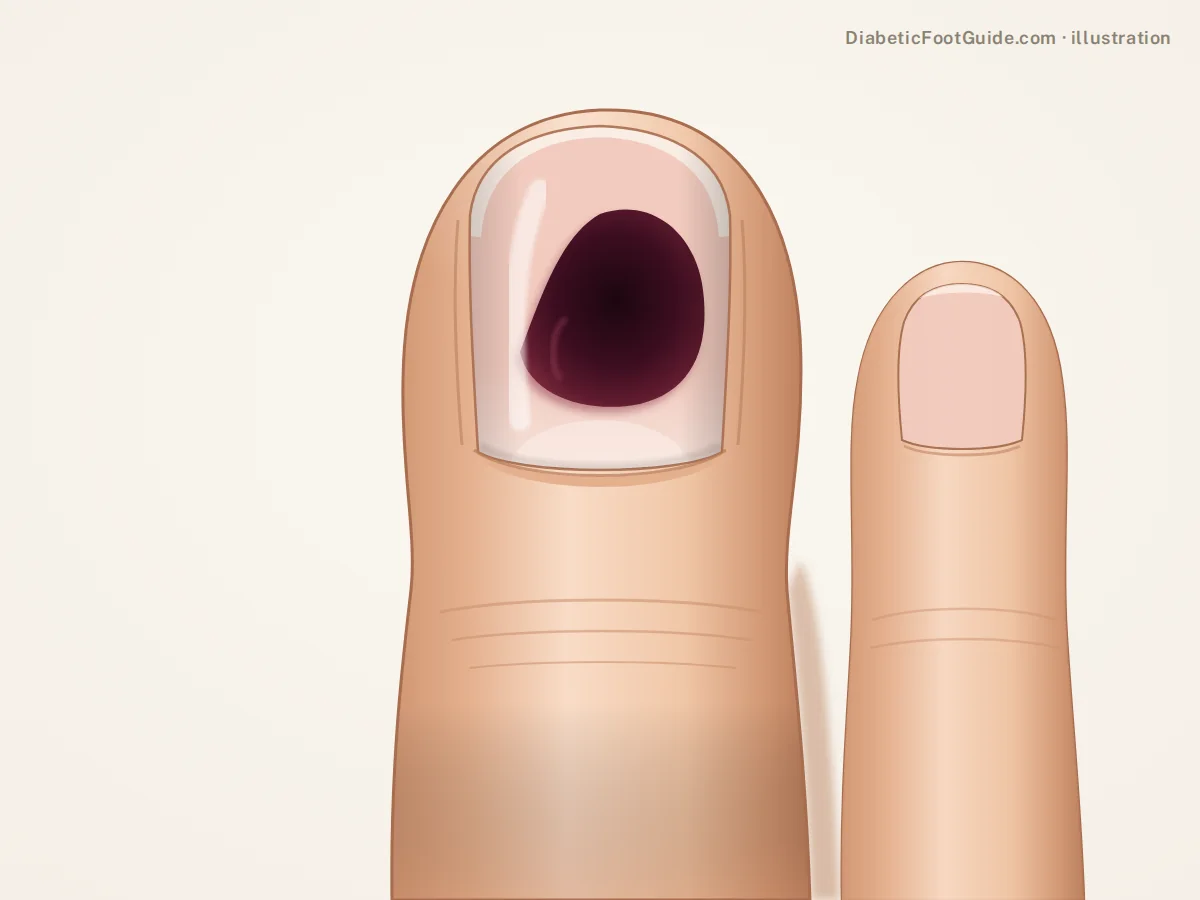
The tell is movement. Blood is carried forward as the nail grows, but slowly: toenails grow roughly 1 to 1.6 mm a month, and a whole toenail can take 12 to 18 months to regrow. A patch that has not moved after several weeks needs examining, as does any “bruise” you cannot explain, because blood does not rule out melanoma: melanomas can bleed too.
Fungus and bacteria that darken a toenail
Fungal nails that turn dark
Fungal nails are usually thick, crumbly and yellow-brown, but some fungi add pigment: Trichophyton rubrum can lay down black streaks, and molds such as Scytalidium stain the whole nail brown. A dense plug of fungus, a dermatophytoma, usually shows as a white or yellow streak instead. Diabetes is an established risk factor for fungal nails. Have a dark one tested rather than guessed at: fungus is unreliable to diagnose by eye, and melanoma can pass for it. Why thick nails matter on a diabetic foot is in diabetic toenails.
Pseudomonas: green to green-black
Pseudomonas is a moisture-loving bacterium that rarely gets into an intact nail. It settles under one already lifted by injury, a tight shoe or fungus, and stains it green, green-brown or green-black; fungal infection seems to encourage it. Treatment usually means trimming off the lifted part, keeping it dry and an antibiotic on the nail or by mouth, not removing the whole nail. Redness, swelling or drainage around it is a foot infection until proven otherwise, and a same-day visit.
A black line under the toenail: pigment or melanoma?
A brown or black stripe from cuticle to tip is longitudinal melanonychia: pigment made in the nail’s growth center and built into the nail as it grows, so it runs the full length rather than drifting like a bruise. Most bands are harmless, from pigment cells switched on by friction or inflammation, a mole or freckle in the growth center, or skin color. They are common in darker skin, usually on several nails: one review cites figures from 1% of white people to 77–100% of African Americans. Tight or pointed shoes can also leave brown pigment in the big, fourth and fifth toenails.
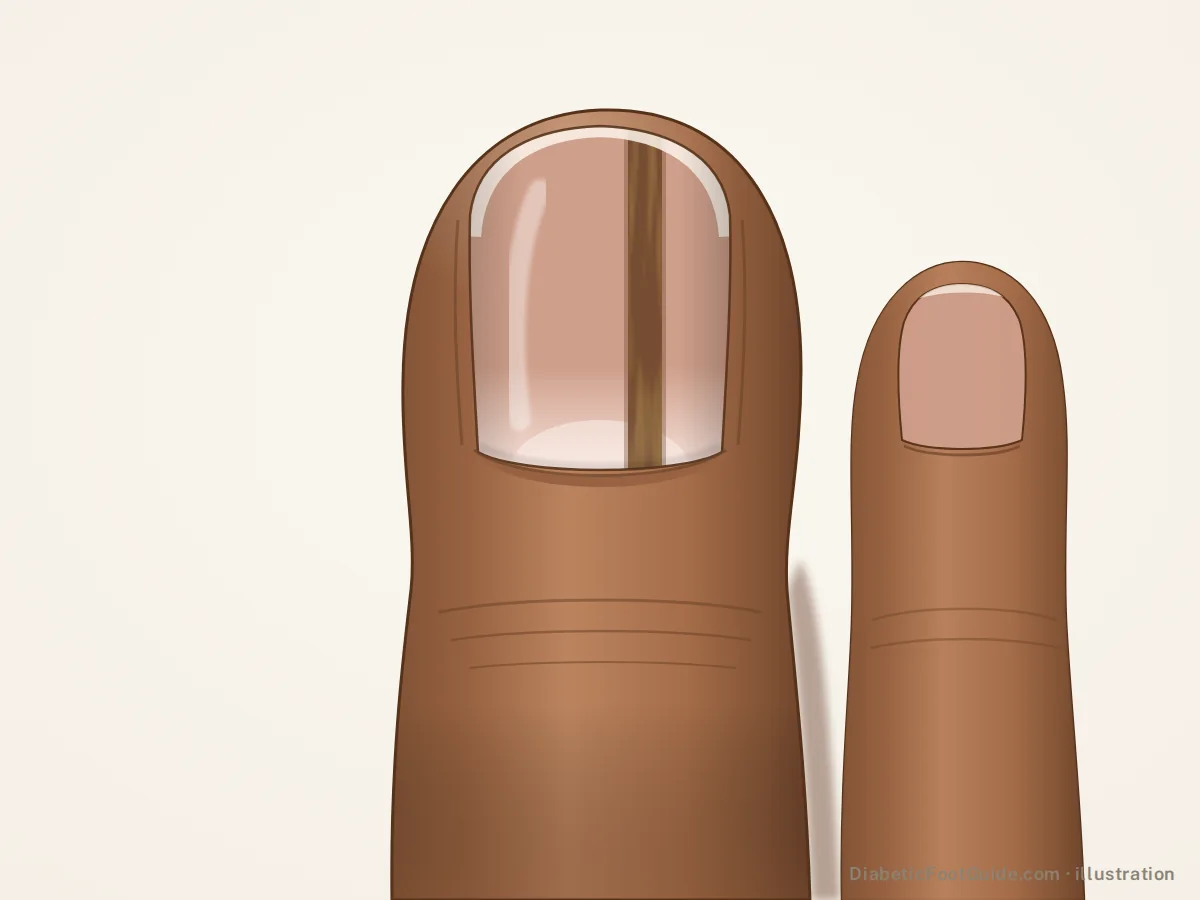
The reason bands get checked is subungual melanoma, which usually starts in the growth center. It is rare, 0.7% to 3.5% of melanomas in Western countries, but diagnosis is delayed by about two years on average. In Black, Asian and Native American people it makes up a much larger share of the melanomas that do occur, up to a third, so darker skin is a reason to know the warning signs, not to dismiss them.
When a band needs examining within weeks
- A single new band on one nail, especially the big toe or the thumb
- Widening, darkening or changing shape
- 3 mm or wider, black rather than brown, mixed in color, or blurred at the edges
- Pigment on the skin of the cuticle, the sides or the tip of the nail (Hutchinson’s sign)
- The nail splitting, bleeding or breaking down over it
Age 40 to 70 and a personal or family history of melanoma or atypical moles raise the stakes. Most of these signs come from the ABCDEF checklist, which is a prompt rather than a test: it has not been validated. A biopsy from the nail’s growth center is how melanoma is confirmed or ruled out.
Dark color in several nails at once can come from some chemotherapy drugs, the HIV drug zidovudine or certain antimalarials, and may fade once the drug is stopped; from Addison’s disease; or from stains such as tobacco, henna or dyes. Never stop a medicine over a nail without asking your prescriber. Brown patches on the skin are covered in brown spots on feet with diabetes.
When the toe itself is turning black
If the skin of the toe is turning black, blue-black or gray, the problem is the toe, not the nail: tissue is dying because blood is not reaching it, an infection has taken hold, or both. That is gangrene until proven otherwise, and on a numb foot it may not hurt. Go to an emergency department now rather than booking. A foot that suddenly turns cold, pale and painful is a 911 call. More in gangrene in the diabetic foot and red, purple or black toes with diabetes.
Why a black toenail matters more with diabetes
What sets a diabetic black toenail apart is the foot it is on. Neuropathy removes the warning, so pressure that would make anyone else change shoes goes unnoticed. The nail hides what is under it: blood under a nail is a pressure sign, like blood inside a callus, which is often the first sign of a wound underneath, and an infection beside a nail can spread beneath it. And poor circulation slows healing: arterial disease is present in up to half of people with a diabetic foot ulcer and is an important risk factor for poor healing, gangrene and amputation. None of this makes a black toenail an emergency in itself. It makes it a reason to find out why it happened.
What to do at home, and what not to do
Do
- Photograph it with the date and a coin for scale, then every few weeks from the same angle. Blood moves toward the tip; a band should not change.
- Check the shoes you wore that week: length, depth over the toes, seams, anything inside.
- Keep it clean and dry. If the nail is loose or the skin broken, cover it with a non-stick dressing and book a visit.
Do not
- Drill, burn or pierce the nail. On a numb foot you may not feel a burn, and the hole lets bacteria in.
- Pull or cut off a loose nail; it still protects the nail bed. Cover a snagging edge and have it trimmed.
- Cut into the dark area or dig under the nail.
- Soak it. Soaking dries the skin, and a numb foot cannot judge hot water.
- Paint over it. Polish hides the change you are watching.
How soon to be seen
Find the first row that matches.
- Emergency department now
Black, blue or gray skin on the toe; a foot suddenly cold, pale or very painful; or a dark nail with redness spreading up the foot, a foul smell, fever or chills.
Go now and say you have diabetes. A suddenly cold, pale foot is a 911 call.
- Seen the same day
Redness, swelling, pus or drainage around the nail; a nail torn in an injury, with the bed bleeding or exposed; or a fresh, throbbing black nail after a stub or crush.
Call a podiatrist, or urgent care if nobody can see you. Drainage is considered within 48 hours of an injury, and a crushed toe may need an X-ray.
- Seen within days
A new dark patch you do not remember causing, a nail that has lifted, or a green-black nail with healthy skin around it.
Book this week and retire the shoe that did it. In Michigan? Call (810) 206-1402 or book online →
- Seen within a few weeks
A new band on one nail; a band widening, darkening, blurred or 3 mm or wider; pigment on the skin around the nail; or a patch that has not moved in several weeks of photos.
Book now rather than waiting for it to grow out, and bring your photos.
- At your next routine foot check
Even bands on several nails, unchanged for years; a fungal nail unchanged for months with healthy skin around it; or a bruise already examined and growing out.
Mention it at the visit, and keep up the daily checks.
What a podiatrist does about a black toenail
- Examines the whole foot: feeling, pulses, the other nails and your shoes, with circulation tests if pulses are weak or missing.
- Trims or thins the nail to see the bed beneath, relieve pressure and take a sample.
- Drains fresh blood through a small hole when a tense, painful collection is under about 48 hours old. Removing the nail is kept for a significant nail bed tear.
- X-rays a real injury, such as a crush or a hard stub with a swollen toe, to look for a fracture of the bone at the tip.
- Tests for fungus by microscopy, culture or PCR. Culture can take weeks and miss the fungus; PCR is more sensitive and can return within 48 hours.
- Looks closely at bands with dermoscopy, which magnifies the pigment, and arranges a biopsy, often with a dermatologist, if one stays suspicious.
Preventing the next black toenail
- Room in front of the toes: the inside of the shoe 1–2 cm (roughly 3/8 to 3/4 inch) longer than your foot, as wide as the ball of the foot and deep enough for every toe, fitted standing, later in the day. No pointed toes or high heels. See diabetic shoes.
- Socks that are clean, seamless or worn seams-out, not tight, and changed daily.
- Nails cut straight across, or by a podiatrist if you cannot see, feel or reach your feet or the nails are thick.
- Never barefoot or in socks alone, even at home, and feel inside each shoe before putting it on.
- A daily look, and a foot exam at least once a year, or at every visit if you have lost feeling, have poor circulation or have had an ulcer. A sensible kit is in diabetic foot care products.
Free: the 30-Second Daily Foot Check. A dark nail is far easier to judge when you know the day it appeared, and the daily check is how you find out. This one printable page from Dr. Tom Biernacki lists five steps to do before your socks go on, says when to call your foot doctor and when to go to the ER, and gives you a week of tick boxes for the fridge.
ER or 911 now, not a download: a foot or leg that is suddenly cold, pale, blue or very painful; any skin turning black; redness spreading fast, or fever or chills with a foot wound.
Download the Daily Foot Check (PDF, 1 page)
Out now on Kindle: The Diabetic Foot Care Guide, Dr. Tom’s book.
Common questions
Is a black toenail dangerous if you have diabetes?
Usually not in itself; the commonest cause is blood. What matters is the setting: something pressed hard enough to bleed unnoticed, the nail can hide a wound, and poor circulation slows healing. Have a new one checked within days; black skin on the toe itself is an emergency.
Why is my toenail turning black with no injury?
Often there was one you did not notice, such as a toe pressing on the end of a short or shallow shoe over a long walk. Fungus, a pigment band and some medicines can darken a nail with no injury at all. A dark area that does not grow out, or a single band that changes, needs examining.
Can toenail fungus turn a toenail black?
Yes. Some fungi, including Trichophyton rubrum, make black streaks, and Pseudomonas can move in under a nail lifted by fungus and add green-black. Because a dark fungal nail and melanoma can look alike, have clippings tested rather than treating on looks.
How long does a black toenail take to grow out?
Toenails grow roughly 1 to 1.6 mm a month and a whole toenail can take 12 to 18 months to regrow, so blood near the cuticle can take a year or more to reach the tip. After a hard knock the old nail sometimes starts to separate four to eight weeks later and is pushed off as a new one grows beneath it. Leave it in place and let a clinician trim it.
Sources
Clinical literature retrieved from PubMed, plus the governing federal sources.
- Lee DK, Lipner SR. Optimal diagnosis and management of common nail disorders. Annals of Medicine. 2022;54(1):694-712. doi:10.1080/07853890.2022.2044511 — blood as the commonest dark nail pigment, often without a remembered injury, growing out and not excluding melanoma; toenail growth of about 1 mm a month; fungal and Pseudomonas pigment; dermatophytomas; diabetes and fungal nails; lab confirmation, culture and PCR; melanoma warning signs, the unvalidated ABCDEF rule and biopsy; drug, hormonal and surface pigment; infection spreading under a nail; and a nail separating four to eight weeks after an injury.
- Singal A, Bisherwal K. Melanonychia: Etiology, Diagnosis, and Treatment. Indian Dermatology Online Journal. 2020;11(1):1-11. doi:10.4103/idoj.IDOJ_167_19 — single-injury and repeated-trauma bleeding under the nail; fungal pigment; band prevalence by skin color; shoe-pressure pigment in the big, fourth and fifth toenails; drug pigment fading after withdrawal; nail melanoma as 0.7–3.5% of melanomas, common in the thumb and big toe, with a two-year average delay; and biopsy as the gold standard.
- Levit EK, Kagen MH, Scher RK, Grossman M, Altman E. The ABC rule for clinical detection of subungual melanoma. Journal of the American Academy of Dermatology. 2000;42(2 Pt 1):269-274. doi:10.1016/S0190-9622(00)90137-3 — the original ABCDEF signs, including a band 3 mm or wider and Hutchinson’s sign; up to a third of melanomas in African American, Asian and Native American people; biopsy for diagnosis.
- Chiriac A, Brzezinski P, Foia L, Marincu I. Chloronychia: green nail syndrome caused by Pseudomonas aeruginosa in elderly persons. Clinical Interventions in Aging. 2015;10:265-267. doi:10.2147/CIA.S75525 — green-brown to green-black Pseudomonas nails, lifting and fungal infection as the way in, and trimming with antibiotics rather than removing the nail.
- Yaemsiri S, Hou N, Slining MM, He K. Growth rate of human fingernails and toenails in healthy American young adults. Journal of the European Academy of Dermatology and Venereology. 2010;24(4):420-423. doi:10.1111/j.1468-3083.2009.03426.x — toenails growing 1.62 mm a month on average.
- Sequeira Campos MB, Launico MV. Subungual Hematoma Drainage. In: StatPearls. Treasure Island (FL): StatPearls Publishing; updated June 24, 2025. NCBI Bookshelf NBK482508 — drainage within 48 hours of injury, nail removal for significant nail bed tears, X-rays for fractures, and evaluation when a hematoma does not move forward.
- American Academy of Dermatology. Nail fungus: Diagnosis and treatment. Updated June 26, 2025. aad.org — Nail fungus: Diagnosis and treatment — toenails taking 12 to 18 months to regrow.
- Schaper NC, van Netten JJ, Apelqvist J, et al. Practical guidelines on the prevention and management of diabetes-related foot disease (IWGDF 2023 update). Diabetes Metab Res Rev. 2024;40(3):e3657. doi:10.1002/dmrr.3657 — ill-fitting shoes as a major cause of injury to an at-risk foot, arterial disease in up to half of foot ulcers and its effect on healing, pulses and circulation tests, daily checks, shoe fit, socks, nail cutting and never going barefoot.
- National Institute of Diabetes and Digestive and Kidney Diseases. Diabetes and Foot Problems. NIH. niddk.nih.gov — Diabetes and Foot Problems — lost feeling hiding injuries and burns, reduced blood flow slowing healing, gangrene, blood in a callus as an early sign of a wound, not soaking feet, nail trimming, shoe fit, socks, and how often feet should be examined.
Related guides
Diabetic toenails
Every nail color and change, and safe trimming.
Gangrene in the diabetic foot
When the toe, not the nail, has turned black.
Toe color changes with diabetes
Red, purple, pale and black toes, and how urgent each is.
Diabetic foot infection
What redness beside a nail can become.
Brown spots on feet with diabetes
Brown marks on the skin, not the nail.
Diabetic shoes
Fit, extra depth and Medicare rules.
Dark toenail checks in Michigan
A dark nail on a diabetic foot deserves an examination, not months of watching. Balance Foot & Ankle sees patients in Howell and Bloomfield Township.

Dr. Tom Biernacki is a double board-certified podiatric foot and ankle surgeon practising in Michigan. He treats diabetic wounds, Charcot neuroarthropathy and at-risk feet daily, and writes here to put the clinical reasoning behind that care in front of the people living with it.