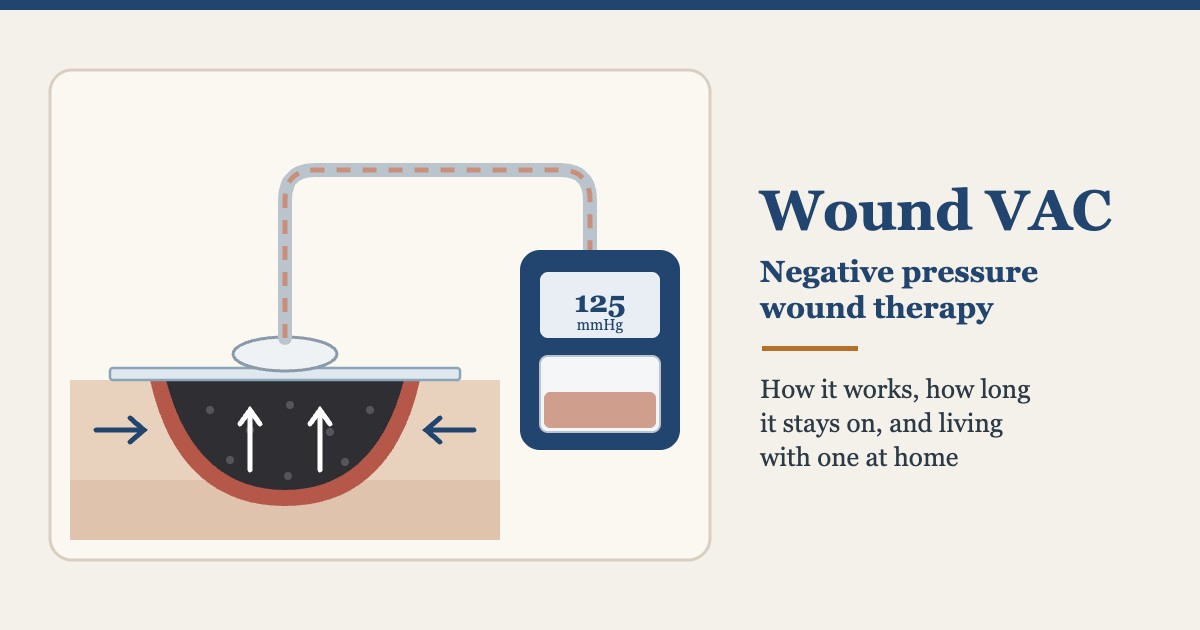
A wound VAC is a small pump that keeps a wound under gentle, steady suction. Foam is cut to fit the wound, sealed under clear film and connected by a tube to the pump, which draws fluid out into a canister and helps the wound fill in from the bottom. On the foot it earns its place after surgery, such as a partial amputation or the removal of a lot of dead or infected tissue. Here is how it works, how long people wear one, what the alarms mean, how to shower, sleep and get around with one, and when it is the wrong tool for a diabetic foot.
The short version
A wound VAC, or negative pressure wound therapy, holds a sealed foam dressing under suction, often set at 125 mmHg. It pulls fluid out of the wound and helps it fill with new tissue. The foam is changed every 48 to 72 hours, and at least three times a week, and most people wear one for several weeks or a few months.
On a diabetic foot it earns its place after surgery. The international diabetic foot guideline suggests considering it for wounds left by surgery, and advises against using it to heal an ordinary foot ulcer, where the largest everyday-practice trial found no real benefit. What heals an ulcer is taking the pressure off it, removing dead tissue, treating infection and restoring blood flow.
At home, keep it running day and night. If the pump has been off for more than two hours, call your wound team. Heavy bleeding, or bright red blood filling the tubing or canister, is an emergency.
Wound VAC at a glance
| Question | Answer |
|---|---|
| What it is | Foam (or gauze) in the wound, sealed with clear adhesive film, connected by tubing to a portable suction pump with a canister |
| Other names | Negative pressure wound therapy (NPWT), vacuum-assisted closure (V.A.C.) |
| What it does | Removes wound fluid, draws the wound edges in and encourages new tissue to fill the wound |
| Used on the foot for | Wounds left open after surgery, such as a partial foot amputation or a large debridement |
| Not for | An ordinary diabetic foot ulcer as a healing treatment; wounds with cancer, untreated bone infection, dead tissue still in place, or exposed blood vessels or organs |
| Dressing changes | Every 48 to 72 hours, at least three times a week; more often if the wound is infected |
| How long | Several weeks to a few months; Medicare re-checks progress monthly and covers up to 4 months per wound |
| The rule to remember | If the pump has been off for more than 2 hours, call your wound team |
How a wound VAC works
A nurse or doctor cuts foam to fit the wound and lays it in, covers the foam and a margin of skin around it with clear adhesive film, and fixes a small pad over a hole in the film. A tube runs from the pad to a portable pump, carried in a shoulder bag. When the pump starts it removes the air under the film, and the foam pulls in firm, like vacuum-packed coffee.
The suction pulls fluid out of the wound and into a canister on the pump, which keeps the wound from sitting in its own drainage. It also draws the edges of the wound together. Over days, the wound bed fills with granulation tissue: red, moist, bumpy new tissue that skin can later grow across. In the main trial in diabetic feet, wounds treated this way built that tissue faster than wounds under ordinary moist dressings.
Your team sets the suction. 125 mmHg below normal air pressure, about a sixth of an atmosphere, is a common setting.
When a wound VAC is used on a diabetic foot
After surgery, the evidence is in its favor. The best evidence on the foot comes from wounds left open after a partial foot amputation. In a trial of 162 people with diabetes, 56% of those wounds healed within 16 weeks with negative pressure, against 39% with standard moist dressings, and they healed faster. The 2023 guideline from the International Working Group on the Diabetic Foot (IWGDF) suggests considering negative pressure, alongside standard care, for diabetes-related foot wounds left by surgery. That is a conditional recommendation, made on low-certainty evidence.
For an ordinary foot ulcer, the guideline says no. An earlier trial of 342 people with diabetic foot ulcers found more ulcers closed with negative pressure, 43% against 29%. But the larger DiaFu trial, run in everyday German clinics, found no real difference: 14.6% of wounds closed with negative pressure and 12.1% with standard moist care. Weighing all of it, the IWGDF advises against using negative pressure to heal diabetic foot ulcers that were not caused by surgery, a strong recommendation made on low-certainty evidence. A Cochrane review of 11 trials landed in a similar place: negative pressure may help, but the evidence is too uncertain to be sure.
| Study | Who | Healed with a wound VAC | Healed without |
|---|---|---|---|
| Armstrong and Lavery, Lancet 2005 | 162 people after a partial foot amputation | 56% within 16 weeks | 39% |
| Blume and colleagues, Diabetes Care 2008 | 342 people with diabetic foot ulcers | 43% within 112 days | 29% |
| DiaFu (Seidel and colleagues), BMJ Open 2020 | 345 people with diabetic foot wounds, everyday clinics | 14.6% within 16 weeks | 12.1%, no real difference |
So if a wound VAC is offered for a foot ulcer that has not had surgery, it is fair to ask why, and what else has been tried. The steps that heal ulcers come first: offloading, removing dead tissue, treating infection and checking blood flow. See diabetic foot ulcers for the whole picture.
Dressing changes, and what they feel like
The foam is changed every 48 to 72 hours, and at least three times a week, more often if the wound is infected. A home health nurse usually does it, or it is done at a wound clinic. The wound is looked at with each change and measured regularly, which is how your team tells whether it is filling in.
When the pump starts, most people feel pulling or tightness that settles within minutes. The change itself is the part that can hurt, because new tissue grows into the foam. Ask whether to take pain medicine beforehand, and say so if it hurts: there are ways to make changes easier.
How long you will have one
Usually several weeks to a few months, depending on the wound and how well you heal. A wound that stops getting smaller is a reason to rethink the plan rather than carry on.
Medicare covers a home wound VAC for a diabetic foot ulcer only after a full wound-care program has been tried or ruled out: measurements, moist dressings, removal of dead tissue and a nutrition check, with diabetes being managed and the pressure taken off the ulcer. Progress has to be measured at least monthly. Coverage stops if a month passes with no measurable healing, and runs for at most four months per wound.
Living with a wound VAC at home
Keep it on, day and night. The dressing only works under suction. The maker’s patient booklet tells patients to contact their clinician if the pump has to be off for more than two hours, and hospital guides say the same. If it stops and you cannot restart it, call.
| Alarm | What it usually means | What to do |
|---|---|---|
| Leak | Air is getting in under the film, often with a whistling or hissing sound | Find the leak, usually where the film meets the skin or the tube, and press the film down; call if it will not seal |
| Blockage | The tubing is kinked, pinched or clamped | Straighten the tubing and check any clamp is open; call if it keeps alarming |
| Canister full | The canister needs changing | Change it as you were shown, or call your team |
| Low battery | The battery is running down | Plug the pump in, and take the charger with you when you go out |
| Therapy off | The pump has been switched off or has stopped | Turn it back on; if it has been off for more than 2 hours, call |
Showers. No baths, hot tubs or swimming. Ask your team whether you may shower. When they allow it, the pump is disconnected and the tubing clamped as you were shown, the dressing is kept out of the spray, and the pump itself never gets wet. Keep it short: the two-hour rule still applies.
Sleep. The pump runs through the night. Keep it beside you, with the tubing loose and not underneath you, so it cannot kink.
Walking. A wound VAC does not take the pressure off your foot. If the wound is on the sole, you still need the offloading your surgeon prescribed, such as a boot, a surgical shoe or crutches, and should follow their instructions on how much weight to put through the foot. See offloading a foot ulcer.
Clothes. Loose trousers with wide legs or side zips go over the dressing and tubing without pulling on the film.
When to get help
Call 911 or go to an emergency department for sudden or heavy bleeding, bright red blood filling the tubing or canister, or blood pooling under the film.
Call your wound team the same day for any blood in the tubing, a fever, pus or a bad smell, more redness, warmth, swelling or pain around the wound, fluid in the canister that changes color or thickness, or a pump that has been off for more than two hours. With diabetes, an infected foot may not hurt, so go by what you see.
Who should not have one
Negative pressure is not used over:
- Exposed blood vessels or organs.
- Cancer in the wound.
- Dead tissue that has not been removed. It comes off first, by surgery or with an enzyme ointment such as Santyl.
- An untreated bone infection. Infection in the bone of a diabetic foot needs treating in its own right; see diabetic foot infections.
- Certain abnormal tunnels between the wound and the organs or tissues beneath it.
- Anyone allergic to the foam, the film or the adhesive.
Tell your team if you take a blood thinner or bleed easily, because bleeding, though rare, can be severe. There are also small, disposable, battery-powered versions for smaller wounds and surgical incisions; ask whether one suits your wound.
What to buy
The pump, foam, film and canisters come from the supplier your team arranges. These help with life around it. Our editorial policy names a product only once we can say what was assessed and on what basis, so this list shops by type rather than by brand.
- For showers your team has allowed: a waterproof cast and bandage protector for the foot, with the pump disconnected and the tubing clamped as you were shown.
- For clothes that fit over the dressing: side-zip or tear-away trousers.
- If your surgeon wants the foot raised: a leg elevation wedge pillow.
Common questions
How long do you have to wear a wound VAC?
Usually several weeks to a few months, depending on the wound. Your team checks it at each dressing change and measures it regularly. Medicare re-checks progress every month and covers up to four months per wound.
Does a wound VAC hurt?
Most people feel pulling or tightness when the pump starts, which settles within minutes. Dressing changes can hurt because new tissue grows into the foam; ask about pain medicine beforehand, and tell the nurse if it hurts.
How often is a wound VAC dressing changed?
Every 48 to 72 hours, and at least three times a week. Infected wounds may need more frequent changes.
Can you shower with a wound VAC?
Only if your team says so. No baths or swimming. When showering is allowed, the pump is disconnected and the tubing clamped as you were shown, the dressing stays out of the spray, and the pump never gets wet. Keep it well under two hours.
What happens if my wound VAC turns off?
Turn it back on and check the battery and tubing. If it has been off for more than two hours, or will not restart, call your wound team: the dressing is designed to work under suction.
Why is my wound VAC beeping?
The usual causes are a leak in the seal, a kinked or clamped tube, a full canister, a low battery or the pump being off. Fix the cause if you can, and call if the alarm keeps going.
Can you walk with a wound VAC on your foot?
Yes, the pump is portable. But it does not take pressure off the wound, so if the wound is on the sole you still need the offloading your surgeon prescribed, and should follow their instructions on weight-bearing.
Can you sleep with a wound VAC?
Yes. It runs all night. Keep the pump beside you and the tubing loose, not under your body, so it cannot kink.
Does a wound VAC help a diabetic foot ulcer heal?
After surgery, such as a partial foot amputation, the evidence is in its favor and the IWGDF guideline suggests considering it. For an ordinary ulcer that has not had surgery, the guideline advises against it; offloading, removing dead tissue, treating infection and restoring blood flow come first.
Does Medicare cover a wound VAC?
Yes, when its criteria are met. For a diabetic foot ulcer, a full wound-care program must have been tried or ruled out first, with diabetes managed and the pressure taken off the ulcer. Progress is checked monthly, and coverage lasts at most four months per wound.
Is blood in the wound VAC tubing normal?
Tell your team about any blood in the tubing. Sudden or heavy bleeding, or bright red blood filling the tubing or canister, is an emergency: call 911 or go to an emergency department.
Sources
The maker’s patient booklet, hospital patient guides, the trials and guideline named, and Medicare’s coverage rules.
- KCI (Acelity). V.A.C. Therapy patient information booklet, hosted by Oxford Health NHS Foundation Trust. oxfordhealth.nhs.uk — dressings changed every 48 to 72 hours and no less than three times a week, more often for infected wounds; contact your clinician if the system must be off for more than two hours; a whistling sound means air is getting in; the canister-full alarm also sounds for kinked or blocked tubing; showering with the dressing only when disconnected with the tubing clamped, without soaking the dressing, and never wetting the unit; call for excessive bleeding, pus or a bad smell, or fever.
- St. Jude Children’s Research Hospital. Negative pressure wound therapy (Together by St. Jude). together.stjude.org — common alarm causes (pump off, low battery, leak or blockage, full canister); let the care team know if the system is off for more than two hours; call for increased bleeding or canister fluid that changes color or consistency.
- Cleveland Clinic. Negative pressure wound therapy. my.clevelandclinic.org — pulls fluid and bacteria from the wound; dressings changed every 48 to 72 hours; avoid baths; risks include bleeding and infection; not used with exposed organs or blood vessels, cancer, dead tissue or certain abnormal connections.
- Johns Hopkins Medicine. Vacuum-assisted closure of a wound. hopkinsmedicine.org — used for several weeks or months; pain medicine may be prescribed for dressing changes; report fever, increased pain or swelling, or blood in the tubing.
- Skin and Wound Care (open textbook). Negative-pressure wound therapy. eCampusOntario Pressbooks — contraindications including malignancy in the wound, untreated osteomyelitis, necrotic tissue with eschar, exposed vital organs or blood vessels, non-enteric and unexplored fistulas, and allergy to the materials.
- Armstrong DG, Lavery LA. Negative pressure wound therapy after partial diabetic foot amputation: a multicentre, randomised controlled trial. Lancet. 2005;366(9498):1704-1710. doi:10.1016/S0140-6736(05)67695-7 — 162 patients; 56% healed with negative pressure against 39% with standard moist care within 16 weeks; faster healing and faster granulation.
- Blume PA, Walters J, Payne W, Ayala J, Lantis J. Comparison of negative pressure wound therapy using vacuum-assisted closure with advanced moist wound therapy in the treatment of diabetic foot ulcers: a multicenter randomized controlled trial. Diabetes Care. 2008;31(4):631-636. doi:10.2337/dc07-2196 — 342 patients; complete closure in 43.2% against 28.9% within 112 days; fewer secondary amputations.
- Seidel D, Storck M, Lawall H, et al. Negative pressure wound therapy compared with standard moist wound care on diabetic foot ulcers in real-life clinical practice: results of the German DiaFu-RCT. BMJ Open. 2020;10:e026345. doi:10.1136/bmjopen-2018-026345 — 345 participants analysed; wound closure within 16 weeks in 14.6% against 12.1% (p=0.53); not superior to standard moist wound care.
- Liu Z, Dumville JC, Hinchliffe RJ, et al. Negative pressure wound therapy for treating foot wounds in people with diabetes mellitus. Cochrane Database Syst Rev. 2018;(10):CD010318. doi:10.1002/14651858.CD010318.pub3 — 11 trials, 972 adults; low-certainty evidence that negative pressure may increase healing; the authors cannot be certain it is effective.
- Chen P, Vilorio NC, Dhatariya K, et al. Guidelines on interventions to enhance healing of foot ulcers in people with diabetes (IWGDF 2023 update). Diabetes Metab Res Rev. 2024;40(3):e3644. doi:10.1002/dmrr.3644 — recommendation 28: consider negative pressure as an adjunct to standard care for post-surgical diabetes-related foot wounds (conditional, low certainty); 28a: do not use it for non-surgical diabetes foot ulcers (strong, low certainty).
- Centers for Medicare & Medicaid Services. Local Coverage Determination L33821, Negative Pressure Wound Therapy Pumps. cms.gov — for a diabetic ulcer, a complete wound therapy program tried or ruled out first, a comprehensive diabetic management program, and pressure taken off the ulcer; monthly measurement; coverage ends after a month with no measurable healing or at four months.
Related guides
Offloading a foot ulcer
Why taking the pressure off heals an ulcer more than any dressing or device.
Diabetic foot ulcers
The whole of ulcer care: debridement, dressings, infection and circulation.
Toe amputation with diabetes
What recovery involves after limb-preserving surgery on the foot.
Santyl ointment
How the enzyme clears dead tissue, and what switches it off.
Hydrocolloid bandages
How they work, how long to leave one on, and when not to.
Diabetic foot infections
The signs, why they can be painless, and why they cannot wait.
A wound after foot surgery, or one that will not heal, in Michigan?
Balance Foot & Ankle, the author’s practice, treats foot wounds in people with diabetes in Howell and Bloomfield Township, including wounds after foot surgery, with checks of circulation and infection at the same visit.

Dr. Tom Biernacki is a double board-certified podiatric foot and ankle surgeon practising in Michigan. He treats diabetic wounds, Charcot neuroarthropathy and at-risk feet daily, and writes here to put the clinical reasoning behind that care in front of the people living with it.