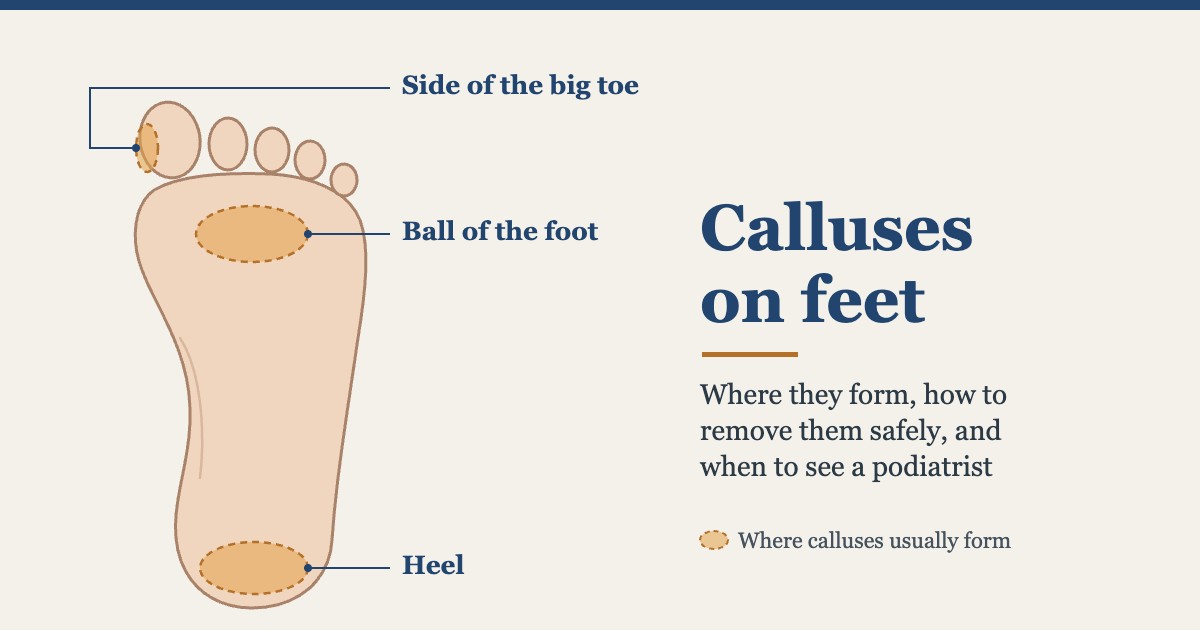
A callus is a patch of thick, hard skin that builds up where the foot is pressed or rubbed again and again, most often under the ball of the foot, on the heel and along the side of the big toe. Most calluses are harmless, and gentle filing, a softening cream and better padding keep them down. But a callus that hurts, keeps coming back or sits on a foot with diabetes needs more care: in people with diabetic nerve damage, a callus is one of the strongest warning signs of a future foot ulcer. Here is how to tell a callus from a corn or a wart, how to remove one safely, which callus removers to skip, and when to see a podiatrist.
The short version
A callus is the skin’s way of protecting itself from pressure and friction. It is broad, flat and usually painless, and on the foot it forms where the load is greatest: under the ball of the foot, on the heel and on the side of the big toe. A corn is smaller and deeper, with a hard core that hurts when pressed.
If you do not have diabetes, nerve damage or poor circulation, most calluses can be handled at home: soak the skin for 5 to 10 minutes, file it gently with a pumice stone or foot file, use a cream with urea or ammonium lactate every day, and take the pressure off with padding and roomier shoes. Never cut or shave a callus, and see someone if it is no better after three weeks, bleeds or drains.
If you have diabetes, leave calluses to a podiatrist. In people with diabetic nerve damage, a callus on the sole raised the risk of a foot ulcer 11-fold in one study, and blood showing inside a callus can mean an ulcer is forming underneath. Medicare may cover callus care when diabetes has damaged the nerves or circulation in the feet.
Calluses at a glance
| Question | Answer |
|---|---|
| What it is | A broad patch of thickened outer skin, of fairly even thickness, built up in response to repeated pressure or friction |
| Where on the foot | Under the ball of the foot, on the heel, on the side of the big toe, and wherever a shoe rubs |
| Does it hurt? | Usually not. A corn, or a thick callus over a bony point, can |
| Common causes | Shoes that are too tight, too loose or high-heeled; going without socks; bunions and hammertoes; thinning padding under the foot |
| Home care | Soak, file gently, moisturize daily with urea or ammonium lactate, pad it, change the shoes |
| Never | Cut or shave it, or use acid corn and callus removers if you have diabetes or poor circulation |
| See a podiatrist if | It hurts, bleeds or drains, is no better after three weeks, or you have diabetes, nerve damage or poor circulation |
| Will it come back? | Yes, unless the pressure or rubbing behind it is dealt with |
Callus, corn or plantar wart?
All three can look like a patch of hard skin on the sole, but they have different causes and need different care.
| Callus | Corn | Plantar wart | |
|---|---|---|---|
| Size and shape | Broad and flat, even thickness, no sharp edge | Small and round, with a hard central core | Round and rough, often with hard skin over it |
| Where | Ball of the foot, heel, side of the big toe | Tops and tips of the toes; soft corns between the fourth and fifth toes | Anywhere on the sole |
| Skin lines | Run across it | Run across it | Broken up by it |
| Dots | None | None | Tiny black dots, which are clotted blood vessels |
| What hurts | Usually nothing | Pressing straight down on it | Squeezing it from the sides |
| Cause | Pressure and friction | Pressure over a bony point | A virus, HPV |
If you are not sure which you have, or you have diabetes or poor feeling in your feet, have it looked at before treating it.
Why calluses form on the bottom of the foot
Thickening is the skin’s normal protective response to pressure or rubbing that happens again and again. The sole carries your weight with every step, so calluses gather where pressure peaks: under the ends of the long foot bones at the ball of the foot, under the heel, and along the side of the big toe. Common causes are:
- Shoes. Shoes that are too tight or too loose, high heels that tip your weight onto the ball of the foot, and seams or stitching that rub.
- No socks. Bare feet in shoes or sandals rub more.
- Foot shape. Bunions, hammertoes and other prominent bones push one spot harder into the shoe or the ground.
- Thinner padding. Losing some of the natural fat pad under the foot leaves the skin with less cushioning.
- Time on your feet. Long walks and long hours standing add to the load.
Once it forms, a callus adds to the problem by pressing back on the tissue under it. When 43 calluses under the ball of the foot were removed in people with diabetes, peak pressure at those spots fell by 26%. That is also why a callus comes back if the shoe, the foot shape or the activity behind it is left unchanged.
How to get rid of calluses on your feet safely
These steps are for people who do not have diabetes, nerve damage in the feet or poor circulation. If any of those apply to you, go to calluses and diabetes instead.
- Soften it. Soak the foot in warm, not hot, water for 5 to 10 minutes, until the hard skin softens.
- File a little. Wet a pumice stone or foot file and rub the callus in circular or sideways strokes. Stop while some hard skin remains: taking off too much can cause bleeding and infection. Repeat over several days rather than trying to remove it all at once.
- Moisturize every day. A cream or lotion with urea or ammonium lactate softens hard skin gradually. Creams with salicylic acid work too, but skip them if you have diabetes.
- Take the pressure off. Cut moleskin into two half-moons and place them around the callus, put a felt or gel metatarsal pad just behind a callus under the ball of the foot rather than on it, and use soft insoles or heel pads.
- Fix the cause. Wear shoes with room for your toes, a low heel and a soft sole, always with socks. Shop for shoes at the end of the day, when feet are largest, and keep toenails trimmed so the toes are not pushed into the shoe.
- Know when to stop. See a doctor or podiatrist if the callus is no better after three weeks, hurts a lot, bleeds, or has pus or other discharge.
Never cut or shave a callus
Razor blades, callus shavers and scissors are how a harmless callus becomes a wound. The NHS and Cleveland Clinic both warn against cutting corns and calluses yourself. A podiatrist pares them with a sterile blade, which usually brings almost immediate relief.
Callus removers: what is safe and what to skip
| Type | Verdict | Why |
|---|---|---|
| Pumice stone or foot file | Fine, used gently | Used wet, after soaking, a little at a time. Not for a numb foot: with diabetes, nerve damage or poor circulation, leave filing to a podiatrist. |
| Electric callus remover | As for a foot file | It is a powered file, so the same rules apply: softened skin, light pressure, short sessions, and never on a numb foot. |
| Urea or ammonium lactate cream | Good for almost everyone | Softens hard skin gradually and can be used every day. For people with diabetes, moisturizing dry skin is part of the international foot ulcer prevention guideline. |
| Salicylic acid pads, plasters and liquids | Skip with diabetes or poor circulation | The label the FDA requires says not to use them if you have diabetes or poor blood circulation, or on irritated, infected or reddened skin, and to stop after 14 days. The acid can also damage the healthy skin around the callus, especially on a foot with nerve damage. |
| Callus-dissolving gels and foot peels | Skip with diabetes or poor circulation | Products that dissolve calluses contain harsh chemicals. Read the label, and if you have diabetes or poor circulation, leave them on the shelf. |
| Callus shavers, razors and blades | Never | Easy to cut too deep and start an infection. A podiatrist does this with sterile instruments. |
Calluses and diabetes
Why a callus matters more
Diabetes can damage the nerves in the feet, so pressure no longer hurts. Calluses then build up where pressure is highest, and the callus pushes the pressure higher still. In a study that followed 63 people with diabetic nerve damage for about 15 months, a callus on the sole raised the risk of a new ulcer 11-fold, more than high foot pressure did (about 5-fold); only a previous ulcer at the same spot was a stronger warning. The international guideline on preventing diabetic foot ulcers, from the International Working Group on the Diabetic Foot (IWGDF), lists excess callus as a risk factor and strongly recommends treating it, by someone trained to do so, because callus care can cause harm when it is done badly.
Blood in a callus is a warning sign
A red, brown or black spot inside a callus, or a callus that is soggy, cracked or draining, can mean the skin underneath is breaking down. The IWGDF treats bleeding into the skin, blisters and cracks as pre-ulcerative signs that need treatment. Do not pick or dig at it: have it seen by a podiatrist promptly, and see early-stage diabetic foot ulcers for what to look for.
What to do instead
- Do not treat it yourself. The NHS advises people with diabetes, circulation problems or a weakened immune system not to treat corns and calluses themselves, and the labels on corn and callus removers say not to use them if you have diabetes.
- Moisturize dry skin every day with a plain emollient or a urea cream; see diabetic foot creams.
- Do not soak your feet. The NIDDK advises people with diabetes against soaking, because it dries the skin.
- Check your feet every day, and have calluses trimmed by a podiatrist, who can also deal with the pressure behind them: extra-depth shoes, custom insoles, toe silicone or other orthoses, as the IWGDF suggests. See diabetic shoes.
Does Medicare pay for callus care?
Not as routine care for most people: Medicare excludes cutting or removing corns and calluses. The exception is a condition such as diabetes that has caused severe circulation problems or lost feeling in the feet, so that routine foot care by a non-professional could be hazardous. Then it can be covered, and the podiatrist records specific findings, such as absent foot pulses or a past amputation, to show it. People with diabetic nerve damage and loss of protective sensation can also have a covered foot exam every 6 months. After the Part B deductible, you pay 20% of the Medicare-approved amount.
What a podiatrist does
- Pares the callus or corn with a sterile blade, which usually brings quick relief and lowers the pressure under it.
- Looks for the cause: your shoes, your activities, the shape of your foot and the way you walk.
- Takes the pressure off with felt or foam padding, metatarsal pads, silicone toe sleeves, insoles or custom orthoses.
- Advises on shoes: a low heel, a soft upper and a roomy toe box, with extra depth for hammertoes.
- Considers surgery only when a bony deformity keeps causing painful corns or calluses and padding, insoles and shoes have not worked.
Preventing calluses
- Wear shoes that fit, with room for your toes, a low heel and a soft sole, and buy them late in the day.
- Wear socks with shoes, every time.
- Pad the spots that rub with moleskin, felt pads or silicone sleeves.
- Moisturize the soles every day.
- Keep toenails trimmed straight across.
- With diabetes, check your feet daily and have them examined by a professional at least once a year; see the diabetic foot exam.
What to buy
For people without diabetes, nerve damage or poor circulation, these are the basics for keeping a callus down at home. With diabetes, stick to the cream and the padding, and leave the filing to a podiatrist. Our editorial policy names a product only once we can say what was assessed and on what basis, so this list shops by type rather than by brand.
- To soften the skin every day: a urea foot cream; see diabetic foot creams for what to look for.
- To file after soaking: a pumice stone or a foot file, never a blade.
- For a callus under the ball of the foot: metatarsal pads, placed just behind the callus rather than on it.
- For a corn or callus on a toe: non-medicated silicone toe sleeves.
- To pad around a callus: moleskin, cut into two half-moons.
Common questions
What causes calluses on the bottom of the feet?
Repeated pressure and friction: shoes that are tight, loose or high-heeled, going without socks, foot shapes such as bunions and hammertoes, thinner padding under the foot, and long hours on your feet.
How do you get rid of calluses on your feet fast?
There is no safe instant fix at home. Soak, file a little at a time, moisturize daily with urea or ammonium lactate and pad the spot; it takes days to weeks. A podiatrist can pare a painful callus down in one visit.
Will a callus go away on its own?
Usually only if the pressure or rubbing that caused it stops. If the cause stays, the callus comes back, which is why shoes, padding and insoles matter as much as filing.
Is it OK to cut off a callus?
No. Cutting or shaving at home risks a deep cut and an infection, and the NHS and Cleveland Clinic both advise against it. If it needs paring, a podiatrist does it with sterile instruments.
What is the difference between a corn and a callus?
A callus is broad, flat and usually painless, and forms under the ball of the foot, the heel or the side of the big toe. A corn is small and deep, with a hard core that hurts when pressed, and usually sits on or between the toes.
Is it a callus or a plantar wart?
A wart breaks up the normal lines of the skin, often has tiny black dots, and hurts more when squeezed from the sides. A callus has none of these. If you are not sure, or you have diabetes, have it checked.
Does Vaseline get rid of calluses?
Petroleum jelly keeps skin soft and can help stop it cracking, but it does not break down thick skin. Creams with urea or ammonium lactate soften calluses gradually.
Are callus removers safe if you have diabetes?
Salicylic acid pads, plasters and liquids are not: their labels say not to use them if you have diabetes or poor circulation. Dissolving gels contain harsh chemicals, and blades and shavers are never safe at home. A moisturizing cream and padding are fine; trimming is a podiatrist’s job.
Should I worry about a callus if I have diabetes?
Take it seriously. In people with diabetic nerve damage, a callus on the sole raised the risk of an ulcer 11-fold in one study. Have it trimmed by a podiatrist, and get any blood, drainage or cracking in a callus seen promptly.
Does Medicare cover callus removal?
Not as routine care, unless diabetes or another condition has seriously affected the circulation or feeling in your feet. People with diabetic nerve damage and loss of protective sensation can also have a covered foot exam every 6 months.
Sources
Clinical guidance and patient information from the bodies named, the federal labeling rule and Medicare coverage rules, and the clinical literature.
- NHS. Corns and calluses. Reviewed 28 July 2026. nhs.uk — soaking, pumice stone or foot file, moisturizing, soft insoles and heel pads, wide well-fitting shoes with a low heel and soft sole; do not cut corns or calluses yourself; people with diabetes, circulation problems or a weakened immune system should not treat them themselves; see a GP if there is bleeding or discharge or no improvement after 3 weeks; what a podiatrist offers.
- American Academy of Dermatology. How to treat corns and calluses. aad.org — soaking for 5 to 10 minutes; filing with a wet pumice stone in circular or sideways motions; not removing too much skin; moisturizers with salicylic acid, ammonium lactate or urea; moleskin half-moons around a callus; well-fitting shoes bought at the end of the day; trimmed toenails; see a dermatologist with diabetes.
- Mayo Clinic. Corns and calluses: symptoms and causes. mayoclinic.org — corns smaller and deeper with a hard center that hurts when pressed; calluses larger, rarely painful, on heels and balls of the feet; ill-fitting shoes, skipping socks, hammertoe and bunion as causes; medical advice before home treatment with diabetes or poor blood flow.
- Cleveland Clinic. Corns and calluses. Updated 25 July 2023. my.clevelandclinic.org — lost natural foot padding as a risk factor; creams with urea or ammonium lactate; harsh chemicals in products that dissolve corns and calluses; never cut or shave them; they return if the cause is not addressed; custom insoles; surgery for a structural deformity.
- Mayo Clinic. Plantar warts: symptoms and causes. mayoclinic.org — a growth that interrupts the normal lines and ridges of the skin; black pinpoints, which are clotted blood vessels; caused by HPV; see a provider with diabetes or poor feeling in the feet.
- Freeman DB. Corns and calluses resulting from mechanical hyperkeratosis. Am Fam Physician. 2002;65(11):2277-2280. aafp.org — callus as broad, even, diffuse hyperkeratosis, usually under the metatarsal heads; hard corns with a central core; soft corns between the fourth and fifth toes; corns more sensitive to direct pressure and warts to side-to-side compression; paring for almost complete relief; avoiding over-the-counter salicylic acid products, which can damage surrounding skin in people with neuropathy; metatarsal pads and silicone sleeves; footwear; surgery only after conservative care fails.
- US Food and Drug Administration. Labeling of corn and callus remover drug products. 21 CFR 358.550. ecfr.gov — required warning not to use on irritated, infected or reddened skin, or if you are a diabetic or have poor blood circulation; use for up to 14 days.
- Bus SA, Sacco ICN, Monteiro-Soares M, et al. Guidelines on the prevention of foot ulcers in persons with diabetes (IWGDF 2023 update). Diabetes Metab Res Rev. 2024;40(3):e3651. PMID 37302121 — excess callus as a risk factor for ulceration; recommendation 9 (strong) to treat any pre-ulcerative lesion or excess callus; blisters, fissures and haemorrhage as pre-ulcerative signs; callus treatment by an appropriately trained professional; removal of callus reduces plantar pressure; emollients for dry skin; extra-depth or custom footwear, custom insoles and toe silicone or other orthoses.
- Murray HJ, Young MJ, Hollis S, Boulton AJ. The association between callus formation, high pressures and neuropathy in diabetic foot ulceration. Diabet Med. 1996;13(11):979-982. PMID 8946157 — 63 people with diabetic neuropathy followed for a mean of 15.4 months; relative risk of ulceration 11.0 for callus, 4.7 for high plantar pressure and 56.8 for a previous ulcer site.
- Young MJ, Cavanagh PR, Thomas G, Johnson MM, Murray H, Boulton AJ. The effect of callus removal on dynamic plantar foot pressures in diabetic patients. Diabet Med. 1992;9(1):55-57. doi:10.1111/j.1464-5491.1992.tb01714.x — 43 forefoot calluses in 17 people; peak pressure fell 26% after removal.
- National Institute of Diabetes and Digestive and Kidney Diseases. Diabetes and foot problems. niddk.nih.gov — do not soak your feet, because the skin gets too dry.
- Centers for Medicare & Medicaid Services. Medicare Benefit Policy Manual, chapter 15, section 290: foot care. cms.gov — cutting or removal of corns and calluses excluded as routine foot care; exception for systemic conditions such as diabetes that cause severe circulatory problems or diminished sensation; class findings such as nontraumatic amputation and absent foot pulses.
- Medicare.gov. Foot care (for diabetes). medicare.gov — a foot exam every 6 months for diabetic peripheral neuropathy with loss of protective sensation; 20% of the Medicare-approved amount after the Part B deductible.
Related guides
Early-stage foot ulcers
What an ulcer looks like as it starts, often under a callus.
Dry, cracked feet
Why heels crack, and how to stop cracks turning into wounds.
Diabetic foot creams
Which creams soften hard skin, and what to look for on the label.
Diabetic shoes
Shoes and insoles that take pressure off the sole.
Blisters on the feet
Why blisters form on numb feet, and how to care for them.
The diabetic foot exam
What a foot exam checks, and how often you need one.
A painful callus or corn, in Michigan?
Balance Foot & Ankle, the author’s practice, trims calluses and corns and looks for the pressure behind them in Howell and Bloomfield Township, including for people with diabetes, nerve damage or poor circulation.

Dr. Tom Biernacki is a double board-certified podiatric foot and ankle surgeon practising in Michigan. He treats diabetic wounds, Charcot neuroarthropathy and at-risk feet daily, and writes here to put the clinical reasoning behind that care in front of the people living with it.