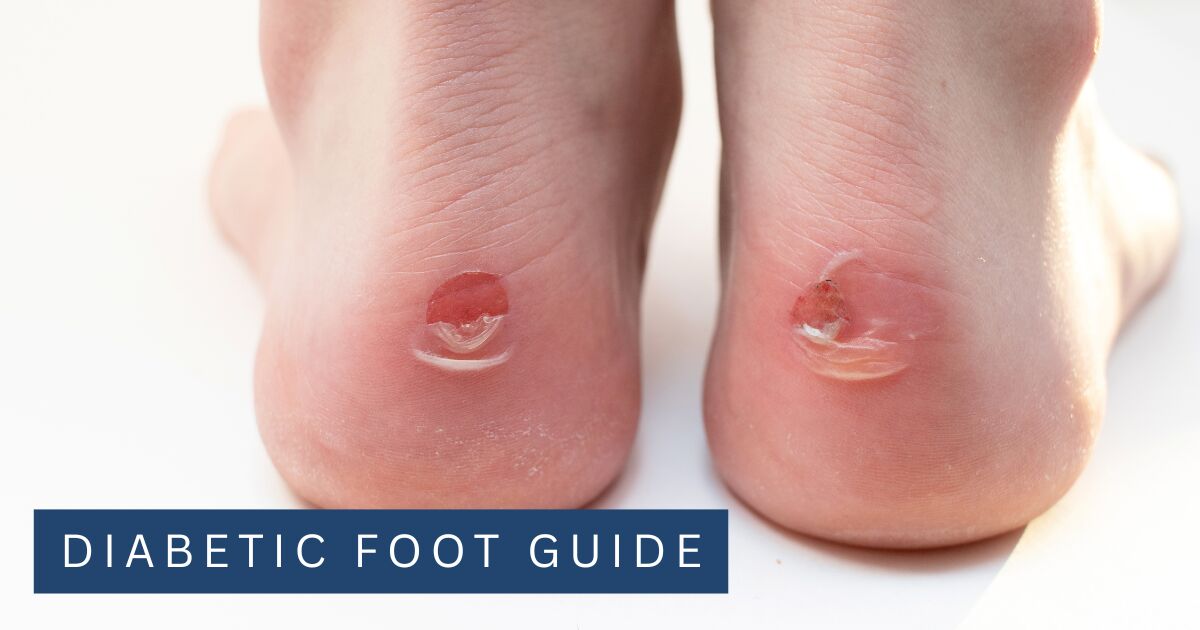
A blister that appears on a diabetic foot overnight, with no shoe rub and no burn to explain it, is a recognized condition with a name — bullosis diabeticorum. It is usually painless, it usually heals, and it is still a wound on a foot that cannot feel.
The short version
Most blisters on a diabetic foot are ordinary friction blisters that matter more than they would on anyone else, because the foot did not report the rubbing. A smaller number are diabetic bullae — large, tense, clear blisters that appear spontaneously, usually on the feet and lower legs, in people with long-standing diabetes and neuropathy.
Either way the rule is the same: do not pop it, do not cut the roof off, cover it, and have it looked at. Intact blister skin is the best dressing that wound will ever have.
Diabetic blister pictures: the three kinds
Three kinds of blister account for most of what turns up on a diabetic foot. They look different, start differently and run on different clocks. The rule for all three is the same: leave the roof on.
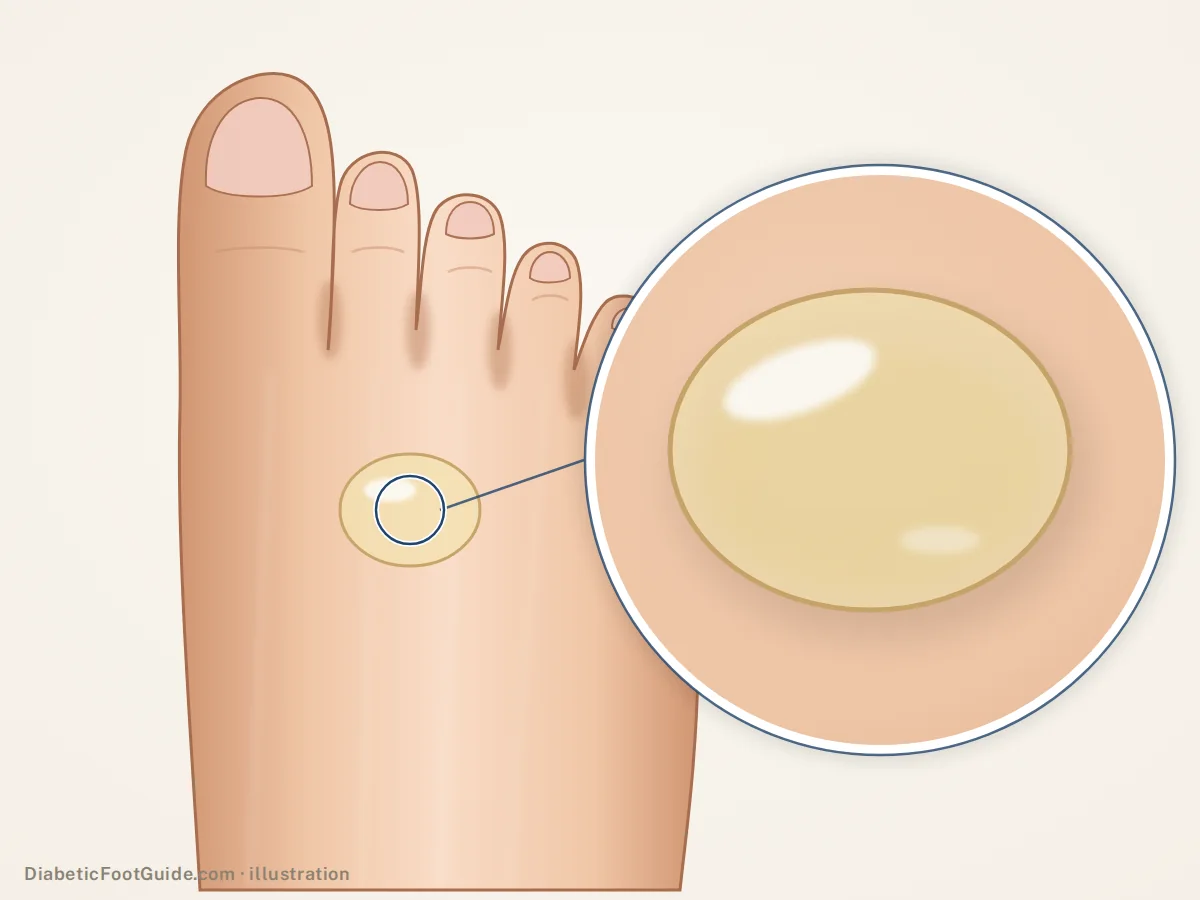
Diabetic bullae (bullosis diabeticorum)
Looks like: one or more large, tense blisters of clear fluid that appear overnight on skin that otherwise looks normal. No redness around them, no rub to explain them, often no pain. They turn up on the feet and toes and on the shins and lower legs, so diabetic blisters on the legs can be this same condition.
Usually: long-standing diabetes with neuropathy. Left intact and protected, they generally heal over a few weeks without a scar.
Urgency: have it seen within days, and call the same day if it breaks. The roof is the only thing between it and an open wound.
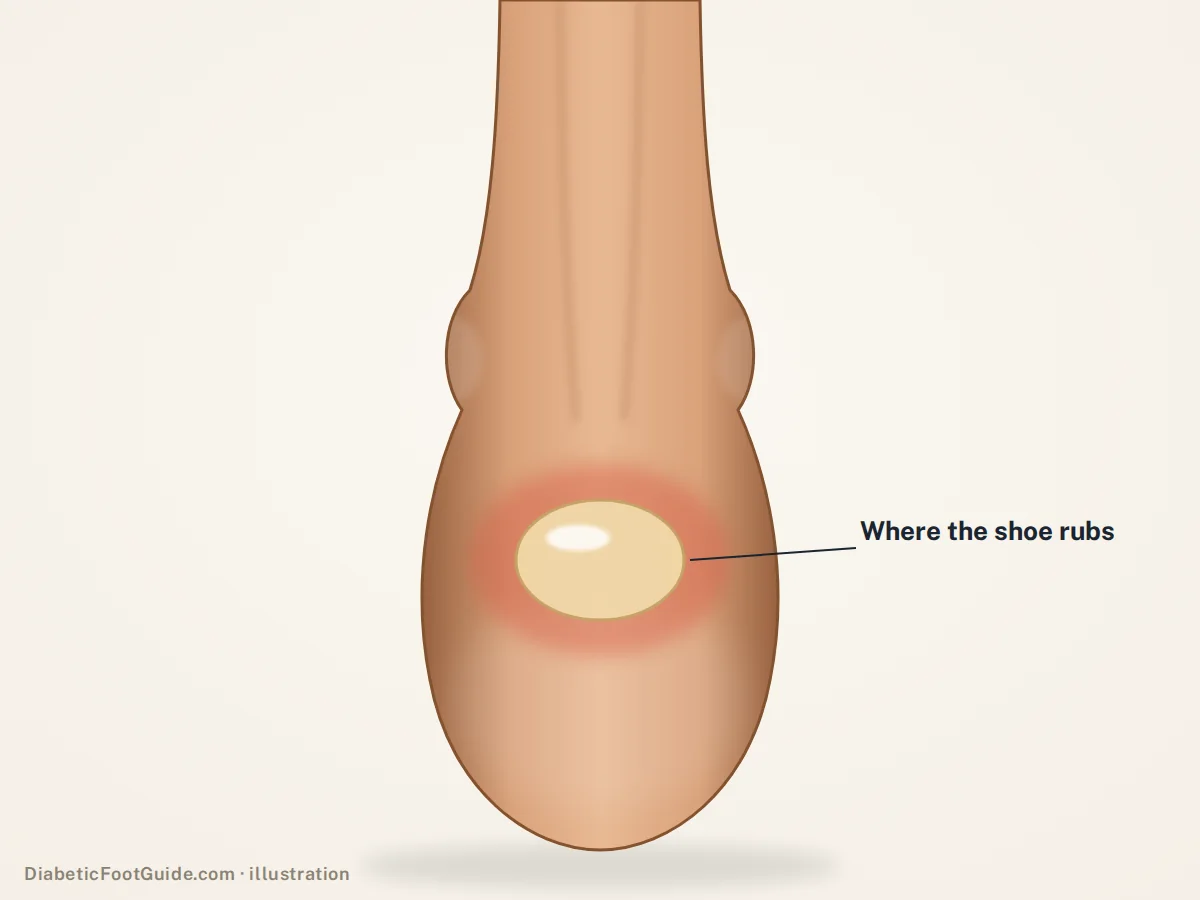
Friction blister
Looks like: a bubble of clear fluid exactly where the shoe rubs: the back of the heel, the side of the big toe, the top or tip of a toe. A thin rim of pink redness from the shoe is common. Redness that spreads outward or feels warm is not the shoe; it is infection.
Usually: new or ill-fitting shoes, a seam, a wrinkled sock, a long walk, or a foot that swelled into yesterday’s shoe.
Urgency: stop the rub today and have it seen within days. On a foot that cannot feel, it is a pre-ulcer.
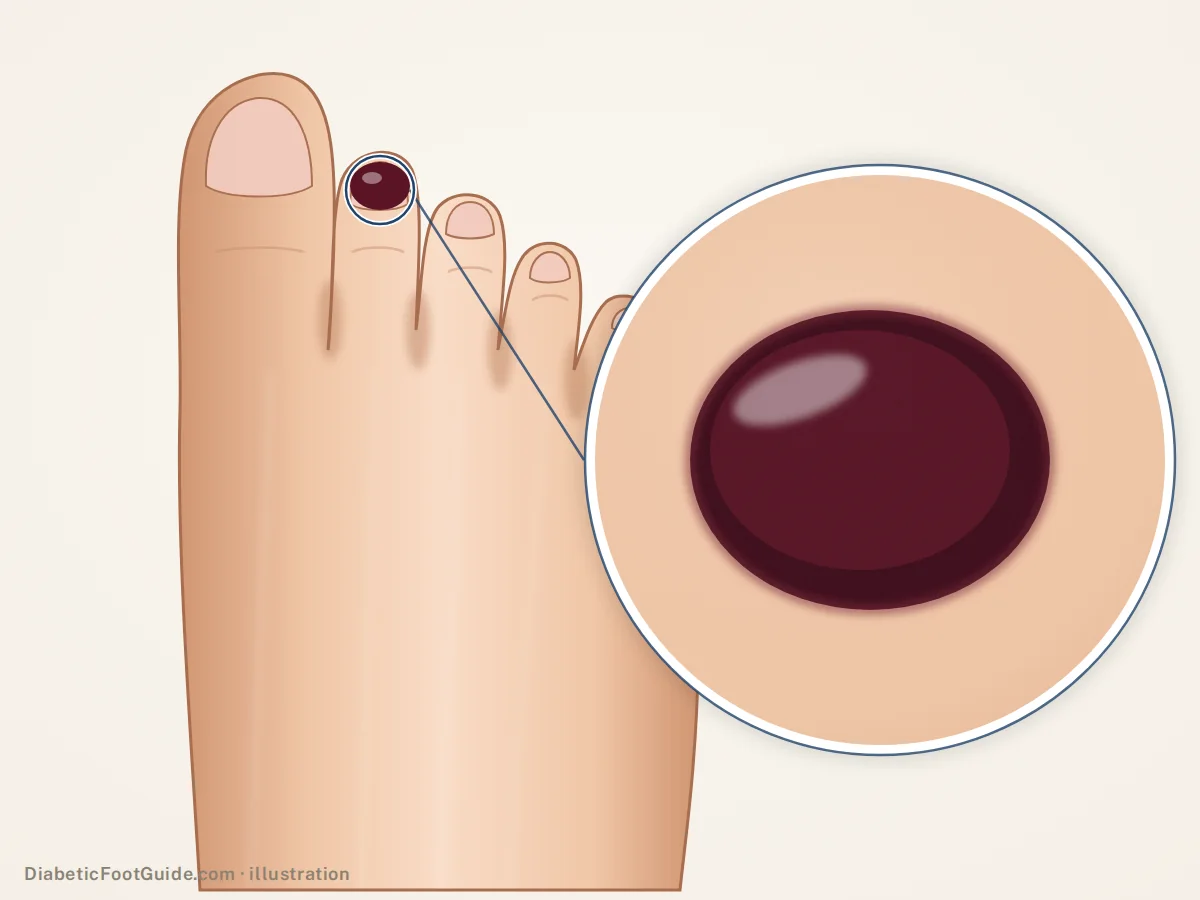
Blood blister, on a toe or in a callus
Looks like: dark red, purple or nearly black fluid instead of clear, on the tip or top of a toe, or showing through a callus on the ball of the foot as a dark spot.
Usually: pressure or shear strong enough to break small blood vessels under the skin, from a shallow toe box, a clawed toe whose tip takes weight, or a callus the foot keeps landing on. A diabetic blood blister on a toe is rarely random: something is pressing on that toe.
Urgency: same day. Blood inside a callus usually means the skin has already started to break down underneath.
Blisters on the shins and lower legs. Besides diabetic bullae, the other common cause is swelling itself: when legs swell quickly, the stretched skin can blister and weep clear fluid. Those blisters come with puffy, heavy legs, and they are a swelling problem as much as a skin one; see swollen feet and diabetes.
When a blister is an ulcer in disguise
A blister is damaged skin that is still covered. Once the cover is gone, or the damage runs deeper than the blister, it is an open wound, and on a diabetic foot an open wound is treated as an ulcer whatever it started as. Diabetic bullae are not exempt: once open, they heal on an ulcer’s timetable, and a Danish diabetic foot clinic that managed them as foot ulcers reported a median of about two and a half months to heal.
Signs it has become a wound
- The roof has come off, or split and slid aside, leaving raw skin showing.
- The base is red, yellow, gray or black. Moist red is a fresh wound. Yellow, gray or black usually means dead tissue or deeper damage.
- There is drainage. A wet or stained spot on the sock or dressing, whether clear, yellow, pink or bloody, is often how people find out.
- A blister inside a callus has a dark center. The callus is hiding tissue that has already broken down.
- It has not flattened in a week or two. A friction blister should be drying out and flattening by then. One that stays full, refills or keeps growing is not behaving like a blister.
- The skin around it is red or warm, or the redness is moving outward from the edge. That is infection until proven otherwise.
What to do the same day
- Call your podiatrist or foot clinic today and say “open wound” and “diabetes” in the same sentence, so it is booked as a wound rather than a routine visit. Ask to be seen that day if the base is yellow or gray, or the blister was inside a callus.
- Cover it with a clean, non-stick dressing held on by a light bandage rather than tape on fragile skin. Leave any loose roof in place.
- Take the weight off it. A different shoe, as little walking as possible, and never barefoot. A wound that keeps being walked on does not close.
- Leave it alone otherwise: no soaking, no hydrogen peroxide, no trimming, no corn pads.
- Go to the emergency department today instead if the redness is spreading, there is pus or a bad smell, you can see black tissue or a toe is turning dusky, cold or blue, you have a fever or chills, or your blood sugars have suddenly become hard to control.
What an early ulcer looks like, and how it progresses, is on early-stage diabetic foot ulcers. How ulcers are graded and treated, and why taking the pressure off matters more than the dressing, is on diabetic foot ulcers.
Telling the common causes apart
| What it looks like | Likely cause | What it means here |
|---|---|---|
| Blister at a pressure point — heel, side of the big toe, back of the heel — after new shoes or a long day | Friction | The commonest by far. On an insensate foot it is a pre-ulcer, because nothing stopped you walking on it. |
| Large, tense, clear blister appearing overnight on normal-looking skin, no rub to explain it, often painless | Bullosis diabeticorum — diabetic bullae | Associated with long-standing diabetes and neuropathy. Usually heals over weeks without scarring if it is left intact. |
| Small itchy blisters between the toes with damp, white, peeling skin | Fungal infection | Needs treating, because macerated skin between the toes is where bacteria get in. |
| Blister with surrounding redness, warmth, pus or a bad smell | Infection | Not a blister problem any more. Same-day assessment. |
| Blood-filled rather than clear | Deeper tissue damage, or bleeding under a callus | A dark blister inside a callus is a wound that has already started underneath. This one is urgent. |
| Blisters elsewhere too — hands, mouth, trunk | Something other than the foot | Points at a systemic blistering condition or a drug reaction, and needs a broader work-up. |
Bullosis diabeticorum, specifically
The typical picture is abrupt: a person with long-standing diabetes notices a large blister on the foot or lower leg that was not there the night before. It is tense, filled with clear fluid, sitting on skin that is otherwise unremarkable — no redness ringing it, no obvious trauma, and often no pain at all, which is what makes it alarming to look at and easy to under-react to.
It is strongly associated with peripheral neuropathy and with diabetes of long duration. Left alone and protected, these blisters generally heal over a few weeks without scarring. The risk is not the blister itself; it is what happens if it deroofs on an insensate foot and becomes an open wound nobody is watching.
Why a doctor may draw the fluid off rather than leave it
A very large, tense blister that is going to burst on its own is sometimes drained with a sterile needle at the edge, keeping the roof in place as a biological dressing. That is a clinical decision made with a sterile field — it is not the same as popping it at home, which introduces bacteria and removes the covering.
What to do, and what not to
Leave the roof on
Intact blister skin is sterile, adheres perfectly and keeps the wound moist. Nothing you can buy performs as well.
Cover it, without tape on fragile skin
A non-adherent dressing held with a light retention bandage. Adhesive dressings can strip diabetic skin when they come off.
Take the pressure off
Change the shoe, and stop wearing whatever caused it. A friction blister in the same spot twice is a footwear problem, not bad luck.
Look at it daily
New redness spreading out from it, drainage, warmth or a smell means it is infected and needs seeing that day.
No sharp instruments
No needles, no scissors, no blades, and no corn plasters or callus removers anywhere near it.
Get it seen
Any blister on a diabetic foot is worth a clinician’s eyes on it, particularly if you have neuropathy or poor circulation.
Same-day assessment if
- The blister is blood-filled, or sits inside a callus with a dark center
- Redness is spreading away from it, or the foot is hot and swollen
- There is drainage, pus, or a bad smell
- You have a fever, or your blood sugars have suddenly become hard to control
- The blister has burst and the base looks yellow, gray or black — that is now an ulcer
Free: the 30-Second Daily Foot Check. On a foot that has lost feeling, a blister is found by looking, not by feeling, so a daily look finds it while it is small. This one printable page from Dr. Tom Biernacki lists five steps to do before your socks go on, says when to call your foot doctor and when to go to the ER, and gives you a week of tick boxes for the fridge.
ER or 911 now, not a download: a foot or leg that is suddenly cold, pale, blue or very painful; any skin turning black; redness spreading fast, or fever or chills with a foot wound.
Download the Daily Foot Check (PDF, 1 page)
Out now on Kindle: The Diabetic Foot Care Guide, Dr. Tom’s book.
Common questions
Why do diabetics get blisters on their feet for no reason?
The recognized condition is bullosis diabeticorum — spontaneous, tense, usually painless blisters on the feet and lower legs in people with long-standing diabetes, closely associated with neuropathy. The mechanism is not fully settled, but the pattern is well described and it does not require an injury to explain it.
Should I pop a blister on a diabetic foot?
No. The roof of the blister is the best possible cover for the raw skin underneath, and opening it at home introduces bacteria into a foot with impaired healing and a blunted immune response. If a blister genuinely needs draining, that is done sterile, in a clinic, with the roof left in place.
How long do diabetic blisters take to heal?
Diabetic bullae typically settle over two to six weeks when they are left intact and protected, usually without scarring. A blister that has burst and become an open wound is on a different and much longer timetable, and one that becomes infected is longer again.
Can a blister turn into a diabetic ulcer?
Yes, and that is the reason to take it seriously. A blister that deroofs on a numb foot leaves an open wound at a pressure point which continues to be walked on — which is the standard route to a foot ulcer.
What about blisters between the toes?
Damp, split, whitish skin between the toes with small blisters is usually fungal. It matters because that skin is the commonest entry point for the bacteria that cause a foot infection. Treat it, keep the area dry, and never put moisturizer between the toes.
What do diabetic blisters look like?
Most are ordinary friction blisters: a bubble of clear fluid exactly where a shoe rubs, sometimes with a thin rim of redness. The blister specific to diabetes, bullosis diabeticorum, is larger and tenser, full of clear fluid, and appears overnight on the feet or lower legs on skin that otherwise looks normal, often without pain. Dark red or purple fluid means a blood blister, which is deeper damage and needs seeing the same day.
Why do I get blood blisters on my toes?
Usually pressure or shear: a toe box that is too shallow or narrow, a hammertoe or claw toe whose tip takes weight or rubs the top of the shoe, or a stubbed toe you did not feel. On a diabetic foot a blood blister is treated as a warning sign of an ulcer, not a bruise. If the same toe keeps blistering, the fix is the shoe or the toe: a deeper toe box, a silicone toe device, or, for a hammertoe that is still flexible, a small outpatient tendon release (flexor tenotomy) that the international diabetic foot guidelines suggest considering.
Sources
Clinical literature retrieved from PubMed.
- Lipsky BA, Baker PD, Ahroni JH. Diabetic bullae: 12 cases of a purportedly rare cutaneous disorder. Int J Dermatol. 2000;39(3):196-200. doi:10.1046/j.1365-4362.2000.00947.x — spontaneous diabetic bullae in patients with peripheral neuropathy, healing without scarring.
- Larsen K, Jensen T, Karlsmark T, et al. Incidence of bullosis diabeticorum — a controversial cause of chronic foot ulceration. International Wound Journal. 2008;5(4):591-596. doi:10.1111/j.1742-481X.2008.00476.x — bullosis diabeticorum progressing to chronic foot ulceration in a clinical series, and a median of about 2.5 months to heal when the bullae were deroofed and managed as foot ulcers.
- Swoboda L. Blistering Disorders of the Foot. Adv Skin Wound Care. 2024;37(8):429-433. doi:10.1097/ASW.0000000000000190 — blistering disorders of the foot and how bullosis diabeticorum is distinguished.
- Bus SA, Sacco ICN, Monteiro-Soares M, et al. Guidelines on the prevention of foot ulcers in persons with diabetes (IWGDF 2023 update). Diabetes Metab Res Rev. 2024;40(3):e3651. doi:10.1002/dmrr.3651 — blisters and cutaneous hemorrhage as pre-ulcerative lesions needing prompt professional treatment, and flexor tendon tenotomy or toe orthoses for a flexible hammertoe with a pre-ulcerative lesion at its tip.
- Murray H, Young M, Hollis S, et al. The Association Between Callus Formation, High Pressures and Neuropathy in Diabetic Foot Ulceration. Diabetic Medicine. 1996;13(11):979-982. doi:10.1002/(SICI)1096-9136(199611)13:11<979::AID-DIA267>3.0.CO;2-A — callus, high plantar pressure and neuropathy combining to produce ulceration, which is why blood inside a callus matters.
Related guides
Diabetic foot ulcers
What a deroofed blister becomes if nobody is watching.
Rashes on diabetic feet
Blisters between the toes are usually fungal.
Dry and cracked feet
The other way skin on a diabetic foot opens.
The diabetic foot exam
The check that finds these before you do.
Blister on a diabetic foot, in Michigan?
Balance Foot & Ankle sees at-risk feet in Howell and Bloomfield Hills. A blister is a five-minute appointment and a much shorter story than the wound it can become.

Dr. Tom Biernacki is a double board-certified podiatric foot and ankle surgeon practising in Michigan. He treats diabetic wounds, Charcot neuroarthropathy and at-risk feet daily, and writes here to put the clinical reasoning behind that care in front of the people living with it.