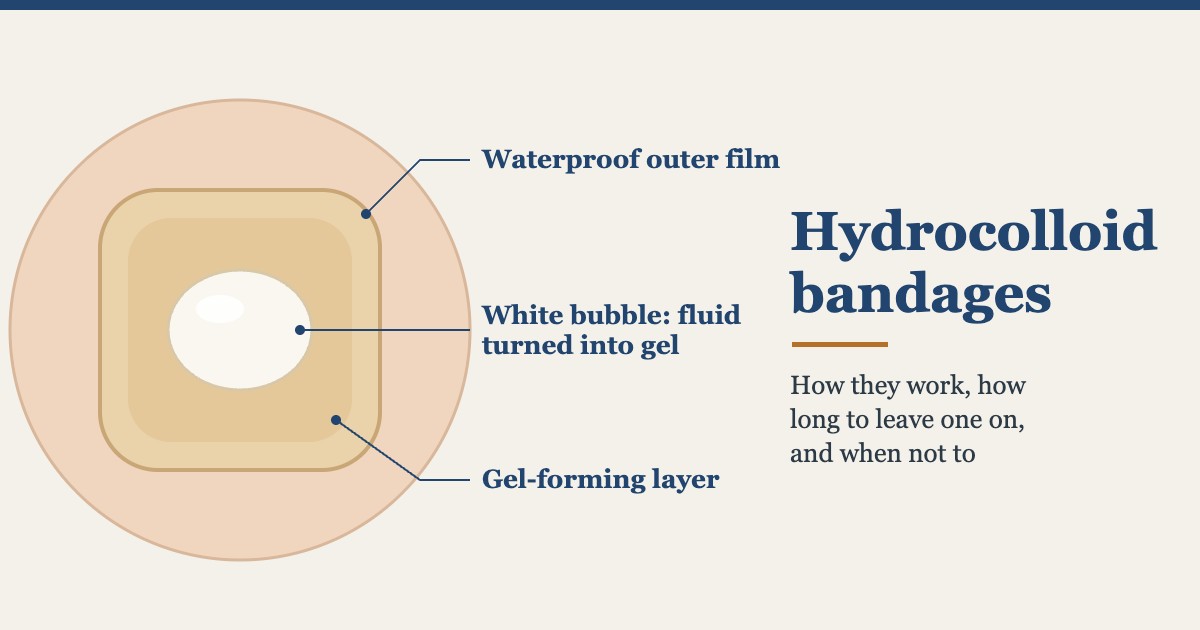
Hydrocolloid bandages, such as DuoDerm, Band-Aid Hydro Seal and Compeed blister plasters, are thick, gel-forming dressings. They soak up fluid from a wound, turn it into a soft gel and hold it under a waterproof seal for days at a time, which cushions a blister and keeps a scrape moist while it heals. On a foot with diabetes they need more care: a sealed dressing can hide a wound that is getting worse, and Compeed’s own label tells people with diabetes to check with a doctor first. Here is how they work, what the white bubble means, how long to leave one on, and when to choose something else.
The short version
A hydrocolloid dressing is a layer of gel-forming material, such as carboxymethylcellulose, gelatin and pectin, under a thin waterproof film. As it absorbs fluid from the wound it swells into a soft gel, which shows through as a white bubble. Leave it on until it starts to come away, the bubble nears the edge or it leaks: several days for most bandages, and up to seven for DuoDerm.
They suit small, shallow wounds with light drainage: blisters, scrapes, small cuts and minor burns. Put nothing underneath, no cream or ointment, and do not use one on an infected wound unless a clinician has told you to.
With diabetes, ask a doctor or podiatrist before using one on your feet, and never use one to manage a foot ulcer at home. A Cochrane review found no hydrocolloid dressing healed diabetic foot ulcers better than other dressings, basic ones included; what heals an ulcer is taking the pressure off it and treating infection and poor blood flow.
Hydrocolloid bandages at a glance
| Question | Answer |
|---|---|
| What it is | A gel-forming layer, such as sodium carboxymethylcellulose, gelatin and pectin, under a waterproof polyurethane film |
| Common brands | DuoDerm (ConvaTec), Band-Aid Hydro Seal and Compeed, plus store brands |
| Good for | Blisters, scrapes, small cuts, and minor burns and scalds; under a clinician’s care, some pressure, leg and diabetic ulcers and surgical wounds |
| Not for | Infected wounds unless a clinician is managing them, wounds that drain heavily, and anyone allergic to the dressing |
| How long it stays on | Until it starts to come away, the bubble nears the edge or it leaks: several days for most bandages, up to 7 days for DuoDerm |
| Showers | Fine: the outer film is waterproof. Swimming is not advised |
| What goes underneath | Nothing: no creams, ointments, lotions or powders |
| With diabetes | Ask a doctor or podiatrist first, and do not use one to treat a foot ulcer at home |
How hydrocolloid bandages work
The sticky layer is a mix of gel-forming materials. Fluid from the wound soaks into it and it swells into a soft gel, which keeps the wound surface moist and cushioned while the outer film keeps water and dirt out. A moist wound does not dry out and scab over, and the gel helps the body clear dead tissue on its own, which is called autolytic debridement.
Within about a day a white bubble appears over the wound. That is the gel, and it means the dressing is working, not that the wound is infected.
When the dressing comes off, the gel left behind can be yellow or brown and smell unpleasant. NHS burns teams tell patients this is normal: the yellow fluid is the gel, not pus, and the smell comes from the dressing and goes once the area is cleaned. A bad smell that stays after cleaning is a different matter.
How to use a hydrocolloid bandage
- Clean and dry. Clean the wound with water or saline and dry the skin around it well. Put nothing underneath: creams, ointments, oils and powders stop it sticking and working.
- Pick the right size. The dressing should reach at least 3 cm (about 1 1/4 inches) past the edge of the wound on every side. Thin hydrocolloid sheets such as DuoDerm Extra Thin can be cut to shape; blister plasters such as Compeed should not be cut.
- Put it on smoothly. Peel off the backing without touching the sticky side, center the dressing over the wound and smooth the edges down firmly, without stretching it.
- Leave it alone. A white bubble appearing within a day is normal. You can shower with it on; pat the skin around it dry.
- Change it at the right time: when the bubble nears the edge, it leaks, it wrinkles or the edges lift, or after 7 days at most.
- Take it off gently. Press down on the skin and stretch the dressing along the skin, working around the edges, rather than pulling it straight up.
When not to use one
- An infected wound. Spreading redness, warmth, pus or worsening pain. Compeed says not to use its plasters on infected wounds, and DuoDerm is for infected wounds only under a clinician’s care.
- A wound that drains heavily. Thin hydrocolloids are made for light drainage, and a soaked dressing leaks and needs changing too often to help.
- A deep or dirty wound, or a large or deep burn. These need medical care before any dressing.
- An allergy to the dressing or anything in it.
- A foot ulcer, or any wound on a foot with diabetes, nerve damage or poor circulation, unless a clinician has chosen the dressing.
Take it off and get the wound checked if
The wound becomes more painful, bleeds or drains more, or changes color, or there is a bad smell that does not go after cleaning. With diabetes, an infected foot may not hurt, so go by what you see, and call the same day.
Hydrocolloid bandages and diabetic feet
Hydrocolloids are not off-limits with diabetes, but they need more caution on the feet. A sealed dressing that stays on for days hides the wound underneath, and on a numb foot nothing hurts to warn you that it is getting worse. Compeed’s label tells people with diabetes to consult a doctor before using its blister plasters.
For foot ulcers, the evidence does not favor them. A Cochrane review of five trials with 535 people found no evidence that any type of hydrocolloid healed diabetic foot ulcers better than other dressings, including basic wound contact dressings, which were the more cost-effective choice in one trial. The international diabetic foot guideline advises choosing dressings mainly to absorb drainage and keep the wound moist, at the lowest cost. What heals an ulcer is offloading, removing dead tissue, treating infection and restoring blood flow: see diabetic foot ulcers.
For a blister on a diabetic foot, see blisters on a diabetic foot. The NIDDK advises calling your health care provider if a cut, blister or bruise has not started to heal after a few days.
Hydrocolloid or something else?
- A plain non-stick pad and gauze. Cheap, and easy to lift and check every day: the kind of basic dressing the evidence supports for diabetic foot ulcers. A Kerlix roll can hold it in place without tape on the skin.
- A foam dressing. For wounds that drain more than a hydrocolloid can hold, with extra cushioning.
- An alginate dressing. For wetter wounds, because the alginate soaks up fluid; some carry honey, as described in MediHoney. Gelling fiber dressings such as Aquacel do a similar job.
- A hydrocolloid. For a small, clean, lightly draining wound or blister that you want covered and cushioned for several days.
What to buy
For blisters, scrapes and small cuts on feet without diabetes, nerve damage or poor circulation. With diabetes, check with your doctor or podiatrist before using these on your feet. Our editorial policy names a product only once we can say what was assessed and on what basis, so this list shops by type rather than by brand.
- For blisters on heels and toes: hydrocolloid blister bandages, sized to cover the whole blister.
- For scrapes and small cuts: hydrocolloid bandages in assorted sizes.
- For larger areas, or to cut to shape: thin hydrocolloid dressing sheets, about 4 x 4 inches.
- To clean the wound first: sterile saline wound wash.
Common questions
How long can you leave a hydrocolloid bandage on?
Until it starts to come away on its own, the white bubble nears the edge, or it leaks. That is usually several days. DuoDerm can stay on for up to seven days.
What does the white bubble mean?
It is the dressing turning wound fluid into gel, and it usually appears within a day. It means the bandage is working. Change it when the bubble reaches near the edge.
Is the yellow goo under a hydrocolloid bandage pus?
Usually not. The gel left on the wound is yellow or brown and can smell, and NHS burns teams tell patients this is normal and clears with cleaning. Spreading redness, more pain, or a smell that stays after cleaning are signs to get it checked.
Can you shower with a hydrocolloid bandage?
Yes. The outer film is waterproof, and Band-Aid says its Hydro Seal bandages stay on through showers. Pat the skin around it dry afterwards. Swimming is not advised.
Can you put Neosporin or Vaseline under a hydrocolloid bandage?
No. Creams, ointments and lotions stop the dressing sticking and forming its gel. Clean and dry the skin and put the bandage straight on.
Can you cut a hydrocolloid bandage?
It depends on the product. Thin hydrocolloid sheets such as DuoDerm Extra Thin can be cut to shape, but Compeed says never to cut its blister plasters.
Is DuoDerm the same as a hydrocolloid bandage?
DuoDerm is a brand of hydrocolloid dressing made by ConvaTec, sold in sheets for larger wounds and designed to stay on for up to seven days. Consumer hydrocolloid bandages are smaller versions of the same idea.
Can I use a hydrocolloid bandage if I have diabetes?
Ask your doctor or podiatrist first if it is going on your feet, as Compeed’s label advises. A sealed dressing can hide a worsening wound on a numb foot, so look at the dressing and the skin around it every day.
Do hydrocolloid dressings heal diabetic foot ulcers faster?
Not as far as the evidence shows. A Cochrane review found no type of hydrocolloid dressing healed diabetic foot ulcers better than other dressings, including basic ones.
When should you take a hydrocolloid bandage off early?
When it leaks, wrinkles or lifts at the edges, or if the wound becomes more painful, bleeds or drains more, or changes color or smell.
Sources
The makers’ instructions and product information, NHS patient leaflets, and the clinical literature and guidance named.
- ConvaTec. DuoDERM Extra Thin CGF dressing, product information. clockmedical.com — sodium carboxymethylcellulose, gelatin, pectin and adhesive polymers under a waterproof polyurethane film; for lightly exuding, superficial wounds; can be cut to shape; a dressing 3 cm beyond the wound margin; removal by pressing the skin and stretching each edge.
- ConvaTec. DuoDERM Signal dressing, instructions for use. clockmedical.com — over-the-counter use for minor abrasions, cuts, lacerations and minor scalds and burns, and use under professional supervision for leg, diabetic and pressure ulcers and surgical wounds; infected wounds only under professional care; signs of infection; a dressing 1 1/4 inches (3 cm) larger than the wound; change when clinically indicated, at strikethrough, or at 7 days at most; not for people sensitive to the dressing.
- ConvaTec. DuoDERM CGF dressing. convatec.com — a moist wound environment that allows autolytic debridement; wear time of up to seven days.
- BAND-AID Brand. HYDRO SEAL hydrocolloid bandages, product page. band-aid.com — waterproof; can stay on for multiple days, through hand washing and showers; a white bubble forms within 24 hours.
- Compeed blister plasters, directions and cautions, as listed by Boots. boots.com — clean, dry skin free of creams and oils; leave in place until it starts to detach; remove by stretching along the skin; never cut the plaster; do not apply on infected wounds; diabetics should consult a doctor before use.
- Chelsea and Westminster Hospital NHS Foundation Trust. DuoDerm advice (burns patient leaflet). chelwest.nhs.uk — yellow leakage is the gel, not pus; the odour comes from the dressing and goes on cleansing; replace a dressing that leaks or wrinkles.
- NHS Lothian, Royal Hospital for Children and Young People. Hydrocolloid dressing (parent information). nhslothian.scot — forms a gel with fluid from the wound; may be left for up to 7 days; an unpleasant smell and brown liquid on removal are normal; bath or shower allowed, swimming not advised; replace if fluid leaks from the edge.
- Dumville JC, Deshpande S, O’Meara S, Speak K. Hydrocolloid dressings for healing diabetic foot ulcers. Cochrane Database Syst Rev. 2013;(8):CD009099. cochrane.org — five studies with 535 participants; no evidence that any type of hydrocolloid dressing is more effective than other dressings; a basic wound contact dressing more cost-effective in one study; cost and exudate management as deciding factors.
- Chen P, Vilorio NC, Dhatariya K, et al. Guidelines on interventions to enhance healing of foot ulcers in people with diabetes (IWGDF 2023 update). Diabetes Metab Res Rev. 2024;40(3):e3644. doi:10.1002/dmrr.3644 — basic dressings chosen to absorb exudate and keep the wound moist, at the lowest cost.
- National Institute of Diabetes and Digestive and Kidney Diseases. Diabetes and foot problems. niddk.nih.gov — call your health care provider if a cut, blister or bruise does not start to heal after a few days.
Related guides
Blisters on a diabetic foot
Why blisters form on numb feet, and how to care for them safely.
Diabetic foot ulcers
The whole of ulcer care: debridement, dressings, infection and circulation.
Offloading a foot ulcer
Why taking the pressure off heals an ulcer more than any dressing.
MediHoney: the recall
Why MediHoney is off the market, and what to use instead for other wounds.
Santyl ointment
How the enzyme clears dead tissue, and what switches it off.
Silver sulfadiazine cream
What the burn cream is for, who must not use it, and why it can slow healing.
A blister or wound on a diabetic foot, in Michigan?
Balance Foot & Ankle, the author’s practice, treats foot wounds and blisters in people with diabetes in Howell and Bloomfield Township, with checks of circulation and infection at the same visit.

Dr. Tom Biernacki is a double board-certified podiatric foot and ankle surgeon practising in Michigan. He treats diabetic wounds, Charcot neuroarthropathy and at-risk feet daily, and writes here to put the clinical reasoning behind that care in front of the people living with it.