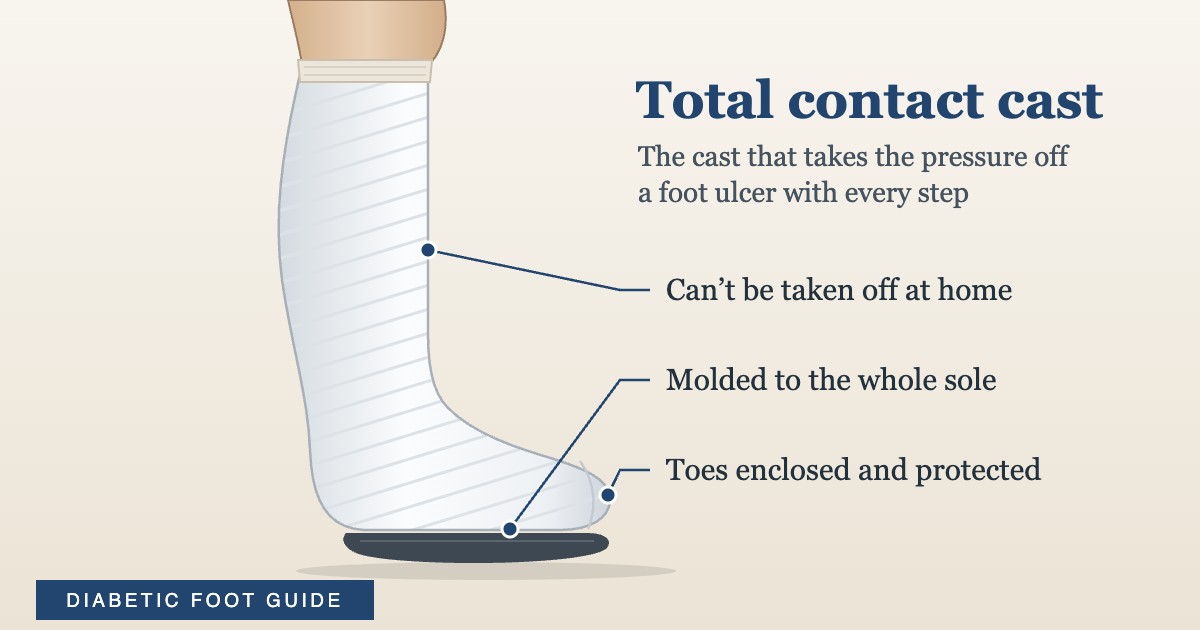
A total contact cast is a knee-high cast molded closely to the whole sole and lower leg, put on in clinic and usually changed every week. It heals a diabetic foot ulcer by spreading your weight away from the wound, and because you cannot take it off, it does that with every step, including the trip to the bathroom at night.
The short version
Pressure made the ulcer, and every step on it reopens it. A total contact cast (TCC) spreads the load across the entire sole and stays on, so the offloading actually happens. The 2023 international guideline makes a non-removable knee-high device — a TCC, or a walker boot sealed so it cannot come off — the first choice for a neuropathic ulcer under the forefoot or midfoot.
It is not for every wound: more than a mild infection, significant artery disease or a wound needing daily dressing usually means a removable device. You can walk in a cast, though less is better, and it stays on until the ulcer closes. Fever, new pain, a smell, or a wet, loose or tight cast is a same-day call.
What a total contact cast is, and why it works
A total contact cast is a custom-made, minimally padded, knee-high cast of fiberglass or plaster that keeps contact with the entire sole and lower leg. Molded by hand to the sole, it spreads pressure over the whole foot instead of letting it pile onto one spot; a walking sole or cast shoe underneath protects it and lets you walk.
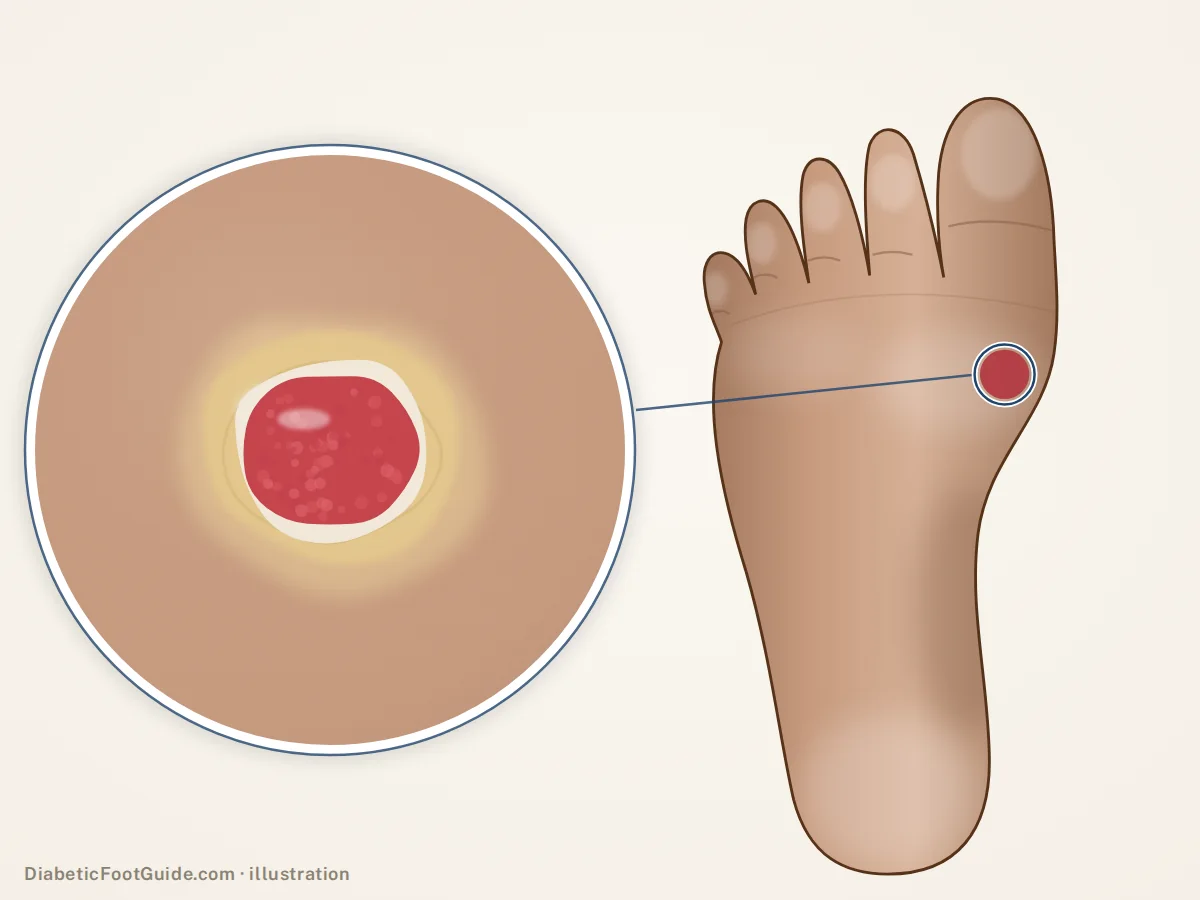
Most diabetic foot ulcers are pressure injuries on a foot that has lost protective sensation (see diabetic foot ulcers and their early signs). Nothing tells you to limp, so the same skin is loaded step after step, and once an ulcer forms it heals slowly unless that spot is offloaded, which is why the international guideline calls offloading arguably the most important treatment. Dressings, debridement, antibiotics and circulation care all matter, but none of them takes the weight off, and without proper care these ulcers can lead to infection, hospital admission and amputation (see gangrene and toe amputation).
The cast’s second feature matters as much: you cannot take it off. A boot offloads only while it is on, and the guideline names enforced adherence as the main advantage of a non-removable device. A prefabricated knee-high walker boot sealed with cast tape or a tie shares that feature; it is often called an instant total contact cast (iTCC) or irremovable walker.
What the 2023 guideline recommends
The International Working Group on the Diabetic Foot (IWGDF) updated its offloading guideline in 2023. For a neuropathic ulcer on the sole of the forefoot or midfoot:
- First choice: a non-removable knee-high device (a strong recommendation, on moderate-certainty evidence), either a total contact cast or a non-removable walker, chosen on resources, skills, your preference and foot shape; the cast suits a severely deformed foot.
- Second: a removable knee-high or ankle-high device, worn for all weight-bearing, when a non-removable one is unsuitable or not tolerated.
- Third: felted foam padding with well-fitting footwear, only when no device is available.
- If those fail: surgical offloading, such as Achilles tendon lengthening or metatarsal head resection, combined with a device.
Ordinary shoes, even off-the-shelf extra-depth shoes, should not be used to heal the ulcer. For heel ulcers a non-removable knee-high device is also suggested, on very low-certainty evidence. Ulcers on the top or sides of the foot get removable devices, shoe changes, toe spacers or orthoses.
The evidence, and its limits
The case rests on small randomized trials and the reviews that pooled them, mostly in uncomplicated neuropathic ulcers under the forefoot. These numbers describe the best case.
| Study | Who | What happened |
|---|---|---|
| Armstrong et al., 2001 | 63 people, superficial plantar ulcers without infection or ischemia | Healed by 12 weeks: 89.5% in a total contact cast, 65.0% in a removable walker, 58.3% in a half-shoe |
| Armstrong et al., 2005 | 50 people, clean superficial ulcers | The same walker, sealed in half: 82.6% versus 51.9% healed by 12 weeks; healed ulcers closed sooner (41.6 versus 58.0 days) |
| Katz et al., 2005 | 41 people, non-ischemic plantar ulcers | Sealed walker versus cast: 80% versus 74% healed within 12 weeks, statistically equivalent; the walker took 39% less time to put on, 36% less to remove, and cost less |
| Cochrane review, 2013 | 14 trials, 709 people | In five of seven trials comparing non-removable casts with removable devices, casts healed significantly more ulcers (risk ratio 1.17, 95% CI 1.01–1.36) |
| IWGDF review, 2023 | 10 randomized and 6 other controlled studies | Non-removable devices healed about a quarter more ulcers than removable ones (risk ratio 1.24, 95% CI 1.09–1.41); a separate pooling found little or no difference between cast and sealed walker |
Walking less does not explain the gap: in the 2001 trial, people in casts took about 600 steps a day and those in removable walkers about 770, not a significant difference, yet more ulcers healed in the cast. The guideline’s explanation is adherence; a cast cannot be left by the bed. Certainty is moderate, and evidence for infected, ischemic and heel ulcers is thin.
Total contact cast vs boot, and the other options
The short answer: a boot you can take off loses to a cast, and a boot you cannot take off ties with it.
| Option | How it works | For it | Against it |
|---|---|---|---|
| Total contact cast | Hand-molded, minimally padded knee-high cast | Works whether or not you remember; suits a badly deformed foot | Needs skilled hands and more time; wound unseen between changes; may cause more new rubs than a sealed walker |
| Irremovable walker (instant total contact cast) | Off-the-shelf knee-high boot sealed with cast tape or a tie | Heals about as well as a cast; quicker to fit and remove; cheaper | Same between-visit limits; may not fit a severely deformed foot |
| Removable walker boot | The same boot, on and off at will | Wound can be checked and dressed often; usable when a sealed device is ruled out | Offloads only while worn; healed fewer ulcers in trials |
| Ankle-high offloading shoe or healing sandal | Removable, ending at or just above the ankle | People keep it on more than a knee-high boot; ranked alongside one | Less pressure relief; the same “only while worn” problem |
| Felted foam with well-fitting shoes | Felt padding around the ulcer, in a shoe with room for it | Cheap, simple, available almost everywhere | Replaced at least weekly; untested in trials with shoes alone; a last resort |
Who it suits, and who it does not
Usually a good fit
- A neuropathic ulcer on the sole of the forefoot or midfoot
- At most a mild infection or mild ischemia, not both, checked at least weekly
- A foot too deformed for an off-the-shelf boot
- Active Charcot foot
- Able to get to the clinic every week
Usually not, or not yet
- Moderate infection (deeper than the skin, or wider redness) or severe infection (signs of sepsis)
- Moderate or severe ischemia, or mild infection plus mild ischemia
- Heavy drainage, or a wound needing daily checks or dressings
- Poor balance without a walking aid; in one study, two people with casts on both legs stopped because of falls
- An ulcer on the top or side of the foot
- A job or home life it cannot fit, or simply declining it
In most of these cases the guideline turns to a removable device worn for every step, and severe infection or ischemia is treated first. Real-world results show why: in a Dutch series of 98 people in casts, 90% of ulcers without ischemia or infection healed, and 87% with superficial infection; with artery disease short of critical ischemia, 69% healed without infection but only 36% with it. Heel ulcers also fared worse. More on spotting infection: diabetic foot infection.
What to expect, step by step
- Assessment. The ulcer is cleaned, the callus around it trimmed, and your circulation and any infection checked, since they decide whether a cast is safe.
- Application in clinic. At one London hospital it takes about an hour, then 20 minutes sitting or lying down before you walk. A cast shoe goes on for every step.
- Walk, but not much. Rest with the leg raised. Ask for crutches or a walker if you are unsteady, and about a lift for the other shoe to even out your height.
- Keep it dry. Shower only with a waterproof cover, and push nothing down inside the cast.
- Sleep in it. A large sock or pillowcase over the cast protects your other leg in bed. Check that foot daily, and your blood sugars regularly.
- Weekly changes, as a rule. The cast comes off, the ulcer and skin are checked and cleaned up, and a new cast goes on.
- Driving and work. No driving with a cast on your right leg; with a left-leg cast, ask your clinician and your insurer first. You may need time off work.
- Never remove it yourself. Out of hours, the emergency department can take it off.
Risks, and how they are watched for
The main risk is the problem the cast treats: pressure on skin that cannot feel it. The weekly change is the safety check.
New rubs and sores
In the Dutch series, 9% developed a new superficial ulcer and 28% a pre-ulcerative lesion such as a blister or abrasion; all healed in the cast within 13 days. Non-removable devices, casts especially, may cause more new lesions, on low-certainty evidence.
Falls
A cast changes your balance and lengthens one leg. The evidence on falls is very uncertain; the guideline’s answers are a walking aid and a lift for the other shoe.
Clots and weakness
A deep vein thrombosis is rare in a cast but serious. Months in a cast, as with Charcot foot, are linked with muscle wasting and extra load on the other leg.
Call the clinic the same day if
- You feel unwell, hot, shivery or unusually tired, or your blood sugars are unstable: this can mean infection.
- There is new pain or discomfort in the foot or leg, or the leg above the cast swells. In a numb foot, new pain is a warning.
- The cast rubs, makes the skin bleed, or stains, drains or smells.
- It gets wet or damaged, or feels too loose or too tight.
Emergency department or 911 now for sudden breathlessness or a sharp chest pain that is worse when you breathe in.
Total contact casting for Charcot foot
The same cast is the first-choice treatment for active Charcot foot, where the aim is to offload and immobilize a hot, swollen foot so it settles without collapsing into a new shape. The IWGDF practical guidelines rank a non-removable knee-high total contact cast first, a knee-high walker made non-removable second, and a removable knee-high device worn at all times third; below-ankle devices are not recommended, and crutches help keep weight off.
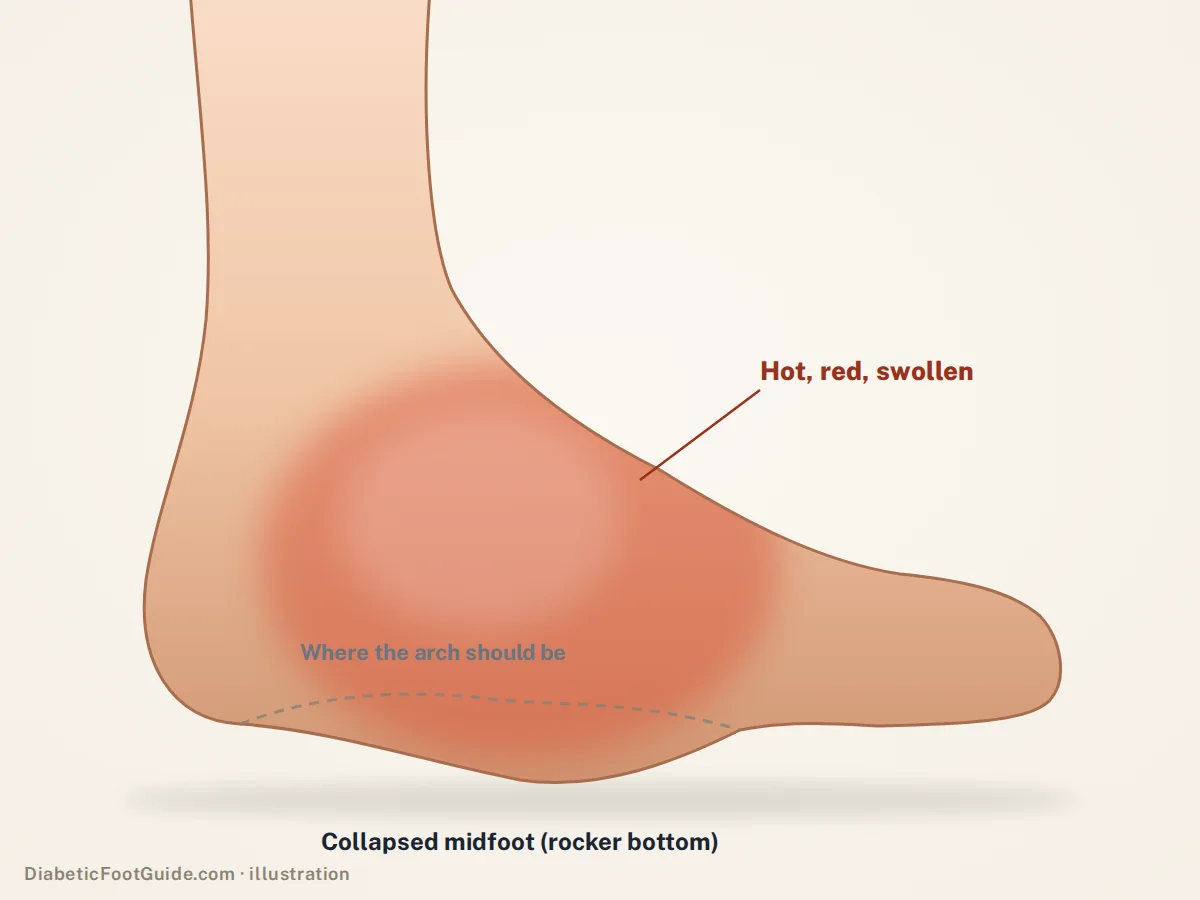
Casting starts once Charcot is suspected and continues until the inflammation has settled and X-rays show any fractures consolidating, which can take many months. Custom footwear or a brace follows, with walking built up gradually because the disease can reactivate. More in Charcot foot and Charcot foot recovery.
How long you wear a total contact cast
Until the ulcer has closed, not for a set number of weeks. In the studies above, that took around five to six weeks: healed ulcers in the 2005 sealed-walker group closed in 41.6 days on average, and the median time in a cast in the Dutch series, which included infected and ischemic ulcers, was 34 days.
Charcot foot takes many months; one London hospital warns that a cast may be needed for months, sometimes more than a year. If an ulcer shows no sign of healing after four to six weeks of good care, the practical guidelines advise considering imaging of the arteries and revascularization (see healing a diabetic wound faster).
After the cast comes off
A closed ulcer is not a cured foot. The IWGDF calls a healed ulcer a foot in remission, at the highest risk of ulcerating again and needing lifelong prevention; the recurrence figures are on our diabetic foot ulcer page.
- Ask about the step-down before the last cast comes off: whether a removable boot comes first, and when your prescribed shoes and insoles will be ready.
- Never go back to the shoe that caused the ulcer.
- Wear prescribed footwear with proven pressure relief. Diabetic shoes covers the Medicare rules.
- Keep up prevention for life: daily checks of both feet, professional callus care and regular foot reviews.
Free: the 30-Second Daily Foot Check. While one foot is in a cast, the daily check carries on for the other one, which the cast can rub in bed. This one printable page from Dr. Tom Biernacki lists five steps to do before your socks go on, says when to call your foot doctor and when to go to the ER, and gives you a week of tick boxes for the fridge.
ER or 911 now, not a download: a foot or leg that is suddenly cold, pale, blue or very painful; any skin turning black; redness spreading fast, or fever or chills with a foot wound.
Download the Daily Foot Check (PDF, 1 page)
Out now on Kindle: The Diabetic Foot Care Guide, Dr. Tom’s book.
Common questions
Can you walk in a total contact cast?
Yes. It has a walking sole or cast shoe, but less is better: people in casts in the 2001 trial averaged about 600 steps a day. Rest with the leg raised, and use crutches or a walker if you are unsteady.
How long do you wear a total contact cast?
Until the ulcer closes. Each cast usually stays on about a week, and in the studies above, healing took around five to six weeks on average. Charcot foot takes many months.
Is a total contact cast better than a boot?
Better than a boot you can take off, and about the same as one you cannot. In one trial the cast healed 89.5% of ulcers by 12 weeks against 65.0% in a removable walker; in another, a sealed walker healed 80% against 74% for the cast.
Can you shower with a total contact cast?
Only with a waterproof cover over it. The cast must stay dry, and if it does get wet, call the clinic the same day.
Can you drive with a total contact cast?
Not with the cast on your right leg: a review of driving after orthopedic surgery says patients should not drive with a cast or brace on the right leg. With a left-leg cast, ask your clinician and check with your insurer first.
Sources
Clinical literature and guidelines retrieved from PubMed, plus one NHS hospital’s patient instructions.
- Bus SA, Armstrong DG, Crews RT, et al. Guidelines on offloading foot ulcers in persons with diabetes (IWGDF 2023 update). Diabetes Metab Res Rev. 2024;40(3):e3647. doi:10.1002/dmrr.3647 — the cast and sealed-walker definitions, the order of offloading choices and when a non-removable device is unsuitable, enforced adherence, the pooled healing, new-lesion and fall findings, the walking aid and the shoe lift.
- Armstrong DG, Nguyen HC, Lavery LA, van Schie CH, Boulton AJ, Harkless LB. Off-loading the diabetic foot wound: a randomized clinical trial. Diabetes Care. 2001;24(6):1019-1022. doi:10.2337/diacare.24.6.1019 — healing by 12 weeks in a cast, a removable walker and a half-shoe, and daily steps.
- Armstrong DG, Lavery LA, Wu S, Boulton AJ. Evaluation of removable and irremovable cast walkers in the healing of diabetic foot wounds: a randomized controlled trial. Diabetes Care. 2005;28(3):551-554. doi:10.2337/diacare.28.3.551 — the instant total contact cast against the same walker left removable.
- Katz IA, Harlan A, Miranda-Palma B, et al. A randomized trial of two irremovable off-loading devices in the management of plantar neuropathic diabetic foot ulcers. Diabetes Care. 2005;28(3):555-559. doi:10.2337/diacare.28.3.555 — sealed walker versus cast: healing, application and removal time, and cost.
- Lewis J, Lipp A. Pressure-relieving interventions for treating diabetic foot ulcers. Cochrane Database Syst Rev. 2013;(1):CD002302. doi:10.1002/14651858.CD002302.pub2 — non-removable casts versus removable devices across 14 trials; still the latest version of the review.
- Nabuurs-Franssen MH, Sleegers R, Huijberts MS, et al. Total contact casting of the diabetic foot in daily practice: a prospective follow-up study. Diabetes Care. 2005;28(2):243-247. doi:10.2337/diacare.28.2.243 — healing by artery disease and infection status, heel ulcers, time in the cast, and new lesions under it.
- Schaper NC, van Netten JJ, Apelqvist J, et al. Practical guidelines on the prevention and management of diabetes-related foot disease (IWGDF 2023 update). Diabetes Metab Res Rev. 2024;40(3):e3657. doi:10.1002/dmrr.3657 — infection grades, debridement, the four-to-six-week review, Charcot casting and its side effects, remission after healing, footwear and daily checks.
- Marecek GS, Schafer MF. Driving after orthopaedic surgery. J Am Acad Orthop Surg. 2013;21(11):696-706. doi:10.5435/JAAOS-21-11-696 — no driving with a cast or brace on the right leg.
- Guy’s and St Thomas’ NHS Foundation Trust. Total contact casting (TCC). Patient information 4755/VER2, last reviewed May 2023. guysandstthomas.nhs.uk — Total contact casting (TCC) — application time, weekly changes, walking, keeping the cast dry, sleeping, driving and insurance, warning signs, clot symptoms and out-of-hours removal.
Related guides
Diabetic foot ulcers
Why they form, how they are graded, and what heals them.
Early-stage diabetic foot ulcer
The signs to catch before a cast is needed.
Healing a diabetic wound faster
The four-week check, and what to change when a wound stalls.
Charcot foot recovery
Casting, the CROW boot and the realistic timeline.
Diabetic shoes
Medicare rules and fit for the footwear that comes after the cast.
Foot ulcer offloading in Michigan
A plantar ulcer that is still open after weeks of dressings usually needs its pressure taken off properly. Balance Foot & Ankle sees patients in Howell and Bloomfield Township.

Dr. Tom Biernacki is a double board-certified podiatric foot and ankle surgeon practising in Michigan. He treats diabetic wounds, Charcot neuroarthropathy and at-risk feet daily, and writes here to put the clinical reasoning behind that care in front of the people living with it.