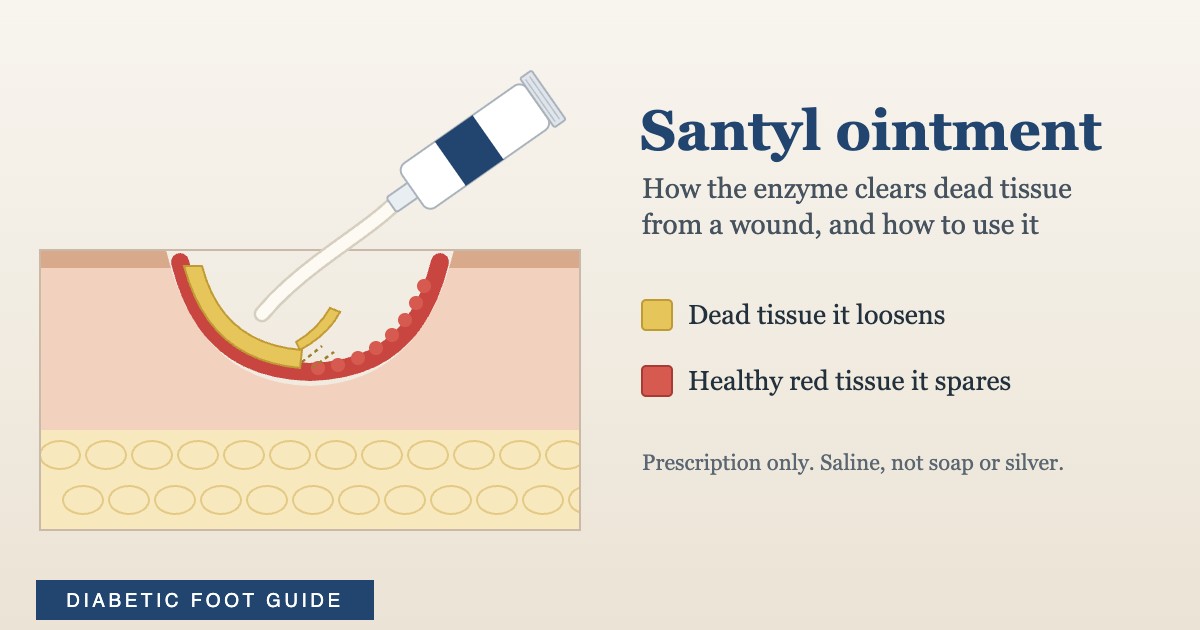
Santyl is a prescription ointment that uses an enzyme, collagenase, to break down the dead tissue in a wound so that the wound can heal. It works only if it is used the right way: some common wound washes and silver products switch the enzyme off, and for a diabetic foot ulcer it is usually the second choice after debridement in the clinic. Here is what it does, how to use it, what it costs and what the alternatives are.
The short version
Santyl (collagenase ointment, made by Smith+Nephew) is approved for removing dead tissue from chronic skin ulcers and severe burns, which is called debridement. Each gram holds 250 units of an enzyme made by the bacterium Clostridium histolyticum that cuts the collagen strands holding dead tissue in place. It goes on once a day after the wound is cleaned with saline, and it is stopped once the dead tissue is gone and healthy red tissue has filled in.
It is easy to switch off. Certain detergents, silver (including silver dressings and silver sulfadiazine cream) and acidic soaks reduce the enzyme’s activity, so the wound is cleaned with saline first. There is no generic and no over-the-counter version, and without insurance a 30 g tube costs about $335 to $400.
For a diabetic foot ulcer, the international guideline’s standard is sharp debridement, trimming dead tissue and callus away in the clinic, and it advises against using an enzyme routinely in its place. Santyl is the conditional choice when sharp debridement is not available. Either way, a foot ulcer also needs the pressure taken off it and its blood flow and any infection checked.
Santyl at a glance
| Question | Answer |
|---|---|
| What is in it | Collagenase from Clostridium histolyticum, 250 units per gram, in white petrolatum |
| What it is approved for | Debriding chronic skin ulcers, such as diabetic foot, pressure and leg ulcers, and severely burned areas |
| Who makes it | Smith+Nephew |
| Prescription needed? | Yes. There is no generic and no over-the-counter version in the US |
| Sizes | 30 g and 90 g tubes |
| How often | Once a day, or more often if the dressing gets soiled |
| What switches it off | Certain detergents, silver and other heavy metals used in some antiseptics, and soaks with metal ions or acidic solutions |
| Storage | Not above 25°C (77°F) |
How Santyl works
Dead tissue in a wound, whether yellow, stringy slough or a black, leathery scab (eschar), is held to the wound bed by strands of collagen. Collagenase cuts those strands, so the dead tissue loosens and can be wiped or trimmed away at the next dressing change. Smith+Nephew says it does this while preserving healthy granulation tissue, the bumpy red tissue that fills a healing wound. Removing dead tissue this way is called enzymatic debridement.
Dead tissue matters because it hides the true size and depth of a wound, feeds bacteria and keeps the edges from closing. Trimming it away with a scalpel or curette, sharp debridement, does the same job at once, but needs a trained clinician. An enzyme works more slowly, at home, between visits.
The enzyme works best at a near-neutral pH, between 6 and 8, which is why the label is specific about what can go on the wound with it.
How to use Santyl
These steps follow the prescribing information. If a nurse or clinic has given you different instructions, follow theirs.
- Clean the wound first. Gently wipe away loose debris and dissolved tissue with a gauze pad soaked in normal saline, then rinse with saline. Dakin’s solution is also compatible.
- Treat infection before the ointment. The label says that when a wound is infected, a topical antibiotic powder goes on first, and that Santyl is stopped if the infection does not respond. With diabetes, an infected foot needs to be seen, not just dressed: see diabetic foot infection.
- Apply it to the dead tissue. Put the ointment directly on the wound, or spread it on a sterile gauze pad and lay that on the wound. Keep it within the wound: slight, short-lived redness of the surrounding skin is the side effect the label mentions.
- Cover and secure the dressing, and change it once a day, or sooner if it becomes soiled.
- Let your clinician trim what has loosened. The label notes that loosened dead tissue can be removed with forceps and scissors, and that a thick scab may be cross-hatched with a scalpel so the ointment reaches more of it. These are clinic jobs, not home ones, least of all on a numb foot.
- Stop when the job is done. Santyl is stopped once the dead tissue is gone and healthy granulation tissue is well established. It removes dead tissue; it does not close the wound.
What switches Santyl off
The label lists certain detergents, and heavy metal ions such as silver and mercury, which are used in some antiseptics, as reducing the enzyme’s activity, and says to avoid soaks containing metal ions or acidic solutions. In practice that means no soap or detergent wound washes, no silver dressings or silver gels, no silver sulfadiazine cream and no vinegar soaks on a wound being treated with Santyl, unless your clinician has a specific reason. Normal saline and Dakin’s solution are compatible.
Santyl and diabetic foot ulcers
Santyl’s approval covers chronic skin ulcers, and diabetic foot ulcers are among the wounds it is prescribed for. But the evidence that it heals them better than the standard approach is thin.
The 2023 guideline of the International Working Group on the Diabetic Foot (IWGDF) found five randomized trials of collagenase ointment, all compared with sharp debridement. Overall, the balance of effects favoured neither approach for complete healing or for shrinking the wound, and all five were exploratory studies, designed to generate hypotheses rather than settle the question. Its recommendation: “Do not routinely use enzymatic debridement as opposed to standard of care (i.e. sharp debridement).” It adds a conditional exception: where sharp debridement is limited by resources or by the availability of skilled personnel, consider enzymatic debridement.
A 2017 systematic review of 22 studies of collagenase in wounds and ulcers reached a similar place. Its authors found results supporting collagenase for debriding pressure ulcers and diabetic foot ulcers, but called the data very limited, noted that the studies were at high risk of bias and mostly funded by industry, and found adverse events more often with collagenase than with the treatments it was compared with.
So for most people with a diabetic foot ulcer, dead tissue and the callus around the ulcer are best trimmed away in the clinic, as often as the wound needs it, which also lets the clinician see how deep it goes and whether bone is involved. Santyl makes sense when that is not available often enough, and some clinicians use it between visits. Whatever is used, a foot ulcer heals only when the pressure on it is taken off (see offloading a foot ulcer) and the blood supply and any infection are dealt with. If an ulcer has not shrunk by about half after four weeks of good care, the plan needs to change. More is in diabetic foot ulcers.
Not on a dry black scab with poor circulation
A dry, hard, black scab on a heel or toe of a foot with poor blood flow is a different problem. Pressure injury staging guidance says stable eschar on the heel or on a limb with poor blood flow should not be softened or removed, and an enzyme does exactly that. The circulation needs checking first; see poor circulation in the feet and legs. Black tissue that is new, spreading, wet or smelly is an emergency, not a job for an ointment.
What Santyl costs, and why it can be hard to find
- No generic. GoodRx lists no lower-cost generic for Santyl in the US. In November 2026 it showed a 30 g tube at about $335 with its coupon against an average retail price of about $399, and a 90 g tube at about $942 with the coupon.
- Medicare. Santyl is a prescription drug, so it falls under Part D, and GoodRx says most Medicare drug plans put restrictions on it, such as prior authorization (your prescriber contacts the plan first) or quantity limits. Ask the pharmacy to run it through your plan before you pay cash.
- The maker’s copay card. For people paying more than $20 a fill, insured or not, Smith+Nephew’s card pays up to the next $220 after the first $20, for six fills and up to $1,000 a year. It cannot be used with Medicare, Medicaid or other government plans. The company also has a patient assistance program for people on low incomes.
- The shortage. Collagenase ointment went on the national drug shortage list kept by the University of Utah Drug Information Service in August 2023. By October 2024 the listing noted that Smith+Nephew had both the 30 g and 90 g tubes available, but local stock can still be patchy. If your pharmacy cannot get it, ask whether they can order it, and ask your clinician about the alternatives below rather than going without wound care.
Side effects, and when to call
Side effects are uncommon. The label mentions occasional slight, short-lived redness of the skin around the wound, and says no allergic or toxic reactions have been seen when it is used as directed. It must not be used by anyone who has had an allergic reaction to collagenase. Because breaking down dead tissue could in theory let bacteria into the blood, the label also advises watching frail patients closely for signs of infection.
Call the clinic the same day if
Redness spreads beyond the edge of the wound or keeps growing; the wound becomes more painful, swollen or warm; drainage increases or turns to pus; it starts to smell; a rash or itching appears; or the wound is getting bigger. With diabetes an infected foot may not hurt, so go by what you see.
Go to an emergency room now for a fever or chills, redness spreading up the foot or leg, new black tissue, or toes that turn pale, blue or cold. Call 911 for swelling of the face or throat or trouble breathing.
Alternatives to Santyl
- Sharp debridement in the clinic. The standard for diabetic foot ulcers: dead tissue and callus trimmed away with a scalpel or curette, as often as the wound needs it.
- Moist dressings (autolytic debridement). A hydrogel or a dressing that keeps the wound moist lets the body’s own enzymes loosen dead tissue, more slowly. For diabetic foot ulcers the IWGDF does not recommend it over sharp debridement either.
- Medical honey. MediHoney has been off the market since 2025 and was recalled, and the IWGDF advises against honey for healing diabetic foot ulcers. See MediHoney: the recall and what to use instead.
- Papain ointments. The older enzyme ointments made from papaya are gone: in 2008 the FDA ordered unapproved topical papain products off the market after reports of serious allergic reactions, including anaphylaxis, and named Santyl as an approved alternative.
- Larval (maggot) therapy and other methods. Used in some wound centers, but for diabetic foot ulcers the IWGDF does not recommend them over sharp debridement.
Over-the-counter antibiotic ointments, creams and home remedies do not remove dead tissue.
What to buy
Santyl itself needs a prescription, so buy it only from a pharmacy. These are the supplies that go with it, if your nurse or clinic has not already given you them. Our editorial policy names a product only once we can say what was assessed and on what basis, so this list shops by type rather than by brand.
- For cleaning: sterile saline wound wash, not soap or an antiseptic wash.
- To cover it: individually wrapped sterile gauze pads, a little larger than the wound.
- To hold the gauze in place: gentle paper tape or a conforming gauze roll on a foot or toe.
- If your nurse suggests protecting the skin around the wound: no-sting skin barrier film, kept off the wound itself.
Common questions
Can you buy Santyl over the counter?
No. Santyl is prescription-only in the US, and there is no over-the-counter enzyme ointment that does the same job: the papain ointments that once filled that role were taken off the market by the FDA in 2008.
Is there a generic Santyl?
No. GoodRx lists no lower-cost generic version of Santyl in the US.
How much does Santyl cost?
Without insurance, about $335 to $400 for a 30 g tube and about $940 for a 90 g tube (GoodRx, November 2026). Most Medicare drug plans put restrictions on it, such as prior authorization, and the maker’s copay card can bring the cost down for people with private insurance or none.
How long do you use Santyl?
Until the dead tissue is gone and healthy red granulation tissue is well established, which your clinician judges at each visit. If the dead tissue is not clearly loosening, or the wound is not getting smaller, the plan needs reviewing rather than more of the same.
Can you use Santyl with silver dressings or silver sulfadiazine?
Not normally. The label says silver, and other heavy metals used in some antiseptics, reduce the enzyme’s activity, so silver dressings, silver gels and silver sulfadiazine cream work against it. Clean the wound with saline instead.
What do you cover Santyl with?
The label says it can go directly on the wound or on a sterile gauze pad that is then put on the wound and secured. A wound that drains a lot may need a more absorbent cover; your nurse will choose one that does not contain silver.
Can Santyl be used on a diabetic foot ulcer?
Yes, it is approved for chronic skin ulcers. But the international diabetic foot guideline advises against using an enzyme routinely in place of sharp debridement in the clinic, and suggests it mainly where sharp debridement is not available. It should not be used to soften a dry black scab on a foot with poor circulation.
Does Santyl hurt?
The label lists only occasional slight, short-lived redness of the skin around the wound. Pain that is new or increasing is not expected, and with redness, warmth or drainage it can mean infection, so call your clinic.
Why is Santyl hard to find?
It went on a national drug shortage list in August 2023. By October 2024 Smith+Nephew had both tube sizes available again, but some pharmacies do not keep it in stock and have to order it.
Is Santyl better than MediHoney?
They work differently: Santyl is an enzyme that breaks down dead tissue, and MediHoney was a honey dressing. MediHoney has been recalled and is off the market, and the international guideline advises against honey for healing a diabetic foot ulcer.
Sources
The prescribing information, regulatory and pricing records, and the clinical literature and guidance from the bodies named.
- Collagenase Santyl ointment, prescribing information. DailyMed, US National Library of Medicine. dailymed.nlm.nih.gov — indication; 250 units of collagenase per gram in white petrolatum; once-daily use; saline cleansing; topical antibiotic powder when infection is present; stopping when debridement is complete and granulation tissue is well established; optimal pH 6 to 8; detergents, heavy metal ions such as silver and mercury, and soaks with metal ions or acidic solutions; Dakin’s solution and saline compatible; monitoring of debilitated patients; transient erythema; contraindication; 30 g and 90 g tubes; storage.
- Smith+Nephew. Collagenase SANTYL Ointment, patient information and savings program. smith-nephew.com — preservation of granulation tissue (the maker’s description); copay assistance terms and exclusions; patient assistance program.
- Chen P, Vilorio NC, Dhatariya K, et al. Guidelines on interventions to enhance healing of foot ulcers in people with diabetes (IWGDF 2023 update). Diabetes Metab Res Rev. 2024;40(3):e3644. doi:10.1002/dmrr.3644 — do not use autolytic, biosurgical, hydrosurgical, chemical or laser debridement over standard of care; do not routinely use enzymatic debridement as opposed to sharp debridement (strong, low certainty), and consider it where sharp debridement is limited by resources or skilled personnel (conditional, low); five exploratory randomized trials of collagenase, with a balance of effects favouring neither approach; no honey for healing.
- Patry J, Blanchette V. Enzymatic debridement with collagenase in wounds and ulcers: a systematic review and meta-analysis. Int Wound J. 2017;14(6):1055-1065. doi:10.1111/iwj.12760 — 22 studies; results supporting use in pressure ulcers and diabetic foot ulcers on very limited data at high risk of bias; collagenase-related adverse events more frequent than with comparators (risk ratio 1.79).
- GoodRx. Santyl: price, generic availability and Medicare coverage. goodrx.com and Medicare coverage, accessed November 2026 — no lower-cost generic; coupon and average retail prices; prior authorization and quantity limits on most Medicare drug plans.
- University of Utah Drug Information Service, via Drugs.com. Collagenase ointment shortage. drugs.com — listed 23 August 2023; updated 2 October 2024 with Smith+Nephew’s 30 g and 90 g tubes available.
- US Food and Drug Administration. Questions and answers about FDA’s enforcement action regarding unapproved topical drug products containing papain. fda.gov — manufacturing to stop by 24 November 2008 and shipping by 21 January 2009, after hypersensitivity reactions including anaphylaxis; Santyl named as an approved alternative.
- National Pressure Ulcer Advisory Panel (now NPIAP). Definitions in the updated staging system, as published in Provider, July 2017. providermagazine.com — stable eschar (dry, adherent, intact, without redness or fluctuance) on the heel or an ischemic limb should not be softened or removed.
- Sheehan P, Jones P, Caselli A, Giurini JM, Veves A. Percent change in wound area of diabetic foot ulcers over a 4-week period is a robust predictor of complete healing in a 12-week prospective trial. Diabetes Care. 2003;26(6):1879-1882. doi:10.2337/diacare.26.6.1879
Related guides
Diabetic foot ulcers
The whole of ulcer care: debridement, dressings, infection and circulation.
MediHoney: the recall
Why MediHoney is off the market, and what to use instead for other wounds.
Offloading a foot ulcer
Casts, walker boots and heel boots: the step that matters more than any ointment.
Healing a diabetic wound faster
The factors that speed or stall healing, from glucose to circulation.
Diabetic foot infection
What infection looks like in a foot wound, and when it is an emergency.
Early-stage foot ulcers
What an ulcer looks like before it opens, and what to do the same day.
A foot wound that is not healing, in Michigan?
Balance Foot & Ankle, the author’s practice, treats diabetic foot ulcers and other slow-healing foot wounds in Howell and Bloomfield Township, with debridement in the office and checks of circulation and infection at the same visit.

Dr. Tom Biernacki is a double board-certified podiatric foot and ankle surgeon practising in Michigan. He treats diabetic wounds, Charcot neuroarthropathy and at-risk feet daily, and writes here to put the clinical reasoning behind that care in front of the people living with it.