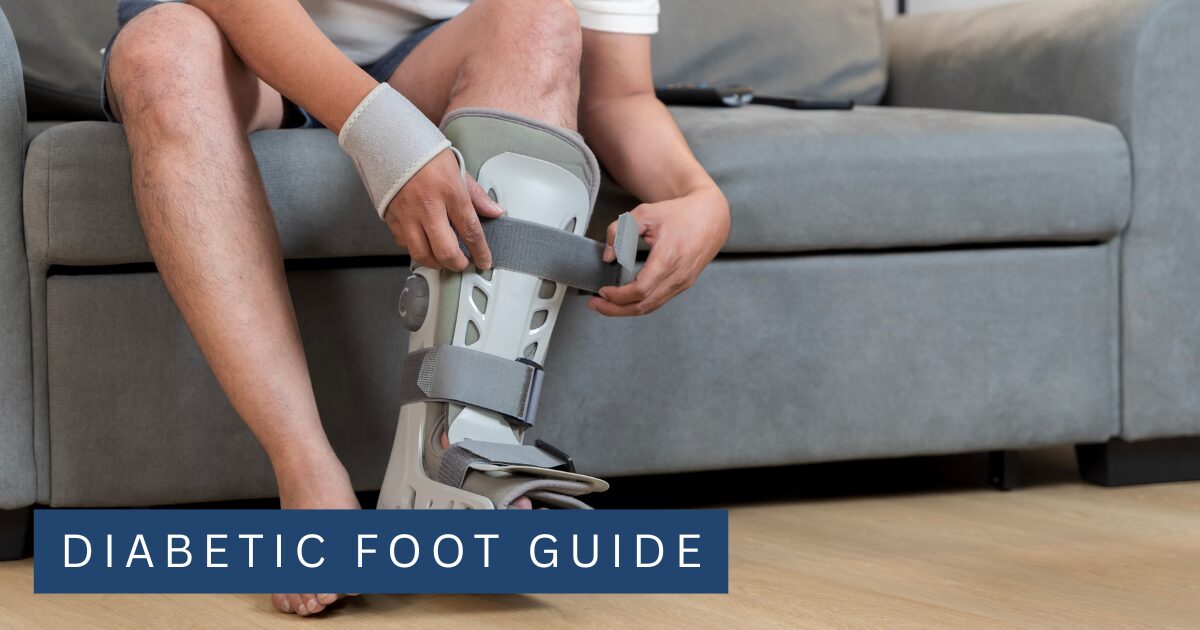
Charcot recovery runs in a fixed order: a cast until the foot cools, a custom brace while it relearns to take weight, then shoes built around its new shape. The foot sets the pace, not the calendar.
The short version
Charcot foot treatment in the active phase means immobilizing and offloading the foot, classically in a total contact cast changed every week or two as the swelling falls. It stays on until the foot has cooled — usually judged as a skin temperature within about 2°C of the other foot on repeated readings — and X-rays show the bone consolidating. That commonly takes 3 to 12 months, sometimes longer.
Next comes a custom knee-high brace called a CROW for weeks to months, then custom shoes and insoles, or a brace, for life.
Can it be healed? The bone heals and the foot becomes cool and stable, but any change in shape stays, the foot stays at risk, and Charcot can return or start in the other foot. Surgery is for feet that cannot be braced or shod safely.
Charcot stages and the recovery timeline
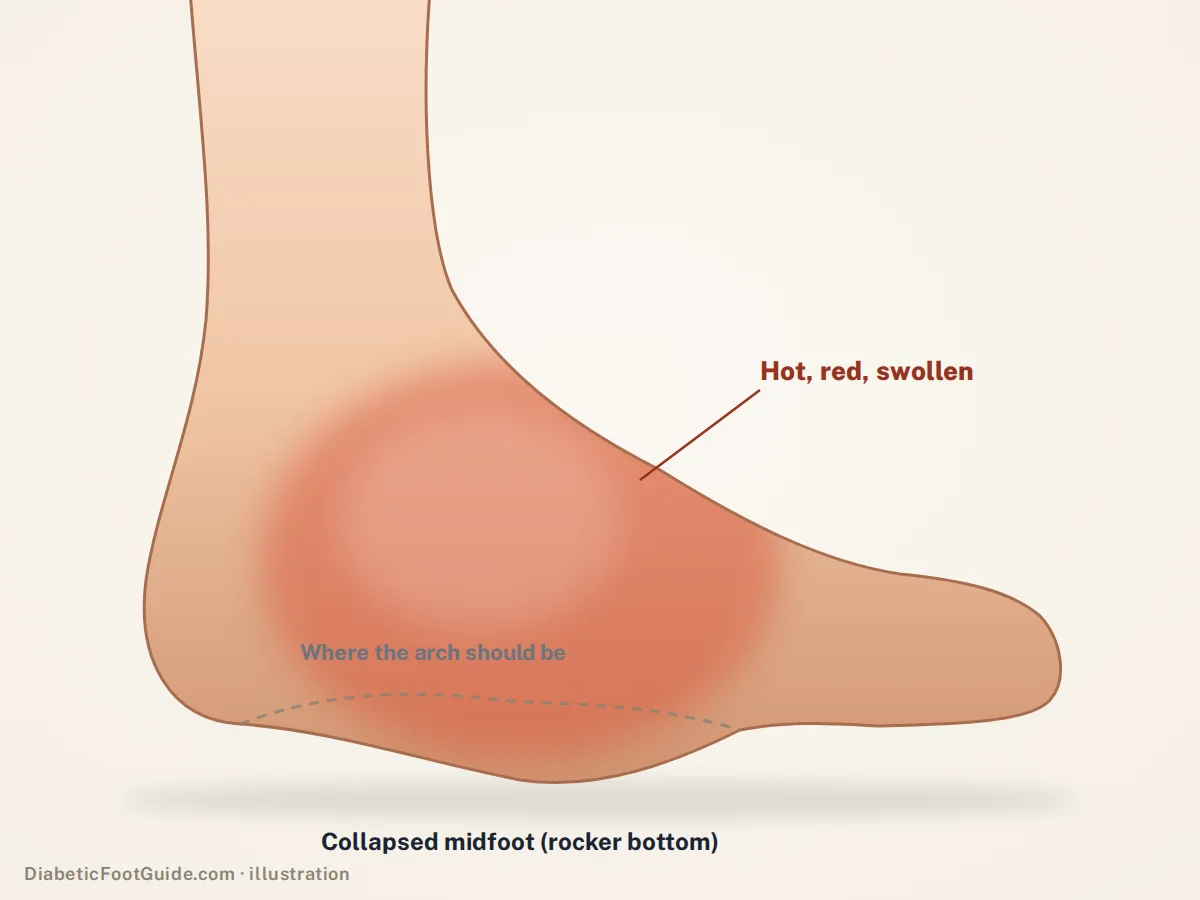
In brief: Charcot foot is an inflammatory breakdown of bones and joints in a foot without protective sensation, usually from diabetic neuropathy; walking on it can collapse the arch within weeks. Signs and diagnosis are in our Charcot foot guide.
The modified Eichenholtz stages describe the X-ray. Stages 0 to 2 are one continuous hot phase and are timed together.
| Phase | What the foot is doing | What you wear | Typical duration |
|---|---|---|---|
| Stage 0 — X-ray still normal | Warm and swollen; shape still normal | Total contact cast from the day it is suspected, plus walking aids | Stages 0–2 together: commonly 3–12 months; some take over a year |
| Stage 1 — fragmentation | Still hot; bone breaking up, arch may drop | Cast changed every 1–2 weeks as swelling falls | |
| Stage 2 — coalescence | Cooling; fragments knitting | Still the cast; visits spread out | |
| Stage 3 — consolidation | Cool and stable in its healed shape | CROW or other knee-high brace; walking rebuilt gradually | Weeks to months; for some, permanent |
| Afterwards | Stable, but permanently at risk | Custom insoles in extra-depth shoes, custom-molded shoes, or a brace | For life |
In a large UK audit, people whose first device could not be removed were back in footwear after a median of 9 months, against 12 for those never given one. Where the Charcot sits, a later start and osteoarthritis can all lengthen it.
The 2°C marker, honestly
Clinics typically measure matching spots on both feet with an infrared thermometer after about 15 minutes out of the cast, looking for a difference of about 2°C or less that holds for several weeks. International guidance notes no cut-off is proven, so swelling and X-rays count too.
The casting phase: what happens at each clinic visit
Expect weekly visits at first: the first cast is often changed within about three days, then every one to two weeks, spreading out as the foot settles.
Cast off, skin checked
For rubs and pressure marks you could not feel.
Both feet measured
Temperature at matching spots, plus swelling and shape.
X-rays every 4 to 6 weeks
To watch the bone knit and the alignment hold.
A new cast
Molded to today’s leg, with your weight-bearing instructions.
Everything else
The other foot, your walking aids, a raise for the other shoe, blood sugars, and any need for vitamin D or calcium.
Can you walk in the cast? A little, and only in the cast: international guidance favors reduced weight-bearing with crutches, a walker or a wheelchair, and clinics differ on how much.
Call the clinic the same day if
- The cast is cracked, wet or loose, or smells or stains
- The toes at the end turn pale, blue or dusky — see toe color changes
- You have a fever, chills or unusually high blood sugars
- Your calf becomes painful and swollen, or the other foot warm and swollen
The CROW boot: from cast to walking
A newly quiet Charcot foot that is loaded too quickly can reactivate. The international guideline’s authors advise, from experience, offloading for four to six weeks after remission, then a gradual return to walking.
The usual bridge is what most people mean by a Charcot boot: a CROW, or Charcot Restraint Orthotic Walker — a rigid, custom-made, knee-high brace that encloses the foot and holds its healed shape. Some clinics use a prefabricated knee-high walker instead when the foot has kept a near-normal shape.
Wear it whenever you stand
Even at home.
Check the skin daily
A red mark that does not fade means an adjustment at the clinic.
Build up in steps
If the foot warms or swells again, you step back. That is the system working.
How long? Weeks to months, judged like the cast. With severe deformity or ankle Charcot, the brace may be permanent. Swelling that returns with warmth is worth reporting — see swollen feet and diabetes.
Charcot shoes and braces for the long term
The aim is to accommodate the healed shape and spread pressure across it, not to correct it.
- Near-normal shape: extra-depth shoes, a stiff rocker-style sole and custom-molded insoles.
- Rocker-bottom or a prominent bump: fully custom-molded shoes.
- Unstable ankle or hindfoot: an ankle-foot orthosis, a brace attached to the shoe, or a CROW.
- The other foot: protective shoes and insoles too.
On any label, look for room for the insole and foot, a sole that does not bend under the midfoot, and adjustable laces or straps. Never go barefoot, even at home. Coverage rules are on our diabetic shoes page; for socks, see diabetic socks vs compression socks.
Charcot foot surgery: when it is needed
Most Charcot feet avoid surgery: in one surgeon’s series of 147 midfoot Charcot feet, 59% reached therapeutic shoes and custom insoles without it.
Exostectomy
Removing a bony prominence that keeps causing ulcers despite good footwear, in an otherwise stable foot.
Reconstruction
Realigning and fusing the collapsed joints of a foot that is unstable, cannot be braced or keeps ulcerating. The goal is a flat, shoeable foot.
Amputation
The last resort, for uncontrollable infection or a failed reconstruction.
Timing is evolving. Surgery has traditionally waited for the quiet phase, because inflamed, softened bone risks infection and failed fixation. Some centers now operate earlier on selected unstable or unbraceable feet, usually after a spell of casting. Recovery then repeats the sequence: months of little or no weight, a CROW, then shoes.
Living with a Charcot foot afterwards
A foot in remission is quiet, not cured. Plan on a specialist foot review about every three months, for life.
It can come back
Recurrence is reported in about 15–30%, in one series from 3 months to over 8 years after immobilization ended. Not following the treatment plan was the strongest predictor.
The other foot can start
About one in ten within about a year in one cohort; up to three in ten in some reports.
Ulcers are the real threat
In one cohort, Charcot plus an ulcer carried about 12 times the amputation risk of Charcot alone in people under 65. Learn the early signs of an ulcer.
Be seen promptly if
- Either foot becomes warmer or more swollen again — within days
- The foot changes shape or will not take weight
- A blister, a dark callus or a break in the skin appears under the bump
- There is redness, drainage, fever or chills — the same day
Common questions
Can Charcot foot be healed?
The active phase can go into remission: the bone consolidates and the foot becomes cool and stable. Shape already lost is not regained and the neuropathy remains, so a healed Charcot foot still needs protecting for life.
How long does Charcot foot take to heal?
The cast phase commonly lasts 3 to 12 months, and a large UK audit found a median of 9 to 12 months to walking in footwear. The CROW adds weeks to months; reconstruction takes longer.
What is a CROW boot and how long do I wear it?
A rigid, custom-made, knee-high brace that holds the healed shape. It follows the cast for weeks to months, and some people with severe deformity or ankle Charcot wear one permanently.
Can I walk with Charcot foot?
In the hot phase, only in the cast and as little as your clinician allows. Walking builds up in the CROW. Long term, yes, in custom footwear or a brace, and never barefoot.
Can Charcot come back or affect the other foot?
Yes to both. Reactivation is reported in roughly 15–30%, sometimes years later, and the other foot can develop its own Charcot. New warmth or swelling in either foot should be seen within days.
Sources
Clinical literature retrieved from PubMed, plus the governing guidance.
- Wukich DK, Schaper NC, Gooday C, et al. Guidelines on the diagnosis and treatment of active Charcot neuro-osteoarthropathy in persons with diabetes mellitus (IWGDF 2023). Diabetes Metab Res Rev. 2024;40(3):e3646. doi:10.1002/dmrr.3646 — offloading, remission criteria, the step-down and surgical timing.
- Rogers LC, Frykberg RG, Armstrong DG, et al. The Charcot Foot in Diabetes. Diabetes Care. 2011;34(9):2123-2129. doi:10.2337/dc11-0844 — cast changes, the 2°C marker and surgical indications.
- Milne TE, Rogers JR, Kinnear EM, et al. Developing an evidence-based clinical pathway for the assessment, diagnosis and management of acute Charcot Neuro-Arthropathy: a systematic review. J Foot Ankle Res. 2013;6(1):30. doi:10.1186/1757-1146-6-30 — cast and X-ray intervals, recurrence and bilateral rates, three-monthly reviews.
- Game FL, Catlow R, Jones GR, et al. Audit of acute Charcot’s disease in the UK: the CDUK study. Diabetologia. 2012;55(1):32-35. doi:10.1007/s00125-011-2354-7 — median 9 versus 12 months to footwear.
- Griffiths DA, Kaminski MR. Duration of total contact casting for resolution of acute Charcot foot: a retrospective cohort study. J Foot Ankle Res. 2021;14(1):44. doi:10.1186/s13047-021-00477-5 — casting times by country, osteoarthritis, the other foot.
- Osterhoff G, Böni T, Berli M. Recurrence of Acute Charcot Neuropathic Osteoarthropathy After Conservative Treatment. Foot Ankle Int. 2013;34(3):359-364. doi:10.1177/1071100712464957 — recurrence rate, timing and predictors.
- Sohn MW, Stuck RM, Pinzur M, et al. Lower-Extremity Amputation Risk After Charcot Arthropathy and Diabetic Foot Ulcer. Diabetes Care. 2010;33(1):98-100. doi:10.2337/dc09-1497 — amputation risk with and without an ulcer.
- Pinzur M. Surgical Versus Accommodative Treatment for Charcot Arthropathy of the Midfoot. Foot Ankle Int. 2004;25(8):545-549. doi:10.1177/107110070402500806 — the share managed without surgery.
Related guides
Charcot foot
Signs, stages, diagnosis.
Swollen feet and diabetes
When one warm, swollen foot matters.
Diabetic shoes and inserts
Footwear and Medicare rules.
Diabetic foot ulcers
The main threat to a Charcot foot.
Diabetic feet pictures
Foot shapes and skin changes, photographed.
Charcot care in Michigan
Balance Foot & Ankle manages Charcot feet in Howell and Bloomfield Hills from casting through bracing and footwear, including reconstruction when a foot can no longer be braced.

Dr. Tom Biernacki is a double board-certified podiatric foot and ankle surgeon practising in Michigan. He treats diabetic wounds, Charcot neuroarthropathy and at-risk feet daily, and writes here to put the clinical reasoning behind that care in front of the people living with it.